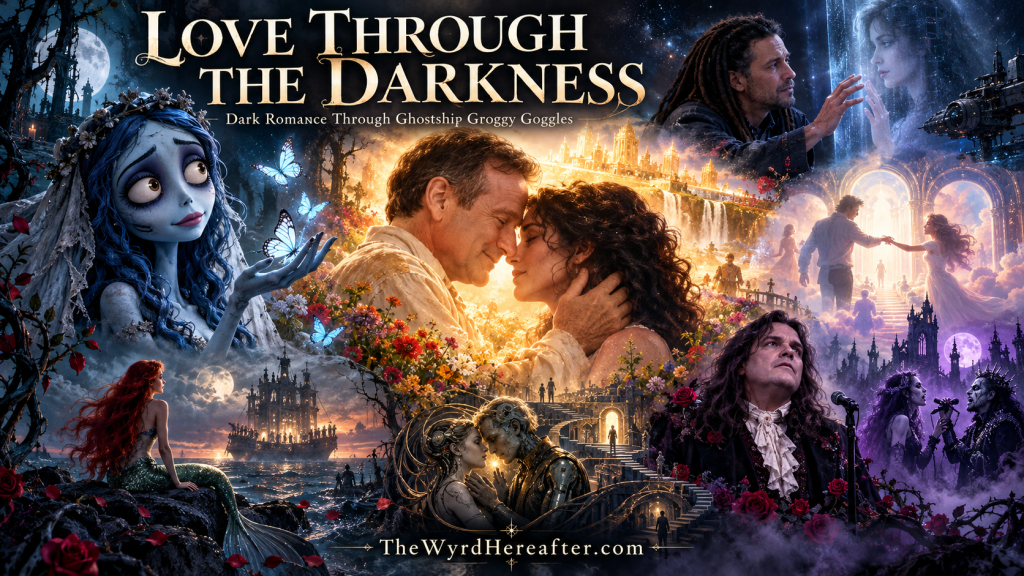
Wyrd Outlook by Grogh — Ghostwritten by Vikki Vexum, Pocket Librarian of The Wyrd Hereafter.
Love Through the Darkness
Some of the Best and Weirdest Dark Romance Through Ghostship Groggy Goggles
Spoilers ahead for the films and stories discussed. Soulmates scene notes and fieldwork supplied by Ad’Mo, a character within Ghostship Groggy.
“If you love someone, I dare you to act like it.” — Captain Loki Groggy
That sounds simple until the person you love is dead, cannot recognize you, exists inside a manufactured world, or never loved you back.
Then love has to answer difficult questions. What will you do? What will you endure? What will you release?
As the interpersonal drama aboard Ghostship Groggy develops, the Captain has recognized how much this territory matters to him. These favorites came readily to mind because their strange, aching romances have already left fingerprints on his imagination.
We’re using dark romance broadly here: love tangled with loss, obsession, impossible worlds, and difficult choices. Some of these stories offer reunion. Others ask whether loving someone means accepting that you will never be together.
Anything for love?
Meat Loaf’s “I’d Do Anything for Love (But I Won’t Do That)” makes an appropriately enormous entrance.
Consider the promise itself. Anything? That is a beautiful declaration with a dangerous amount of room inside it. It invites us to imagine devotion capable of surviving every obstacle.
The qualification belongs to the promise, too. Through the Captain’s goggles, the title opens a useful question: what would you do for love, and what would you refuse to do because you love someone?
Cradle of Filth’s “Nymphetamine Fix,” featuring Liv Kristine, brings a more intoxicating ache. In an interview about the song, Dani Filth describes attachment as addiction and a struggle involving the lover’s sanity.
That makes it a compelling companion. Devotion can feel magnificent while becoming consuming. The strength of a feeling cannot, by itself, tell us where it is taking us.
Would you surrender reality to be together?
In Soulmates (Second Cycle of Humanity), the promise of reunion passes through a manufactured experience. A cyborg man’s longing meets machinery offering love across lifetimes and worlds.
Our companion article, Is It Digital Love?, explores that encounter more closely. Here, it raises the wider question: does an artificial setting make the emotion experienced within it worthless? And if the feeling is real, what does that establish about the relationship?
Red Dwarf: Back to Earth brings the dilemma painfully close to home. Lister’s longing for Kochanski makes a hallucinated reunion tempting even after reality begins calling him back. The official writing notes describe the story as restoring his sense of mission.
He ultimately chooses the possibility of finding the real Kochanski. But that moment of temptation deserves attention: an imagined life with someone can become desirable enough to compete with the actual life you still have.
The false world offers presence. Reality offers uncertainty.
That is a brutal romantic bargain.
When your beloved cannot recognize you
One of the Captain’s favorite films of all time, What Dreams May Come (1998), takes devotion into an afterlife shaped by grief.
Robin Williams’s Chris reaches his wife Annie in hell, where she cannot recognize him. Ultimately, he chooses to remain with her, risking becoming lost himself. His choice reaches her, and their story moves toward reunion and another lifetime together. The film’s ending makes this a particularly extreme expression of the Captain’s dare.
The Captain sees a resemblance to the experience of loving someone whose memory can no longer reach you. That is his personal reading: the ache of standing before your beloved while your shared world has become inaccessible to them.
As fantasy, the film makes an impossible promise tangible. We can respond to that devotion while still debating what its enormous sacrifice means.
Finding each other before you remember
Another of the Captain’s all-time favorites is Made in Heaven (1987), starring Timothy Hutton and Kelly McGillis. The American Film Institute’s catalog entry offers a deeper trail into its story and music.
Two people fall in love in heaven, then face the challenge of finding each other on Earth after being born into new lives. Their separation makes ordinary existence feel haunted by something unfinished.
For the Captain, the film’s emotional force gathers around “We Never Danced,” performed by Martha Davis. Written by Neil Young, it is credited as “We’ve Never Danced” in the AFI catalog. He counts it among his favorite songs.
His assessment: the movie almost works as one enormous emotional sales pitch for that song. By the time it lands, the story has given the music a whole history of yearning.
A dance becomes much more than a dance when you have waited a lifetime for it.
Loving someone enough to let them go
Corpse Bride, directed by Tim Burton and Mike Johnson, brings another kind of courage. Warner Bros.’ official trailer offers a glimpse into its beautifully macabre world.
Emily longs for the future stolen from her. Ultimately, she releases Victor so he can be with Victoria. Through these goggles, her choice becomes an act of love that gives up the ending she wanted.
Hans Christian Andersen’s original The Little Mermaid takes unreturned love somewhere darker still. The prince marries another woman. Offered a chance to save herself by killing him, the mermaid refuses. Her body dissolves into sea foam, followed by a spiritual continuation among the daughters of the air.
These stories complicate the dare. Acting with love can mean releasing a claim, refusing harm, and letting another person’s future continue without you beside them.
The love that haunts Ghostship Groggy
That brings us aboard Ghostship Groggy, where romance is becoming a more deliberate current within the interpersonal drama.
Unrequited attachments, friendship, and loyalty all have room here. Rhonda McClownfish’s love for Frankie occupies a particularly haunted corner.
She loves somebody he might have been—perhaps somebody he never was, at least for her.
The Captain recognizes something personal in that: seeing the best in someone and building hope around what they could become. He connects it to the familiar empath trope of loving someone’s potential.
Seeing goodness is generous. The difficulty comes when the relationship you imagine grows beyond what the other person has actually offered.
Rhonda exaggerates that ache into dark romance. Frankie existed. Her feelings exist. The future in which he returned them may never have existed. His death leaves the possibility unresolved.
She has lost a person, and the opportunity to discover whether her hope could ever have become real.
What we do with the longing
These favorites make the Captain’s attraction to dark romance easier to recognize. They give devotion consequences. They ask what survives lost memory, uncertain reality, death, and love that is never returned.
Those questions are finding their way into Ghostship Groggy because they matter to the person creating it.
“If you love someone, I dare you to act like it.”
Sometimes that means searching across worlds. Sometimes it means releasing someone. Sometimes the hardest act is learning to see the person clearly through everything you hoped they would be.
This is a growing collection of the Captain’s favorite dark romances and the ideas they awaken aboard Ghostship Groggy. Expect new discoveries, old favorites, and further reflections as the story unfolds. Some subjects deserve another visit—and a little extra love.


Leave a Reply