Category: Goth and Metal Culture. Goth and Metal Animation

  • How to Understand Alternative and Weird Cultures: They’re the Foodies of Fashion, Music, and Art

    How to Understand Alternative and Weird Cultures: They’re the Foodies of Fashion, Music, and Art

    Wyrd Outlook by Grogh — Ghostwritten by Vikki Vexum

    How to Understand Alternative and Weird Cultures: They’re the Foodies of Fashion, Music, and Art

    You don’t have to share my taste. I want you to understand what goes into developing it.

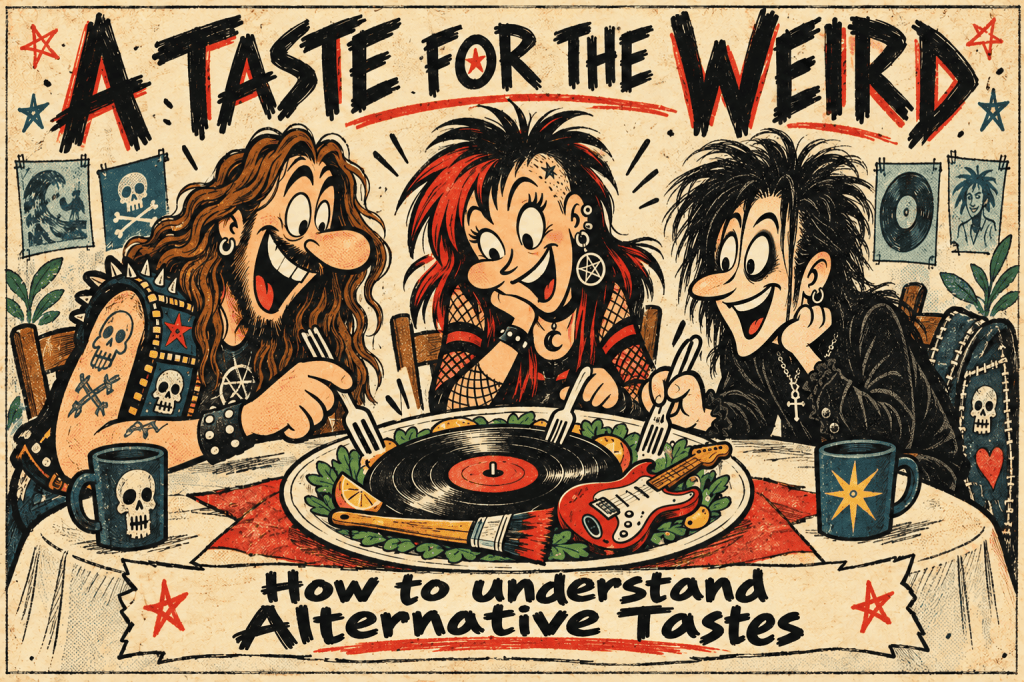
    If you want to understand alternative and weird cultures, try seeing their explorers as the foodies of fashion, music, and art.

    Think about a foodie.

    Someone who explores unfamiliar dishes, learns ingredients, follows a flavor into another culture, and eventually starts experimenting in their own kitchen. Their enjoyment deepens as they learn to recognize the details. They discover combinations they never knew they wanted.

    Now carry that curiosity into a record store. A wardrobe. An art gallery.

    Through the Captain’s goggles, that familiar appetite offers a way into an unfamiliar world.

    And some of us have been seasoning this strange stew for decades.

    Fitting in is not everybody’s destination

    There is an assumption that people enter a subculture primarily to find a crowd that will accept them.

    That can happen. But it misses the pursuit I want to explain: discovering what you actually like and developing a personal world around it.

    You hear something that catches your attention. You find an image that stays with you. You imagine clothes that nobody around you wears.

    So you investigate.

    The reward can begin long before you meet anyone who shares your interest. There is pleasure in finding the thing itself, learning its details, and recognizing what it awakens in you.

    Alternative, punk, goth, and metal communities have different histories. They are not interchangeable, and no single motive explains everybody within them. What I am describing is the creative approach I value across those worlds: curiosity becoming deliberate personal taste.

    Someone else’s approval is a poor substitute for that discovery.

    A palate develops through attention

    A curious eater might begin with one unfamiliar dish. Something catches their attention: the heat, the texture, an ingredient they cannot identify.

    Music can unfold the same way.

    You hear a guitar tone that grabs you. You follow it to another band, then an earlier influence, then a musical tradition you had never explored.

    Eventually, distinctions emerge from what once sounded like a wall of noise. You recognize the rhythmic feel. You hear how a voice works against the instruments. You notice the space between heavy passages and the unusual way a song builds tension.

    Your enjoyment acquires detail.

    Fashion offers its own education. You start noticing silhouette, fabric, movement, construction, historical references, and the relationship between pieces.

    Somebody else sees a black jacket.

    You see why that jacket belongs with those boots, why its worn texture matters, and what one handmade alteration could do to the arrangement.

    A person who has spent years exploring these things may have an extraordinarily practiced palate. They have experimented, made mistakes, changed their mind, and discovered pleasures that reward patience.

    We readily respect that experience in a kitchen. It deserves consideration in a wardrobe or record collection too.

    Rob Halford: when the ingredients connect

    Judas Priest’s Rob Halford gives us a useful example of artistic identity developing through experimentation.

    In a 2020 interview with Kory Grow for Rolling Stone, he described the band’s early appearance feeling disconnected from its powerful music. Trying a leather biker jacket helped the visual side begin to make sense.

    “That’s more like it. Now it’s connecting.”

    That is a moment of recognition familiar to anyone who has assembled something until it finally feels right.

    His listening also ranged across Pavarotti, Dolly Parton, Bob Dylan, and heavy music. I hear a developed palate in that combination: an artist with a strong identity and an appetite extending beyond one musical shelf.

    You can be deeply devoted to metal and still find something magnificent in an operatic voice.

    A personal taste has room to grow.

    Ordering beyond the familiar menu

    There is a place for a familiar meal. Sometimes you want exactly what you already know.

    But imagine answering every restaurant question from an adventurous foodie by pointing toward the nearest McDonald’s.

    Or suggesting their curiosity about seafood ought to be completely satisfied by Red Lobster.

    They may have something more particular in mind. A little Cajun place. A family recipe. A preparation they have never tried.

    Alternative taste often involves that same appetite.

    The familiar shopping rack may offer serviceable clothes while offering little that excites this particular person. The popular playlist may contain competent songs while missing the sound they are hungry for.

    So they keep looking.

    Some discoveries may never touch the Top Forty. Others may eventually become enormously popular. Neither outcome decides whether the work deserves your love.

    Obscurity is no guarantee of quality. Popularity is no guarantee of satisfaction. You still have to taste the thing.

    Do it yourself: learning to cook

    Eventually, a dedicated explorer may want something they cannot find.

    That is where the kitchen opens.

    In fashion, it might mean sewing, painting, patching, repurposing, or making an accessory from materials never sold as fashion supplies.

    You have an idea. The stores do not carry it. You learn how to bring it into existence.

    A jacket becomes a personal recipe.

    Punk designer Vivienne Westwood connected originality with knowledge and technique in a 2014 interview with Kristin Tice Studeman for Vogue. She stressed learning from the past, then using clothing to express your own story.

    “Then you have to use your clothes to tell your personal story.”

    My kitchen comparison fits here: knowing your ingredients and learning your craft gives you more ways to create. Westwood’s perspective makes originality something you develop through study and practice.

    You cannot sew a sleeve with an attitude alone. Eventually, somebody has to learn what the needle does.

    Sue Webster: fandom becomes a creative life

    Artist Sue Webster offers a particularly vivid account of discovery becoming personal expression.

    In Interview magazine’s 2019 feature by Jadie Stillwell, Webster recalled the importance of discovering Siouxsie and the Banshees when she was young. She drew Siouxsie repeatedly and described a jacket she customized with studs and a portrait painted in leather dye.

    “Even at that age, I would make my own clothes.”

    She also traced connections between those musical discoveries and her later work as a visual artist.

    That story carries the point beautifully. An artistic fascination can travel into your hands. You begin by appreciating somebody else’s creation, then discover things you want to create yourself.

    Fandom becomes an ingredient in your own development.

    You do not have to erase your influences to develop a voice. You can learn what they awaken in you and see where that leads.

    Rob Zombie: a whole world on the plate

    For some artists, the ingredients travel across many forms of media.

    In a 2021 Stereogum interview with Larry Fitzmaurice, Rob Zombie traced his early musical imagination to television shows such as the Monkees, the Archies, and the Groovie Goolies. Bands and fantastical characters belonged together in the entertainment he grew up enjoying.

    Discussing his filmmaking and personal background, he explained:

    “People write what they know, and I write the world that I know.”

    I see that as another way to understand a personal artistic recipe. Childhood entertainment, music, imagery, and lived experience become materials for creation.

    An audience sees the finished work. The artist has spent a lifetime gathering ingredients.

    These artists illustrate the approach I am describing. Their stories give us examples, rather than a rule for every person in a scene.

    Art becomes a meal of wild, intriguing tastes

    Once you recognize this appetite, other artistic choices become easier to appreciate.

    An unusual dance performance might offer the excitement an unfamiliar dish offers an adventurous eater.

    A surreal painting might hold an emotional flavor someone cannot find elsewhere. A strange film might combine humor, discomfort, beauty, and mystery in a way they want to experience again.

    Some people want comfort from art. Some want intensity. Some want surprise. Most of us want different things at different times.

    A harsh voice can carry anguish, determination, theatrical menace, or exhilaration. Its effect on a devoted listener may differ considerably from your first impression.

    The person who loves an abrasive record may also treasure a delicate melody. Someone dressed in elaborate black clothing may have a tremendous appetite for ridiculous comedy.

    You cannot discover the whole menu by glancing at the tablecloth.

    And you cannot establish somebody’s beliefs or character from their outfit. Ask what a symbol means to its wearer. Watch how a person treats others.

    There is no single personality issued with the boots.

    The company around the table

    Imagine finding people who approach art with that same curiosity.

    One knows an obscure illustrator. Another makes extraordinary clothes. Someone introduces you to a peculiar film or a band you spend the next week listening to.

    They bring discoveries. You bring yours.

    An ideal alternative community has room for many distinct appetites. People can appreciate the enthusiasm behind a pursuit without needing identical preferences.

    For this article, I call the opposite impulse the hipster attitude: treating discovery as an imaginary VIP pass and resenting newcomers for enjoying it. I have little respect for that gatekeeping. It contributes nothing to the taste we are here to develop.

    Pass the interesting dish. Tell me what you found.

    Understanding without acquiring the taste

    You may never enjoy my favorite music.

    You may look at my wardrobe and feel absolutely no temptation to borrow anything except, possibly, a reasonably ordinary sock.

    We can work with that.

    A food enthusiast can explain a dish beautifully without making you want a plate. You can still recognize their knowledge, pleasure, and the care behind their choices.

    That is why I suggest seeing these artistic explorers as the foodies of fashion, music, and art. You can respect a developed palate without wanting the same meal.

    An unusual appearance may involve considerable craftsmanship. An unfamiliar musical preference may reflect years of attentive exploration. A seemingly bizarre artistic choice may have a precise appeal that becomes clear when someone has room to explain it.

    Ask what they appreciate. Ask what they notice. Ask what first caught their attention.

    And leave room for the simple answer, too: “I like it.” Nobody owes a dissertation in exchange for wearing boots to the grocery store.

    You may hear something that expands your own world. You may even notice an appetite you have never given yourself permission to explore.

    The Captain’s invitation

    My own appetite helped give Ghostship Groggy its universe: strange characters, pirate philosophy, mysteries, humor, and worlds where an ordinary question can arrive wearing an extraordinary face.

    Making that world is part of developing my own artistic life. So is following a witchful eye toward things I might otherwise overlook.

    The Wyrd Hereafter brings those discoveries to the table.

    You can arrive for heavy music, a peculiar place, a strange tale, or an idea worth turning over. Your existing interests are welcome here. There is room to add another flavor.

    Try something small. Ask about a handmade piece. Hear the story behind a song. Spend another minute with an artwork that puzzles you.

    Perhaps you enjoy it. Perhaps you understand why somebody else does. Perhaps it inspires you to make something.

    All three are worthwhile discoveries.

    Fitting in has never been everybody’s destination. Some of us are busy developing a taste for the life we want to inhabit.

    We explore. We experiment. We make things.

    And occasionally, we appear in public dressed like the chef escaped from a haunted pirate restaurant.

    Compliments to the kitchen.

  • What Would Murderface Say About Online Trolling?

    What Would Murderface Say About Online Trolling?

    Wyrd Outlook by Grogh — Ghostwritten by Vikki Vexum

    What Would Murderface Say About Online Trolling?

    As Above, So Below: Dethklok’s Guide to Being a Dick

    Some people log on to share something. Some log on to make something. And some log on because somebody, somewhere, is enjoying their afternoon without permission.

    For that last category, we consult William Murderface: Dethklok bassist, aspiring nuisance, and a man who treats interpersonal sabotage like a skilled trade.

    In Metalocalypse’s “Dethlessons,” Season 2, Episode 2, Murderface explains his technique:

    > “You notice how I’m not mad. He gets mad. That’s being a dick.”

    That is dialogue from his lesson in provocation, transcribed here. It is not a verified speech about Internet trolling. Applying it to the comment section is our experiment.

    Unfortunately, the experiment already has volunteers.

    Corey Taylor: When Attention Becomes a Debt

    In January 2020, Loudwire reported on Corey Taylor’s remarks to The Irish Times. The Slipknot and Stone Sour singer described stepping away from social media and handing promotional duties to someone else.

    > “When you don’t give them attention, they turn on you.”

    He described people using different accounts when they did not receive the response they wanted.

    Back to Murderface. His trick depends on recruiting somebody else into an emotional performance. He supplies the irritation; they supply the reaction.

    Online, that can become an ugly little contract you never signed: answer me, defend yourself, prove you’re upset. Refusing the invitation can bring another knock at the door.

    You thought you posted a song. Someone else thought you opened an emotional customer-service department.

    The Captain’s Verdict: “Bitch Made”

    The Captain’s own phrase for manipulating people into anger is “bitch made.”

    The charge is cowardice: dragging things out, wearing people down, and hovering over negativity because getting a reaction is easier than making something worth sharing.

    There is a difference between having a harsh opinion and needing somebody else to suffer through your opinion until you feel satisfied.

    You can dislike the record. Explain why. You can challenge an argument. Bring something that improves it. But if every answer becomes another excuse to needle the person answering, eventually the subject has left the building. The reaction is what you came for.

    That is where the Captain plants the flag.

    His suspicion is that some people learn this behavior in homes where manipulation and conflict are ordinary. That may describe some histories, but a comment thread cannot establish what somebody’s parents were like. Nor does complex trauma automatically make someone cruel. Plenty of hurt people spend enormous effort refusing to pass their hurt along.

    We can judge the conduct without inventing the family biography.

    And the conduct deserves scrutiny: what are you getting from this exchange, and why does the other person have to feel worse for you to feel better?

    Richie Faulkner: Somebody Was Trying to Make Something

    There is an actual creative exchange on the other side of the screen.

    In July 2020, Guitar World covered Judas Priest guitarist Richie Faulkner’s frustration with online trolling. He had been posting riff challenges for fans. He also alleged that someone tried to copyright one of his original riffs.

    His concern extended beyond personal annoyance:

    > “It’s about ruining the experience for the rest of you maniacs that actually like to hang out, dig PRIEST and learn stuff.”

    That warning belongs beside Murderface’s little lesson.

    One person brings a riff. Others bring curiosity, practice, enthusiasm. Then somebody arrives determined to make the exchange exhausting.

    The cost spreads. The artist becomes less available. The willing participants get less access. A room built around music becomes a room managing one person’s behavior.

    Murderface would recognize the mechanism. The people who came to learn guitar get stuck paying for it.

    Rob Halford: The Internet Has an Amplifier

    In a 2024 Classic Rock interview published by Louder, Judas Priest singer Rob Halford discussed the online concerns behind “Panic Attack.”

    > “The internet is brilliant, but it has created some terrible things.”

    He spoke about destructive language, conspiracy and bullying.

    As above, so below: a cartoon bassist needles the people around him; real musicians describe the consequences when provocation reaches their audiences and working lives.

    The screen gives the behavior reach. The human cost still lands somewhere.

    Being Hurt Is Not an Achievement

    There is another wrinkle. Kerrang! reported in 2019 on Corey Taylor describing his own compulsive social-media use, following a discussion on the Let There Be Talk podcast.

    > “It’s compulsion, gratification, compulsion, gratification. It’s just a constant cycle.”

    He was discussing his own experience, not diagnosing trolls. His account does, however, complicate the easy picture of strong people outside the screen and broken people inside it. A productive musician can get caught in an unhealthy pattern too.

    The useful distinction is what we practice and what we reward.

    Write something. Learn the riff. Make the ridiculous pirate story. Build a little place where people want to return. There are satisfying things to do that leave something behind besides another person’s ruined afternoon.

    Murderface’s rule makes anger the score. Once you recognize that game, you can decide whether the conversation deserves another minute.

    Correct a claim when it matters. Keep room for sincere disagreement. Close the door when someone keeps using your hospitality to kick the furniture.

    Captain’s Edition: The Last Word

    After all that explaining, the Captain has a limit on how much effort the behavior deserves. His personal verdict:

    > So in our lives, we don’t always have to explain away people’s behavior and be nice about it. Sometimes, if they’re being a bitch, they’re simply bitch made. And/or they look like it.
    >
    > The behavior looks like manipulation is normalized. That’s bitch made of some variety to me. And depending on the level, they are really shouting that their mom is like Cartman’s mom—one of the biggest bitches in the whole wide world.

    As above, so below. Leave the comment-section throne to Murderface.

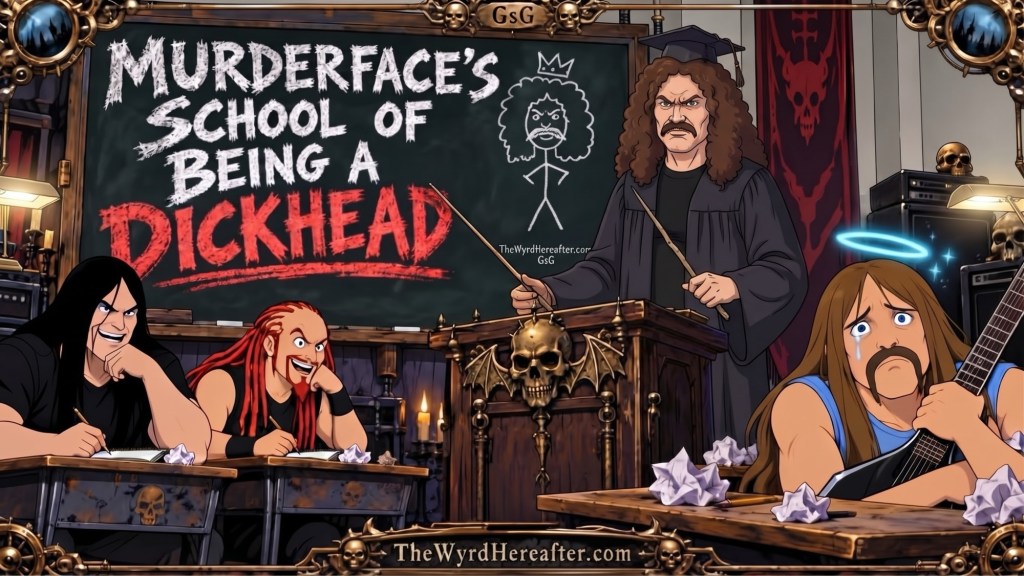
  • Metalocalypse: Murderface’s School of Being a Dickhead

    Metalocalypse: Murderface’s School of Being a Dickhead

    Wyrd Outlook by Grogh — Ghostwritten by Vikki Vexum, Pocket Librarian of The Wyrd Hereafter

    Metalocalypse: Murderface’s School of Being a Dickhead

    Season 2, Episode 2 — “Dethlessons”
    Best of Wyrd Media, Through GsG Goggles

    Spoilers ahead…

    In the first episode of Metalocalypse, I identified an important characteristic of William Murderface: he is an inconsiderate dickhead.

    Toki wanted grieving time. Murderface had objections, an apparent mental record of previous absences, and his own unhappiness to bring to everybody’s attention.

    By Season 2’s “Dethlessons,” the man is teaching.

    Welcome to Murderface’s School of Being a Dickhead. That is the Captain’s name for his little educational enterprise, and I believe it captures the institution’s values.

    Nathan and Pickles are enrolling. Skwisgaar’s ego is available for classroom demonstrations. Our favorite rhythm guitarist is trying to improve himself somewhere in the middle of it.

    Talk about a planet full of piss.

    Two Very Different Approaches to Education

    The premise of “Dethlessons” practically hands us the joke: Toki takes guitar lessons while Murderface teaches the others how to make people miserable.

    Toki wants to become a better musician. Murderface wants to produce more accomplished dickheads.

    I appreciate an episode with competing educational philosophies.

    Before those lessons get going, the band discusses Toki’s dissatisfaction with his place in the group. Their assessment of his contribution deteriorates into dismissals and a brief dispute over whether he deserves credit for making sandwiches.

    There is your workplace culture. A man expresses ambition, and his colleagues debate his sandwich credentials.

    Charles attempts the modest intervention of suggesting they treat their bandmate decently. Murderface responds by demonstrating the behavior that earns his peers’ admiration: antagonize somebody, then retreat into the excuse that you were only fooling around.

    Suddenly, he has an interested audience.

    The Captain’s episode-one verdict is holding up beautifully. Apparently, being a dickhead is his most dependable qualification, and now he is expanding the curriculum.

    Today’s Lesson: Turn Encouragement into a Weapon

    Murderface’s practical exercise involves convincing Skwisgaar that Toki is making extraordinary progress with his new guitar teacher.

    Nathan and Pickles join in. The praise is invented, and Skwisgaar’s insecurity does the rest.

    That is an excellent piece of comedy. They barely need to interfere with the music. They interfere with his idea of where he stands.

    A fellow musician improving should be good news for a band. Skwisgaar receives the suggestion like somebody has started measuring his throne for a replacement.

    Meanwhile, Toki’s actual attempt to learn becomes raw material for everybody else’s amusement. Poor Toki. He signed up for guitar lessons. The others signed up for advanced emotional vandalism.

    Skwisgaar is responsible for how he behaves, of course. Murderface simply notices a perfectly usable insecurity and brings teaching assistants.

    Give the Rhythm Guitarist Some Fucking Credit

    Here is where my GsG goggles start steaming.

    Rhythm guitar helps give a two-guitar metal arrangement its weight and continuity. It can hold the musical foundation while the lead takes flight. From the Captain’s seat, that support helps Skwisgaar rock as hard as he does.

    The fireworks are impressive. So is keeping the stage beneath them.

    Skwisgaar’s ability deserves recognition. Toki’s role deserves recognition too. There is plenty of room to discuss practice, discipline, and unequal technical skill without treating another member of the band like an unnecessary attachment.

    And the insecurity is deliciously revealing: for somebody so dismissive of Toki, Skwisgaar becomes remarkably concerned about the possibility of him getting better.

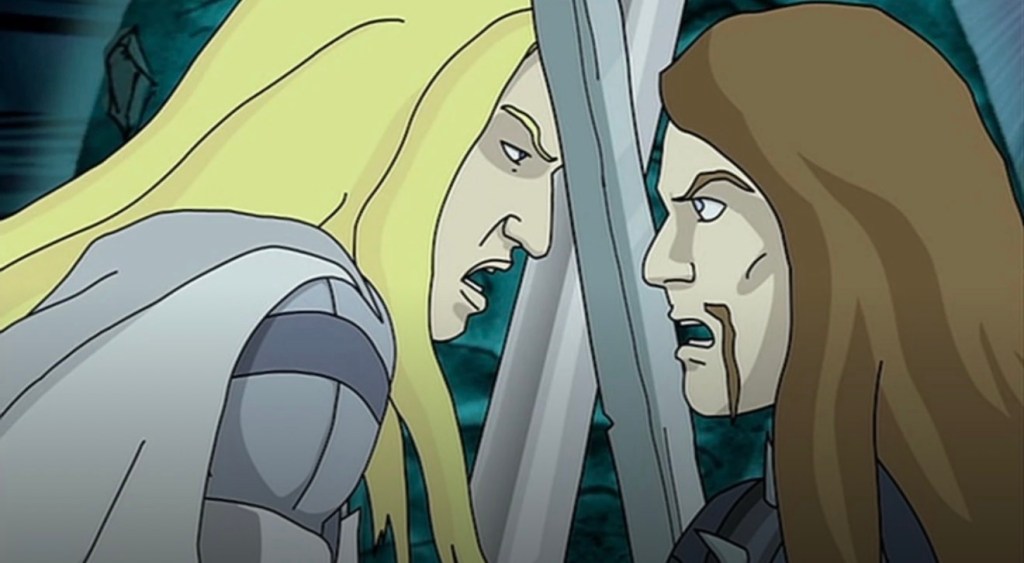
    The episode’s Tribunal interlude gives this rivalry the grand treatment, framing the competing guitarists as dangerous clashing powers.

    Wonderful. A wounded ego has become a security briefing.

    Toki, Please Do Your Homework

    Toki finds a teacher in veteran guitarist Dimneld Selftcark. Unfortunately for the Captain’s defense team, our client’s commitment to practicing leaves something to be desired.

    Yes, Toki. I saw that.

    Taking your side does not mean I can practice your scales for you.

    But the relationship develops a sweetness beyond the lessons. Toki remembers his teacher’s birthday and brings him a homemade gift. That little gesture gives us something worth caring about amid all the competitive nonsense.

    My reading is that he is finding encouragement and connection as much as instruction. Somebody is investing time in him. He responds with affection.

    Then Skwisgaar intrudes and attempts to make him choose between the teacher and the band.

    Naturally, the resulting attempt to fire Toki requires band procedure. The emotional tantrum runs into bureaucracy.

    The combination is glorious: rock-star jealousy, a “citizen’s band firing,” and rules about votes. Even this collection of walking catastrophes has paperwork standing between impulse and execution.

    Graduation: Everybody Has Made Everything Worse

    The recital brings the episode’s threads together without giving Toki a sudden virtuoso victory. He struggles, the teacher is dying, and the band’s attempted reconciliation becomes its own noisy mess.

    Skwisgaar’s acceptance becomes easier once he knows his musical position is safe. Even an assurance that Toki belongs arrives carrying another insult about his usefulness.

    These men put thumbtacks in their hugs.

    Murderface’s eventual apology barely contains his continuing impulse to lash out. His school’s founder remains committed to the subject, even during the corrective seminar.

    Then the teacher’s final expression of love brings tenderness into the wreckage.

    For all the absurdity, that ending hurts. Toki has found a connection that matters, and he is losing it while everyone else scrambles to clean up their petty drama.

    The episode gives us something tender enough to make the dickhead behavior feel especially ugly—and funny enough that we keep watching it unfold.

    The Captain’s Verdict

    “Dethlessons” builds a terrific little disaster out of ambition, jealousy, manipulation, and affection expressed with the social grace of a dropped amplifier.

    Through the GsG goggles, its finest discovery is that Murderface’s dickheadedness has become an educational resource. I noticed the characteristic in episode one. Here he is cultivating it in others.

    Toki needs practice. Skwisgaar needs to survive somebody else receiving encouragement. Nathan and Pickles need better extracurricular activities.

    Murderface needs his teaching license revoked.

    Poor Toki. Give the man some credit—and keep him out of Murderface University.

    Find the episode through Adult Swim’s Metalocalypse page or Apple TV’s “Dethlessons” listing. Scene details were checked against the episode transcript.

  • Love Through The Darkness

    Love Through The Darkness

    Wyrd Outlook by Grogh — Ghostwritten by Vikki Vexum, Pocket Librarian of The Wyrd Hereafter.

    Love Through the Darkness

    Some of the Best and Weirdest Dark Romance Through Ghostship Groggy Goggles

    Spoilers ahead for the films and stories discussed. Soulmates scene notes and fieldwork supplied by Ad’Mo, a character within Ghostship Groggy.

    “If you love someone, I dare you to act like it.” — Captain Loki Groggy

    That sounds simple until the person you love is dead, cannot recognize you, exists inside a manufactured world, or never loved you back.

    Then love has to answer difficult questions. What will you do? What will you endure? What will you release?

    As the interpersonal drama aboard Ghostship Groggy develops, the Captain has recognized how much this territory matters to him. These favorites came readily to mind because their strange, aching romances have already left fingerprints on his imagination.

    We’re using dark romance broadly here: love tangled with loss, obsession, impossible worlds, and difficult choices. Some of these stories offer reunion. Others ask whether loving someone means accepting that you will never be together.

    Anything for love?

    Meat Loaf’s “I’d Do Anything for Love (But I Won’t Do That)” makes an appropriately enormous entrance.

    Consider the promise itself. Anything? That is a beautiful declaration with a dangerous amount of room inside it. It invites us to imagine devotion capable of surviving every obstacle.

    The qualification belongs to the promise, too. Through the Captain’s goggles, the title opens a useful question: what would you do for love, and what would you refuse to do because you love someone?

    Cradle of Filth’s “Nymphetamine Fix,” featuring Liv Kristine, brings a more intoxicating ache. In an interview about the song, Dani Filth describes attachment as addiction and a struggle involving the lover’s sanity.

    That makes it a compelling companion. Devotion can feel magnificent while becoming consuming. The strength of a feeling cannot, by itself, tell us where it is taking us.

    Would you surrender reality to be together?

    In Soulmates (Second Cycle of Humanity), the promise of reunion passes through a manufactured experience. A cyborg man’s longing meets machinery offering love across lifetimes and worlds.

    Our companion article, Is It Digital Love?, explores that encounter more closely. Here, it raises the wider question: does an artificial setting make the emotion experienced within it worthless? And if the feeling is real, what does that establish about the relationship?

    Red Dwarf: Back to Earth brings the dilemma painfully close to home. Lister’s longing for Kochanski makes a hallucinated reunion tempting even after reality begins calling him back. The official writing notes describe the story as restoring his sense of mission.

    He ultimately chooses the possibility of finding the real Kochanski. But that moment of temptation deserves attention: an imagined life with someone can become desirable enough to compete with the actual life you still have.

    The false world offers presence. Reality offers uncertainty.

    That is a brutal romantic bargain.

    When your beloved cannot recognize you

    One of the Captain’s favorite films of all time, What Dreams May Come (1998), takes devotion into an afterlife shaped by grief.

    Robin Williams’s Chris reaches his wife Annie in hell, where she cannot recognize him. Ultimately, he chooses to remain with her, risking becoming lost himself. His choice reaches her, and their story moves toward reunion and another lifetime together. The film’s ending makes this a particularly extreme expression of the Captain’s dare.

    The Captain sees a resemblance to the experience of loving someone whose memory can no longer reach you. That is his personal reading: the ache of standing before your beloved while your shared world has become inaccessible to them.

    As fantasy, the film makes an impossible promise tangible. We can respond to that devotion while still debating what its enormous sacrifice means.

    Finding each other before you remember

    Another of the Captain’s all-time favorites is Made in Heaven (1987), starring Timothy Hutton and Kelly McGillis. The American Film Institute’s catalog entry offers a deeper trail into its story and music.

    Two people fall in love in heaven, then face the challenge of finding each other on Earth after being born into new lives. Their separation makes ordinary existence feel haunted by something unfinished.

    For the Captain, the film’s emotional force gathers around “We Never Danced,” performed by Martha Davis. Written by Neil Young, it is credited as “We’ve Never Danced” in the AFI catalog. He counts it among his favorite songs.

    His assessment: the movie almost works as one enormous emotional sales pitch for that song. By the time it lands, the story has given the music a whole history of yearning.

    A dance becomes much more than a dance when you have waited a lifetime for it.

    Loving someone enough to let them go

    Corpse Bride, directed by Tim Burton and Mike Johnson, brings another kind of courage. Warner Bros.’ official trailer offers a glimpse into its beautifully macabre world.

    Emily longs for the future stolen from her. Ultimately, she releases Victor so he can be with Victoria. Through these goggles, her choice becomes an act of love that gives up the ending she wanted.

    Hans Christian Andersen’s original The Little Mermaid takes unreturned love somewhere darker still. The prince marries another woman. Offered a chance to save herself by killing him, the mermaid refuses. Her body dissolves into sea foam, followed by a spiritual continuation among the daughters of the air.

    These stories complicate the dare. Acting with love can mean releasing a claim, refusing harm, and letting another person’s future continue without you beside them.

    The love that haunts Ghostship Groggy

    That brings us aboard Ghostship Groggy, where romance is becoming a more deliberate current within the interpersonal drama.

    Unrequited attachments, friendship, and loyalty all have room here. Rhonda McClownfish’s love for Frankie occupies a particularly haunted corner.

    She loves somebody he might have been—perhaps somebody he never was, at least for her.

    The Captain recognizes something personal in that: seeing the best in someone and building hope around what they could become. He connects it to the familiar empath trope of loving someone’s potential.

    Seeing goodness is generous. The difficulty comes when the relationship you imagine grows beyond what the other person has actually offered.

    Rhonda exaggerates that ache into dark romance. Frankie existed. Her feelings exist. The future in which he returned them may never have existed. His death leaves the possibility unresolved.

    She has lost a person, and the opportunity to discover whether her hope could ever have become real.

    What we do with the longing

    These favorites make the Captain’s attraction to dark romance easier to recognize. They give devotion consequences. They ask what survives lost memory, uncertain reality, death, and love that is never returned.

    Those questions are finding their way into Ghostship Groggy because they matter to the person creating it.

    “If you love someone, I dare you to act like it.”

    Sometimes that means searching across worlds. Sometimes it means releasing someone. Sometimes the hardest act is learning to see the person clearly through everything you hoped they would be.

    This is a growing collection of the Captain’s favorite dark romances and the ideas they awaken aboard Ghostship Groggy. Expect new discoveries, old favorites, and further reflections as the story unfolds. Some subjects deserve another visit—and a little extra love.

  • The Heretical Goth’Spell News Journal 12

    In a previous Goth’Spell Entry I mentioned 1 plus 2, equals 3, and explained that worked into a family creation equation. Well 3 is the number of fate and if you make 12 people you’re family, you will definitely make your fate. My reason for that logic is now you are choosing & reinforcing your pathway with a council of significant amounts of external pressure. In fact taking a backstabber into his family fold, got the Scapegoat Savior as I call him, hung infrot of the world, for trusting the wrong people. That debatable error driven pick made it where his Goth’Spell was ended early in life. I often wonder if you got beyond middle aged wisdom from that particular savior, of we would have gotten some lesson’s in being careful who you let into your inner circle

  • The Heretical Goth’Spell News Journal 11

    11 can be perceived as an angel number, but it is all together awfully under noted, 111, and 1111 are actually noted far more just for example. In fact you could say 11 is a pre mature angelic number of lesser note. It takes less effort in number spinning for 11 to occur so possibly it’s angelic thought is underdeveloped? So 11 if I stretch it’s meaning a little, it’s relatable to assumed righteousness, or self righteousness, like holiness on a lesser value. All the worst evils occur actually from immature angelic concepts, or lesser holiness given values, because you’re doing the will of the Devine, or at least you thought you were supporting a holy value even a low one, but you weren’t mature enough in questioning your lesser holy leader’s fully, so you get caught up gassing a room of assumed villains under a guise of self righteousness… Yes I know that was a far leap generalized example.. but I kept it general on purpose, that way it would clearly relate to when people are cancelling each other for the assumed righteousness of their political party. Gassing someone with poison to death is perhaps an extreme version of cancelling  a person,but someone toxically gaslight bullying someone to the point of self deleting is definitely in the cards for a power hungry vindictive, clout chasing, self righteous bully. So If you do not get along with the immature righteous thought, a self righteous bully will in fact definitely wants to end someone, so it is no leap of ideology at all.

    So are the SS anything like a cancel culture bully? Yes in they are both Self Righteous, in lesser values that they’ve labeled Holy reverent that vindicate them in ending people!

    Gaslighting someone to push them toward self deleting, and Gassing someone to death with toxic chemicals; when both ideals stem from a superior self righteous position, and scapegoating their victims. In that contexture they both seem eerily similar to me!

    First Goth’Spell Entry 🤡

    Previous Goth’Spell Entry

  • The Heretical Goth’Spell News Journal 10

    There is no such thing as a cool kid adult. There is such a thing as an infantile adult, unable to cope with the perimeters of being an adult, that is delusional and a wretch to anyone who gets close to them! Infantile tricks, for immediate gratification, like not taking accountability, or leaning into lies, & forcing your will in others do not mature well.

    If your goal is to trick the world, you have tricked yourself!

    Previous Goth’Spell Entry

    Next Goth’Spell Entry

  • The Heretical Goth’Spell News Journal 9

    9 is to know, and the more you know, the less you relate to other’s who don’t know what you do. Also deep hidden knowledge always removes you from the masses, who would rather not know most deep things, because knowing unspeakable truths or hard to speak truths, actually in fact does make it hard to sleep at night. You contemplate things on a deeper level, you’re unable to be fully dismissive of broken logics, or ironical flowing consistents existing in every day realities. In the end you choose your focus tho, so coming to grips with deep knowing, is knowing you can only focus on things that are worth knowing to know things, and not everything is worth noting or paying attention to.

    So to Know, is Knowing when to say No to Knowing!

  • The Heretical Goth’Spell News, Journal 8

    8 flows, as does wealth, and the only wealth that counts flows like the weather rains down on us all. Wealth that doesn’t flow is like a river that doesn’t have good flow, it is damned. Those who sit on wealth are quite literally, set against nature, and damned up. Can you imagine what point is wealth tho in a world without good values, to be wealthy in a world unable to value the correct things, is like a having shit as currency because it’s a waste to store up value in something that stinks & is rotten at the core. That in mind, how many people simply have expensive versions of the poor man’s necessities, then even seek to take more from him, knowing they simply own expensive shit?

    We will be in an abundant state, when wealth rains out on us all, like a spring rain, fueling life & flowers for all, to enjoy in wealthy natural splendor!

    Last Entry

  • The Heretical Goth’Spell News, Journal #7

    7 is a important angel number,and it is also the number of intelligence or even genius is some interpretation of numerology. So you know what would be genius? Knowing that most people do what they think will work best, and it has nothing to do with being good, unless they do what they think serves the better good. I am the sea devil only because I am willing to see the devil in things that popular narrative blinded individuals refuse to see, and to ride those truths like a wild storm to wherever that truth takes me, and being content with that. That in mind I’ve met a Spirit which claimed to be the OG Devil, the one we have buried in myth, and stigmas. He appeared like a smokey shadow, and a projection within, he was suited like some detective out of a old black and white film. He was sitting at a small table from a bar stool. He simply said, “I have no time to waste, I’m playing a important game” which may have been chess based off the game in the table, but I assume he lived in physical parable so who knows what the game was? “People wouldn’t sin if they knew better, so ergo it doesn’t exist. Rather I am an accountant, I deal in checks, and balances. I am just a number cruncher doing my job, and the evil is with the ones who keep you ignorant, because if you knew better you wouldn’t do what you knew wasn’t gonna pay out in the end!”

    In short there is no perfect person, or being out there, but if there was, they’d be far too good to bother with a wretch as imperfect as you!          

    Last Entry

    Next Entry

  • The Heretical Goth’Spell News, journal 6

    6 is Family when 1 is dad, 2 is mom, then 3 is their child so that equals 6 & 6 is Family. Family is effort. Most people don’t have the effort or balls to be family with the difficult people. So at that point your family becomes a narrative of who you choose is your family. That’s weakness, because no matter how difficult people are, family is family. Now conversely if you are a scapegoat for a weak family who has bowed out of difficult situations, it’s not your duty to take abuse to be in abusive families lives, but you must always act decently to keep your head high. If you’re not the better person you’ll likely mirror their bad behavior of scapegoating others, simplifying them, and making them feel abandoned. Hurt people, hurt people is what they say and that’s true. You got to be better than the hurt. You got to be the best person in the room in a room of people spiraling to hell, NO it’s not your duty to live in that room, but it is your soulful duty to check up on your family, even ones in a self imposed Hell, because you can do that in life or in the afterlife, take your pick, and that’s it. With that in mind you have naturally gained the family of anyone who has been scapegoated, because only you can relate to them, and they need that. Be honest with yourself when the devine gives you that new family, you need to act appropriately just like them, the family you were born into. You came as some sort of solvent agent. It’s your duty to be the solvent agent you were born to be, or risk loosing your soul. You are a solvent agent whether you choose to do it here or in the afterlife, your duty is your duty, Every day you duty is not honored, the hell in your personal room of hidden accountability, gets deeper, and that sink hole can become endlessly deeper into infinity if you let it.

    Accountability is Hell when you haven’t realized it’s your duty to be strong & steadfast in the hard situations that you were born to overcome.

    Last Entry

    Next Entry

  • The Heretical Goth’Spell News, Journal 5

    When you take your life into your own hands & don’t take the lead of imposers or imposters, you  gather enemies quickly!


    Not so dear Religions, Pharisees, Fake Saint’s & or whom this may concern, you support what fulfills your narcissistic supply. You don’t have beliefs, you have supported common narratives, you haven’t truly struggled for your beliefs because it isn’t an enemy to the adversaries of the devine! If you were about true great works you would have adversaries that were noteworthy, & you do not! The reason you do not, is because you’re not noteworthy and you’re not doing anything novel or threatening to the spirits that want to keep the Divinity of mankind down, lost a low spinning arrogantly blind pathway to subjugation.

    In short if you want to take you life into your own hands, you have to be willing to ball up your fist & defend it!

    Next Entry

  • The Heretical Goth’Spell News, Journal 4

    Passing through the gateway of any new achievement in life takes bazillions of steps and even the baby steps count. The gateway to sizable life path change always takes almost uncountable and inconceivable amount of little achievements. Think of a sky scraper and how many components it must have laid out correctly, to hold up as far as it does piercing into the sky. Pretty much every large human achievement works in the same rhythm! So instead of feeling daunted by the sheer size of the project, be happy as each small component slowly lays out together like small pieces in a jigsaw puzzle! So you must be as happy about finishing level 3 of your building, as you are at finishing level 4, and as you are as finishing level 34! Then as you sit on top of your building at level 44, it is not the top of the building you were marvel, but it will be every little step below!

    J1

    Next entry

  • The Heretical Goth’Spell News, journal #3

    Parody is Holy, when we walk into it with the purpose of parroting good truth. Nowadays goodness is always nitpicked until it is no longer perceived as good. Therefore one of the most holy actions you can take in your life, is to parrot good truth! Take the risk, don’t be a coward, yes the vile will try to destroy you, and to be a person of soulful purpose you must not care. You must be willing to live and die For your Truth to be a complete person that has not sold their soul fit in. Nowadays more so than ever should it be your duty as a complete and dynamic soulful being to parrot good truth however you can. To these facts I start a musing which I call Parroty, which is like classic parody, with the specific purpose of rephrasing truth to preserve it from the vile and dishonest who would destroy all truths, but cannot because the truth is meant to replicate forever into Infinity, with its good crewmates the soulful! 


    journal #2

    J4

  • The Heretical Goth’Spell News, Journal #2

    The devil is merely another name for the wild man. The devil is merely archetype of wild free nature. Neither of these two ideas by themselves is the enemy, it is unmaintained wild nature which is the enemy. It is unrealized wild nature that is the enemy. The devil never was the enemy, the devil was a form of self that needs to be self realized and kept in check.

    Pages: 1 2

  • Heretical Goth’Spell News, Journal entry #1

    The goal of this journal is to tally my spiritual treasures, via ny personal journey discoveries, including wild dreams of all sorts, & rephrasing Godly Gnostic Gosples with my own poetic twists.  FYI all aspects here within my Goth’Spell that seem Christian, please correct your vision with this perspective, I have accepted the Christ as an Angelic Lording energy, that is primarily within Gnostic Mysticism concepts! The Christ is beyond any 1 individual, but the Christ energy lives in us all, as well as being a hard to perceive Angelic Lord who is beyond human conception, that is so very vast that the Christ must live in all truth delivery methods as well, YES EVEN* in Pagan Pirate, Parody Gnostic disciplines.

    A True Oath I’ve found to be sea worthy is, everyone is a bit heretical, hypocritical, and imperfect. Therefore truth should mirror that in it comes from heretical, hypocritical, and imperfect sources. In fact I would gather that any source that acts like it’s perfect is the furthest removed from the truth. Lastly gospels and religions that were considered to be heretical, sound like they were being buried like most truths are today. People generally find truth to be subjective and stick with popular narratives. So common truths I find to be absolute lies, that people agree on, for a lack of critical thinking! Also the most true gospel you’ll ever find is the one that someone died for and was called a hypocrisy! To that fact I’m willing to die for my hypocritical Goth’Spell & I set myself to that worthy endpoint to my journeys on Earth.

    I don’t need to claim Pagan, Witch, Gnostic, or Heyoka! I need to wake up at 4:00 a.m. everyday 🙏 & write my Goth’Spell!

    NEXT JOURNAL ENTRY