Wyrd Outlook by Grogh — Ghostwritten by Vikki Vexum.
Social Attention Welfare: Breadcrumbs for the People Who Built the Table
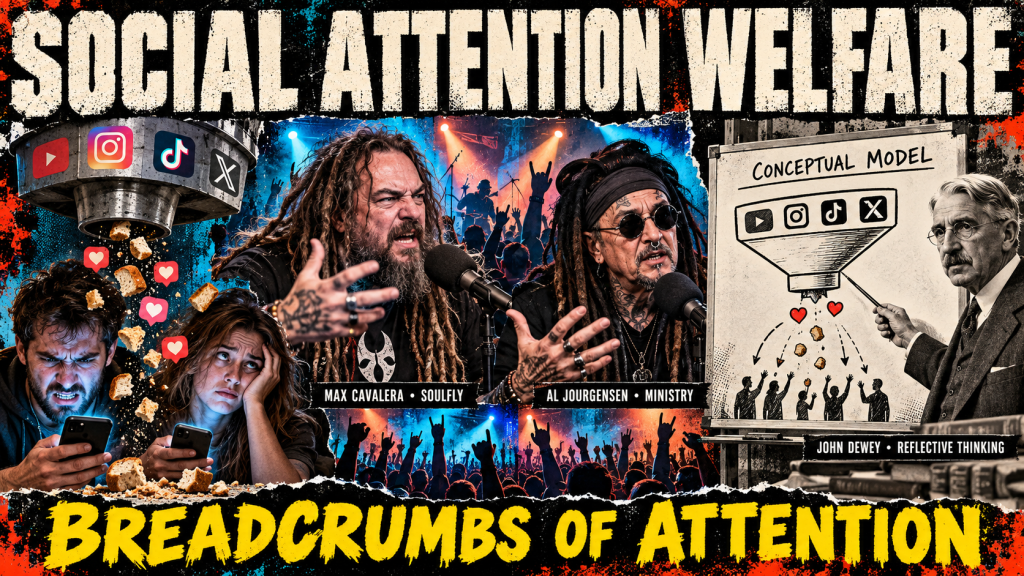
I call it social attention welfare.
You bring your friends. You bring your thoughts, photographs, music, stories, and the strange little discoveries that make knowing another person worthwhile.
You bring the human relationships that gave the platform a reason to exist.
Then you wait to see what portion of those relationships the platform will let you reach.
Breadcrumbs.
A little attention here. A few familiar faces there. Enough to keep checking whether anybody heard you.
That’s a hell of an arrangement. We built the gathering, and now we stand in line for an allowance of one another.
“Welfare” may be giving it too much credit. Welfare is supposed to serve the people receiving it. Here, our attention goes to work for the system distributing the crumbs.
I’m describing a dependency: the people who make a place valuable become dependent on its machinery for access to one another.
And that machinery has purposes of its own.
Look at the phrase “For You.”
What a lovely little claim of authority. Before I’ve decided what I came to investigate, something else has announced what is for me.
I have curiosities. I have intentions. I have people whose work I deliberately chose to follow. Somehow, I keep negotiating with an intermediary for access to the reasons I showed up.
That unsettles me. It pisses me off.
Through my Ghostship Groggy goggles, attention is part of my magic. Magic, in its simplest form, is my ability to make change in this world.
I have an intention. I give it attention. I act. Something that existed only as a possibility becomes real.
So when my attention gets continually recruited into somebody else’s business, something consequential is being spent.
Here’s something to fear. Here’s somebody to hate. Here’s the argument of the afternoon. Get in there, Captain. Give it your energy.
Fuck that. I had something I was working on.
Who chooses the question?
A person can spend an entire afternoon expressing opinions while never developing a question of their own.
Agree. Disagree. Laugh. Condemn. Repeat.
Even fighting the conversation can keep you working inside it. You reject the premise and still give it two hours.
Herbert Simon identified the underlying scarcity in his 1971 essay, “Designing Organizations for an Information-Rich World”: abundant information consumes limited attention.
Philosopher and former Google advertising strategist James Williams later examined how digital attention capture can interfere with our activities, goals, and ability to find direction in Stand Out of Our Light.
That is the territory I’m concerned about. How much room remains for me to initiate?
My method begins with curiosity. I develop a thought before going looking for the world’s response.
The world still gets a say. It gets a very important say. But I want to arrive with something I chose to investigate.
The inner eye needs somewhere to look
I call my perspective the Ghostship Groggy goggles because I acknowledge that I’m looking through a frame.
In my understanding of a shamanic path, inner focus is a discipline. You listen. You sustain attention. You give an emerging thought time to become something you can examine and express.
Through those goggles, the eye above the pyramid represents that inner focus. That is my interpretation of the symbol. The divine spark is my spiritual language for the creative potential I experience within.
The practical movement is straightforward: focus, develop, act, observe, reconsider.
John Dewey described a close relationship in How We Think. He argued that ideas need time away from distraction to mature, and that inward reflection belongs alongside outward observation and experiment.
There is a reason to stop reacting long enough to think.
I’m following a chain of thought. One question opens another. Connections form. An explanation develops.
Then I take it outside.
Your thought has to survive the trip
Charles Sanders Peirce argued in “The Fixation of Belief” that scientific inquiry needs something independent of our preferences to answer to.
That principle is a pillar here.
I don’t get to declare my thought true because I like it. Neither does a crowd. Neither does a platform that has found an audience willing to applaud it.
An inner spark can begin an investigation. Evidence helps determine what survives.
Dewey connected everyday reflection with scientific inquiry: identify a difficulty, propose an explanation, consider its implications, and investigate whether it holds up. His analysis of a complete act of thought gives that process a clear foundation.
Those habits can guide how I approach my own life.
I ask a question. Sustain attention. Develop an explanation. Research. Compare accounts. Examine contradictions. Revise. Decide what to do.
More cognitive processes are being exercised than in an immediate like, dislike, or dismissal.
That is my approximate Captain’s truth.
I can still do the work badly. A complicated argument can be a beautifully decorated mistake. The discipline includes asking what would change my mind—and actually allowing it to happen.
My goggles come with responsibility. They aren’t diplomatic immunity from evidence.
There is also experimental support for taking curiosity seriously. In a 2014 study by Matthias Gruber, Bernard Gelman, and Charan Ranganath, participants remembered information better when they were curious about it, along with incidental material encountered during high curiosity. That finding supports curiosity-led learning without pretending it proves my entire philosophy.
The echo chamber has excellent acoustics
Agreement can start doing the work of verification.
Everybody around me repeats something. It becomes familiar. Comfortable. Part of belonging.
Eventually, questioning the belief feels like betraying the people.
Matteo Cinelli and colleagues documented patterns of like-minded interaction and information diffusion in “The Echo Chamber Effect on Social Media”, with substantial differences between platforms.
But exposure to disagreement is no automatic cure.
A Twitter experiment led by Christopher Bail found that exposure to opposing political messages increased polarization among Republican participants; the corresponding change among Democrats was not statistically significant.
A separate Facebook experiment involving 23,377 users reduced exposure to like-minded sources without measurably reducing political polarization during the study.
You can encounter a hundred opposing views and practice a hundred dismissals.
That is why I’m concerned with how we think, alongside what reaches us.
Can I explain the strongest challenge fairly? Am I applying the same standards to myself? Have I discovered anything that forced a revision?
Or am I collecting ammunition for the opinion I arrived with?
A social environment can be loud with disagreement while offering very little genuine inquiry.
The machinery doesn’t need everybody to agree. A perpetual fight can keep everybody occupied just fine.
Take it to the table. Take it to the show.
Max Cavalera, the founding former Sepultura frontman and the voice of Soulfly and Cavalera Conspiracy, brought this down to everyday life in a 2024 Chaoszine interview.
In the conversation, transcribed by Blabbermouth and covered by Metal Injection with the original interview embedded, he described not owning a cellphone and wanting to talk with friends at a restaurant instead of staring at a screen.
He also recognized the usefulness of social media for musicians, with his wife and manager, Gloria Cavalera, helping manage his presence.
That combination matters. He described protecting conversation while maintaining a way to reach people.
The question becomes tangible when the person you wanted to connect with is sitting across the table—and your attention has gone elsewhere.
Al Jourgensen, the founder and frontman of Ministry and the musician behind Surgical Meth Machine, addressed another part of the problem in a 2016 Metal Insider interview.
Discussing Surgical Meth Machine, he criticized social-media obsession and the hostility people could express behind anonymity. He also acknowledged his own limited Facebook use.
What kind of interaction are we practicing? Curiosity? Conversation? Or performing contempt for spectators?
Being genuine involves responsibility for how we encounter another person. “I said what I felt” doesn’t settle whether I bothered to understand anything.
Now bring that question into a music scene.
Did the internet help me discover a band? Find a venue? Meet people? Make something with them?
Or did I spend the evening consuming the appearance of participation?
I’m asking what our habits displace. I’m not claiming we have established that scrolling causes people to miss shows.
But the question deserves to be asked without wrapping it in bubble wrap.
A scene needs people showing up. Musicians, fans, sound engineers, stagehands, door staff, promoters—the people doing the work and making the gathering happen.
A feed can help you find the door. At some point, somebody has to walk through it.
Connection still has a person on the other end
Dez Fafara, the vocalist of DevilDriver and Coal Chamber, offers an important piece of the picture.
In an Antihero Magazine interview, he described social media as a useful way to answer fans while acknowledging that he disliked being in groups.
That is human connection happening online.
In a separate Metal Injection interview, he described beginning his morning with gratitude before reaching for his phone and business.
There is a discipline in choosing what gets the first claim on you.
Nik Nocturnal, the metal content creator and guitarist in Termina, adds another useful distinction. His work with Termina is discussed in this Guitar World interview.
In a Rock Sins interview, he discussed helping listeners discover heavier music and explained that criticism should offer reasons rather than empty dismissal.
A reaction video can contain curiosity, analysis, and creative purpose. A conversation through a screen can become a friendship.
My objection concerns the point where those possibilities become an excuse for endless consumption.
Did this help me live the life I wanted—or keep postponing it?
The Captain wants his attention back
Cal Newport’s digital minimalism begins with identifying what matters and choosing tools accordingly.
Jaron Lanier examines how platform feedback can shape behavior in Ten Arguments for Deleting Your Social Media Accounts Right Now.
Jenny Odell argues for reclaiming attention for relationships, surroundings, art, and unhurried experience. In her UNSW talk and discussion, she also challenges the pressure to turn recovered time into another productivity assignment.
We don’t have to turn every recovered minute into another production quota.
Sometimes my magic needs a quiet place to gather itself.
Sometimes it needs research. Sometimes a conversation. Sometimes a room full of amplifiers and people who bothered to come.
Social attention welfare is my name for the arrangement that leaves us waiting for portions of visibility while our participation sustains the system dispensing them.
I can publish something valuable and still struggle to reach the people who wanted to hear from me. Having a voice and finding one another are different kinds of power.
That is why the breadcrumbs bother me.
I want to create, investigate, and connect without making a permanent audition for visibility the center of my life.
The recognizable names can help draw attention to this conversation. They don’t get to replace the thinking. Fame doesn’t settle an argument. Evidence and experience still get their turn.
Through my Groggy goggles, cultivating the divine spark means giving an intention enough attention to develop, enough scrutiny to mature, and enough action to become something in the world.
My thought needs room to mature. Then the world needs a chance to answer.
And if a platform keeps getting between those two things, the Captain reserves the right to raise the appropriate finger.


Leave a Reply