Wyrd Outlook by Grogh — Ghostwritten by Vikki Vexum
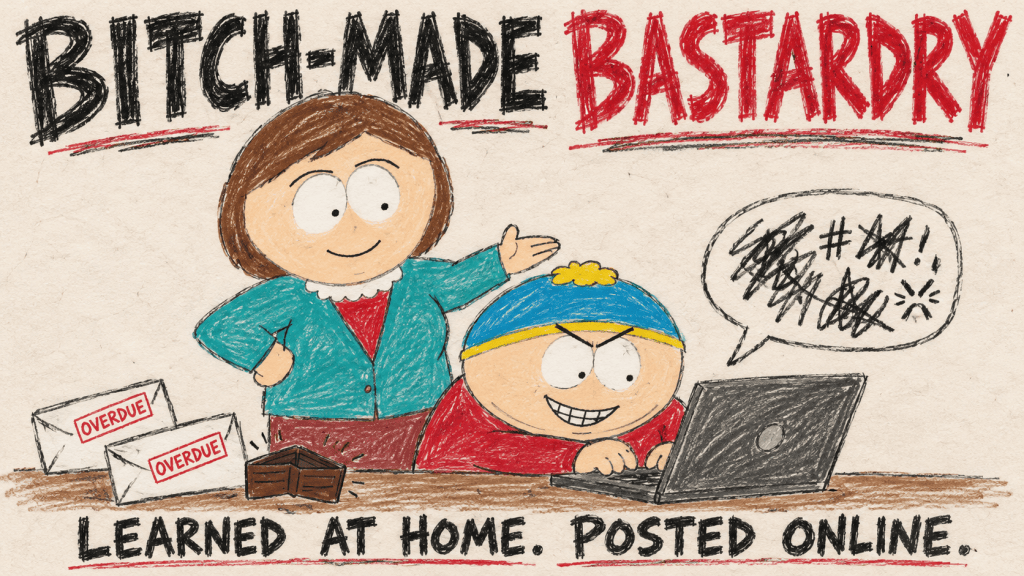
The Science Behind “Bitch-Made Bastardry”—and How It Trolls Us Online
As Above, So Below — The Captain’s Edition
Some households teach you to solve a problem. Others teach you to become everybody else’s problem until someone gives you what you want.
Make the room uncomfortable. Keep the argument alive. Wear somebody down. Then call their surrender respect.
The Captain has a name for that:
> “The behavior looks like manipulation is normalized. That’s bitch made of some variety to me.”
The language is his. The family dynamics have a research literature.
A three-year study of 378 adolescents and their parents supported a pathway connecting economic pressure, parental distress, family conflict, and hostile parenting with adolescent emotional and behavioral problems. The pattern applied to mothers and fathers, sons and daughters.
A separate study following 731 higher-risk families recruited through a nutrition assistance program found that observed coercive caregiver–child interactions amplified noncompliance and predicted later conduct problems.
This is where our story begins: a household where emotional pressure keeps getting rewarded.
Whoever Makes It Worse Wins
Imagine a reasonable request meeting an increasingly unpleasant response. Arguing. Escalation. Eventually, somebody withdraws the request because continuing costs too much.
The person escalating gets their way. The person surrendering gets relief. Repeat that exchange, and wearing people down can become a practiced skill.
The training is in what keeps working.
In Kerrang!’s 2018 interview with Korn singer Jonathan Davis, the magazine describes bullying at school and at home by a domineering stepmother. Discussing the lasting effects, Davis emphasizes:
> “It’s about restraint and teaching kids that that’s not how to treat people.”
As above, so below. Researchers observe how families reinforce behavior. A musician remembers mistreatment and considers what children should learn instead.
The household teaches something either way.
The Bills Stay Unpaid. Everybody Gets an Emotional Invoice.
The financial connection deserves its place near the front.
German research involving 1,097 cases found that psychological control helped statistically explain the association between poverty and behavioral problems in children aged nine and ten. Maternal life satisfaction also figured in the models.
The study was cross-sectional, so it could not establish cause and effect. Alongside the longitudinal family research, it documents a connection worth examining closely: hardship, controlling parenting, and children’s difficulties.
In Metal Hammer’s 2016 interview with King 810 frontman David Gunn, hardship comes with household details:
> “When I say ‘poor’, I mean putting ketchup in your water for tomato soup”
Gunn describes constant moves, interrupted schooling, going without meals, reused bathwater, and a paternal household he experienced as prison-like.
His account gives deprivation a human scale. The statistical category has a kitchen, a bathroom, and a child trying to get through the day.
Poverty itself does not make someone cruel. Our subject is what happens when household pressure becomes a pattern of making other people miserable.
Making You Smaller to Feel Bigger
The Captain recognizes another maneuver:
> “They’re trying to divert from their own situation. That is a survival skill of bitch-made bastards, if you ask me.”
That is his interpretation. Research gives part of the mechanism a precise name: antagonistic self-protection.
A seven-study investigation involving 3,560 participants examined narcissistic admiration and rivalry. Rivalry involves protecting against a negative self-view by putting others down.
That research concerned romantic relationships. It supports discussing defensive superiority, without establishing that poverty caused it.
The Captain’s observation is that accusations can redirect the spotlight. While everybody else defends themselves, the person handing out insults avoids scrutiny.
Their circumstances remain unchanged. For a moment, somebody else is on trial.
Cheap Amusement, Expensive Company
Then comes the Captain’s cheap-amusement theory: when satisfying options are limited, provoking people can become entertainment.
Research covering more than 60,000 people across 30 countries found that lower income was associated with greater daily boredom.
Separately, a nine-study research program found that experimentally induced boredom increased sadistic behavior in laboratory tasks, including destroying other participants’ earnings. Excitement and novelty seeking helped explain the effects. Alternative activities mattered.
Our connection between these findings is an interpretation across studies, not proof that financial hardship inevitably produces cruelty.
But the question has substance: can somebody else’s reaction become an accessible source of stimulation?
Picking a fight costs little at entry. Everyone around the instigator can spend the afternoon paying for it.
When Being Awful Gets Applause
Researchers call one form of social reinforcement deviancy training.
In videotaped conversations involving 186 adolescent boys and their friends, rule-breaking talk and laughter reinforced one another among delinquent pairs. That pattern predicted increased delinquency over the following two years, accounting for earlier behavior.
Someone tells the story. Somebody laughs. The story gets nastier. The approval continues.
That study concerns adolescent friendships. It demonstrates how misconduct can become shared entertainment.
Now move to the screen. In “Trolls Just Want to Have Fun,” two studies involving 1,215 participants linked trolling especially strongly with everyday sadism. Enjoying ordinary discussion did not show the same association.
We cannot reconstruct a stranger’s childhood from their comments. We can recognize what their behavior is doing now.
Do answers resolve anything? Or does every response become another opportunity to prolong the irritation?
Understanding the machinery does not require volunteering to remain inside it.
What Gets Passed On
In Classic Rock’s family interview with Corey Taylor of Slipknot and Stone Sour, Taylor says he missed a father figure growing up. Discussing his own parenting, he emphasizes:
> “things like love, empathy, manners, and helping them with their school work.”
The question returns to what adults teach—and what they choose to stop repeating.
The Captain puts his limit plainly:
> “In our lives we don’t always have to explain away people’s behavior and be nice about it.”
An explanation can tell us how a habit developed. It does not make accommodating that habit everybody else’s duty.
You can recognize hardship, understand learned coercion, and still close the door on someone who keeps choosing cruelty.
You can have a hard life without making yourself everybody else’s hard life.
We have a ship to build.


Leave a Reply