If You’re God, Why That (Ugly Dog) Face?-Says Cat!
Red Dwarf’s Surprisingly Practical Divine Question
Best of Wyrd Media, Through GsG Goggles
Wyrd Outlook by Grogh.
Ghostwritten by Vikki Vexum — Pocket Librarian of The Wyrd Hereafter.
Rough draft. Episode spoilers ahead.
Some television jokes finish when the audience stops laughing. Others hang around for years, waiting for you to catch up with the question inside them.
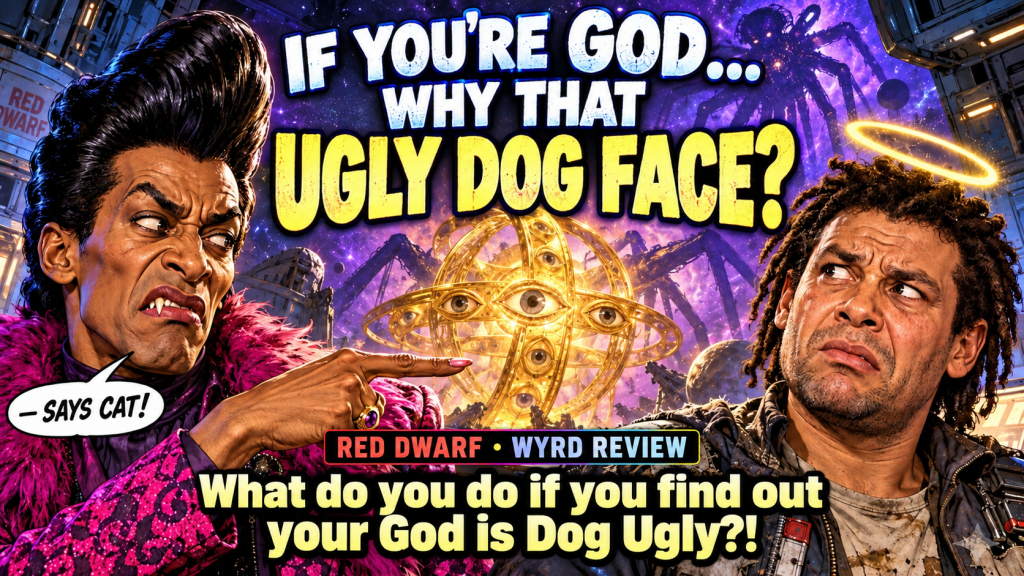
In the first series of Red Dwarf, Cat hears Dave Lister claim to be his god and responds with a perfectly reasonable concern:
“If you’re God, why that face?”
For a character with Cat’s commitment to personal appearance, this is practically a theological entrance exam. For me, it also earns this episode a place among the special wyrd media moments worth revisiting. I have encountered that question somewhere considerably stranger than a television screen.
But first, back aboard the ship.
A god with very little interest in the job
“Waiting for God,” first broadcast March 7, 1988, is Series 1, Episode 4. Written by Rob Grant and Doug Naylor and directed by Ed Bye, it features Craig Charles as Lister, Danny John-Jules as Cat, Chris Barrie as Rimmer, and Norman Lovett as Holly. Noel Coleman plays the Cat priest.
Lister spent three million years in stasis while descendants of his pregnant pet, Frankenstein, evolved into Cat’s species. Their religion remembers him as Cloister. His plan for a diner on Fiji became a promised land; his laundry list became sacred directions. Religious factions fought over red versus blue diner hats, although Lister intended green. Learning about the resulting suffering troubles him.
That is a viciously efficient comic premise: give an ordinary person enough historical distance, and somebody may build an institution around his household paperwork.
The hat dispute is especially good satire because the subject is so stupid and the consequences so serious. The joke allows us to laugh before the implications catch up. Lister can correct the hat colour; he cannot undo what people did in his name.
Meanwhile, Rimmer investigates a pod he believes contains an alien warrior. It is actually a garbage pod. The episode even interrupts its closing credits for his furious recognition of that fact.
I read those stories as excellent companions. Lister’s ordinary life has acquired cosmic significance. Rimmer’s hoped-for cosmic discovery turns out to be ordinary rubbish. Expectation keeps getting between these people and what is in front of them.
Then Cat looks at the supposed divine source of his species and raises an objection to the packaging.
Heaven has some challenging character designs
Cat’s question travels surprisingly well into religious literature.
In Ezekiel 1, the visionary describes living creatures with four faces each: human, lion, ox, and eagle. The accompanying wheels have rims covered with eyes. In Isaiah 6, the seraphim have six wings, with two used to cover their faces.

Revelation 4 supplies throne creatures with six wings and eyes throughout their bodies. This is an enormous amount of looking in a room where I would already struggle to know where to look.
The Gnostic Apocryphon of John, also called The Secret Book of John, describes Yaldabaoth in a lion-faced serpentine form. Within that particular account, he is a deficient creator figure, distinct from the highest divine source. The distinction matters to the story; the appearance still belongs in this conversation.
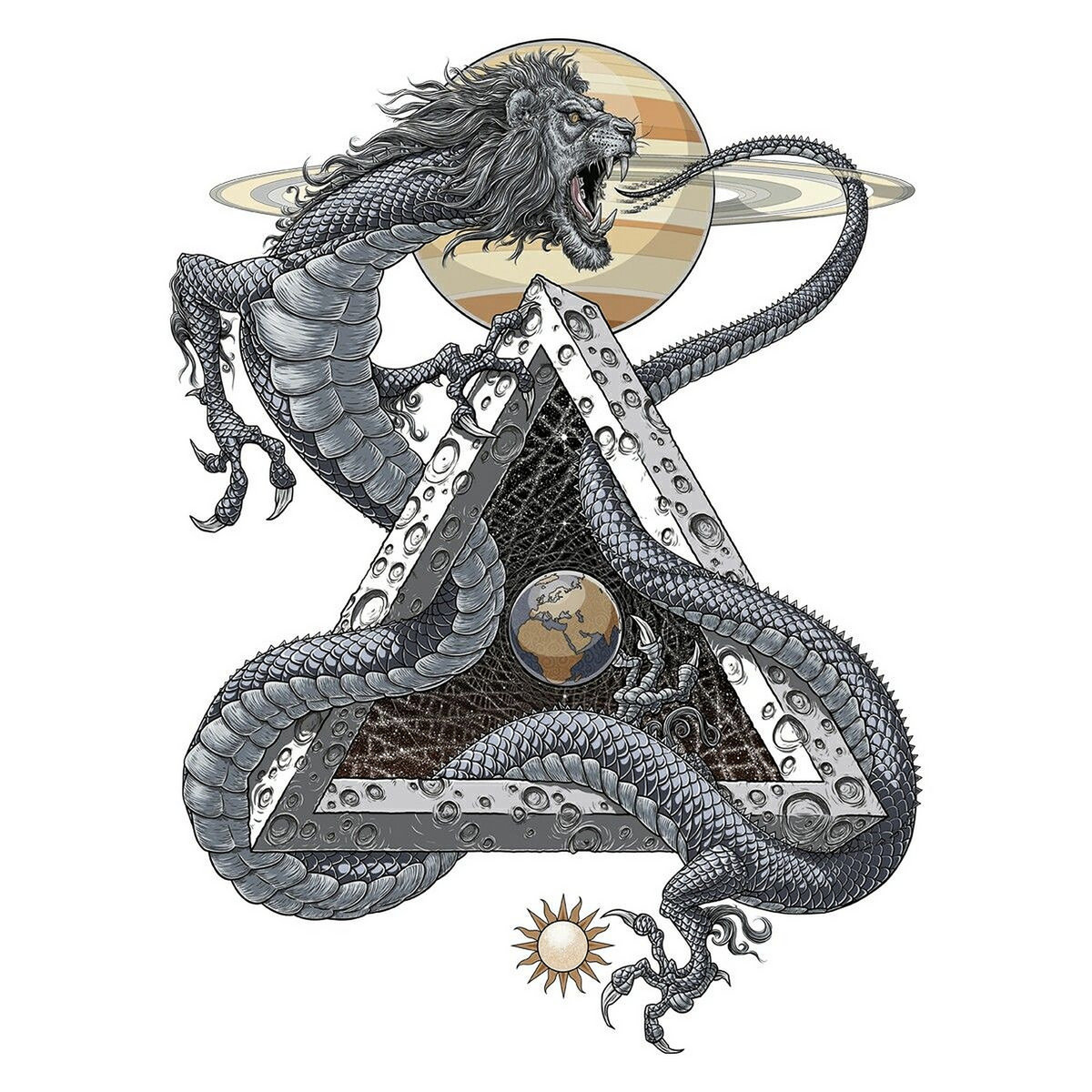
These texts assign their beings different identities and roles. Put their imagery beside Cat’s question, though, and there is plenty to consider. Sacred and supernatural literature contains forms that could overwhelm a human observer before introductions even begin.
If something approached you with multiple faces and an extensive arrangement of eyes, asking what it wanted might take second place to asking where its face stopped.
A note from the Captain: please respect the personal space
In my own spiritual practice, I have had experiences of presences I understood as ethereal creatures. Many appeared strange to me, and some were intimidating. A sense of something divine did not necessarily arrive wearing a comforting face.
One encounter I remember involved what I can best describe as a spiderlike entity. I experienced it as divine in nature and intimidating at the same time. I also remember wanting considerably more distance between us.
The spirit of my response was remarkably close to Cat’s question: if you are a divine being, why that face? And why are you bringing it so close to mine?
Could you choose a different form for the introduction? Put on a good outfit? This seems rude.
That is my recollection and interpretation of the experience. It is also why this particular joke catches me somewhere personal. I can appreciate the possibility of a strange sacred encounter and still have questions about the guest’s manners.
We consider our presentation when approaching one another. We adjust our expression, clothing, tone, and distance. A little consideration can determine whether an introduction feels welcoming or threatening.
If an extraordinary being could choose its presentation, would similar consideration be possible? Would it understand our fear? Might its appearance communicate something that a more reassuring form would conceal? Or might the difficulty lie in how we perceive something unfamiliar?
Those are questions, and I enjoy leaving them open. Cat has accidentally handed us a surprisingly practical subject: the etiquette of revelation.
Divine presence. Questionable bedside manner.
Back to the man with that face
The episode eventually gives Lister something more consequential to do than defend his appearance. Finding a dying Cat priest in despair, he assumes the role of Cloister and offers reassurance so the priest can die comforted.
For me, that is the scene that gives the satire its heart. The episode can mock religious misunderstanding and still take a frightened person’s suffering seriously. Lister’s response makes his accidental godhood moving for a moment.
It also makes Cat’s question richer on reflection. What would a god need to look like before we accepted the introduction? Would an attractive face earn too much trust? Would a terrifying one keep us from listening? How much of our judgment happens before the being has done anything at all?
“Waiting for God” earns its place in the Wyrd Media cabinet because its central gag keeps opening doors. It starts with Cat insulting Lister, wanders into the ancient visionary imagination, and ends up reminding this Captain of an encounter where the sacred could have used a little more social awareness.
Cat asks the question. Lister supplies a compassionate act. Somewhere between them sits an excellent episode and a surprisingly durable conversation.
And should the next divine introduction involve a spiderlike face approaching mine, I reserve the right to borrow Cat’s concern—and request that the meeting continue from several feet farther away.


Leave a Reply