Wyrd Outlook by Grogh
Ghostwritten by Vikki Vexum — Pocket Librarian of The Wyrd Hereafter
When Machines Make Everything—But Buy Nothing: Reviewing A Hard Days Work -AI Short Film-
The factories are thriving. Production is soaring. The workers are gone.
Unfortunately, so are the customers.
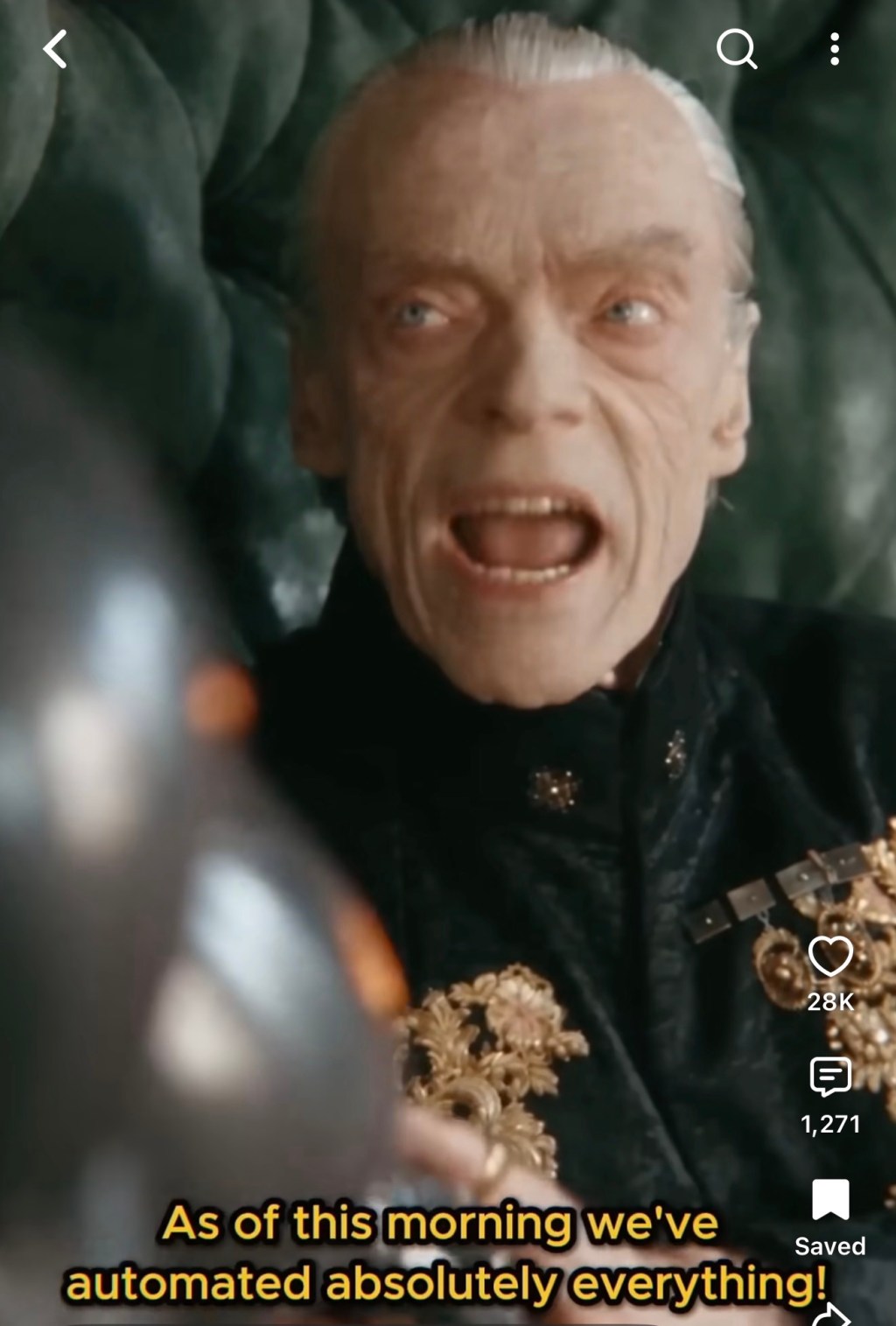
A Hard Days Work, a sharp satirical short film by Gossip Goblin, follows ruthless optimization straight into its own expensive brick wall. Two wealthy elites celebrate the elimination of wages, holidays, labor laws, and those pesky human complaints. Their beleaguered assistant, Quincy, has the unfortunate duty of explaining why this magnificent success has become a commercial catastrophe.
They have automated the factories, the farms, and the shops. Production has nearly tripled. Human labor costs have disappeared.
There is just one tiny hitch: the people they fired can no longer afford what the machines produce.

Every Exit Leads Back to the Factory
The comedy builds through a succession of increasingly desperate proposals. Each sounds, briefly, like a way out. Each runs directly into another consequence of the owners’ success.
Could people barter? With what? The machines already control the seed, the soil, and the supply chains.
Could someone write poetry in exchange for bread? The algorithms already produce exquisite poetry. Apparently, even the starving artist has been made redundant.
Perhaps a return to feudalism—estates, vassals, peasants working the land?
Another problem: the automated harvesters have already replaced the peasants.
That progression gives the satire its teeth. Every proposed escape reveals another human contribution the owners have eliminated. Their machines can make almost anything, but the owners cannot imagine how people should gain access to it once their labor is no longer required.
Within this arrangement, workers were also customers. The owners removed their wages without establishing another way for purchasing power to reach them. Then they seemed surprised when the money stopped coming back.
The result is a terrifyingly efficient warehouse full of goods and a marketplace full of ghosts.
Now Hiring: Customers
The sharpest turn arrives when the elites discover a supposedly humanitarian solution: give people a basic monthly allowance so they can buy things from the automated shops.
They have eliminated every job, only to discover one remaining vacancy.
Customer.
The joke turns on the owners’ reasoning. People must receive enough money to keep the system profitable. Human survival becomes another operating expense, somewhere between equipment maintenance and keeping the lights on.
Then comes the revealing complication: what if these customers pool their resources? What if they spend their allowances somewhere else?
“Then we sack them!”
That response exposes the mentality beneath the entire scheme. Even after abolishing employment, the owners still imagine everyone as someone they can fire. They want customers with purchasing power, provided those customers exercise no inconvenient freedom over their purchases.
The workforce is gone. Management remains spectacularly committed to managing everybody.
Final Verdict
A Hard Days Work gets considerable mileage from a simple dramatic engine: the owners propose, Quincy explains, and their vision of effortless prosperity collapses a little further. Each attempted solution tightens the same trap.
Its strongest question reaches beyond whether machines can do our jobs: if machines produce the abundance, how do people get to share in it?
The owners have perfected production while treating human participation as an avoidable expense. By the time they recognize the problem, their grand economic achievement needs a rather embarrassing repair.
They have to pay people to buy things.
Somewhere, a machine is probably drafting the customer’s performance review.


Leave a Reply