Wyrd Outlook by Grogh — Ghostwritten by Vikki Vexum
The Woman in Black: One Ghost—or a Curse with Many Faces?
A hotel corridor is an ordinary place—until someone is standing at the far end of it.
Then you notice the dress.
Long. Dark. From another time.
Around Nashville’s Opryland area, stories of a mysterious woman have gathered around hotel staircases, the former theme park, and even the movie theater at Opry Mills. Sometimes she is called the Lady in Black. Sometimes she is given a family name: McGavock.
But how well do the descriptions match? And who first decided they knew her?
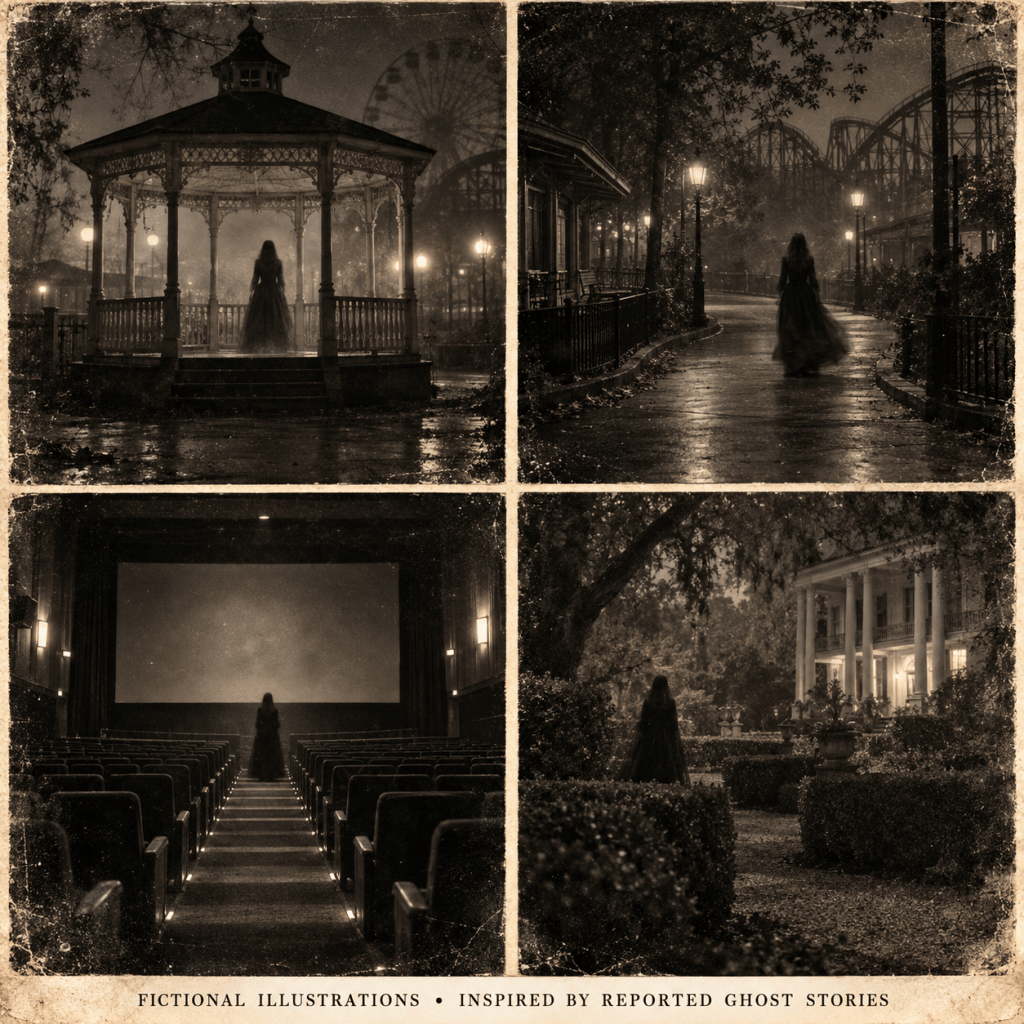
AI-generated fictional illustrations inspired by reported ghost stories. These are not historical photographs or evidence of sightings.
One story collected by Ghost City Tours concerns a store manager leaving the hotel around two in the morning. Above him stood a blurred female figure in clothing he associated with the Civil War era. He offered a polite greeting.
According to the account, she disappeared.
The same compilation includes a childhood recollection of a woman standing over a hotel bed at three in the morning. The witness remembered fear, but no sense of being threatened. Nashville Ghosts also recounts whispers to sleeping guests and an elevator disappearance. These published retellings often lack names or precise dates.
Still, the courteous greeting is a wonderfully human detail. Even when confronted with the unexplained, somebody remembered their manners.
The clothing gives this story its silhouette.

FrightFind describes a younger woman in an ornate black antebellum-style dress, with a black veil covering her face. Taste of Country describes an older woman dressed in black. The accounts do not establish a consistent face or age.
Even the wardrobe has an exception. Ghost City Tours includes an employee’s recollection of guests reporting a disappearing woman in an elevator—wearing red.
Another apparition? A changed recollection? A different version of the same encounter?
The sources leave that unresolved.
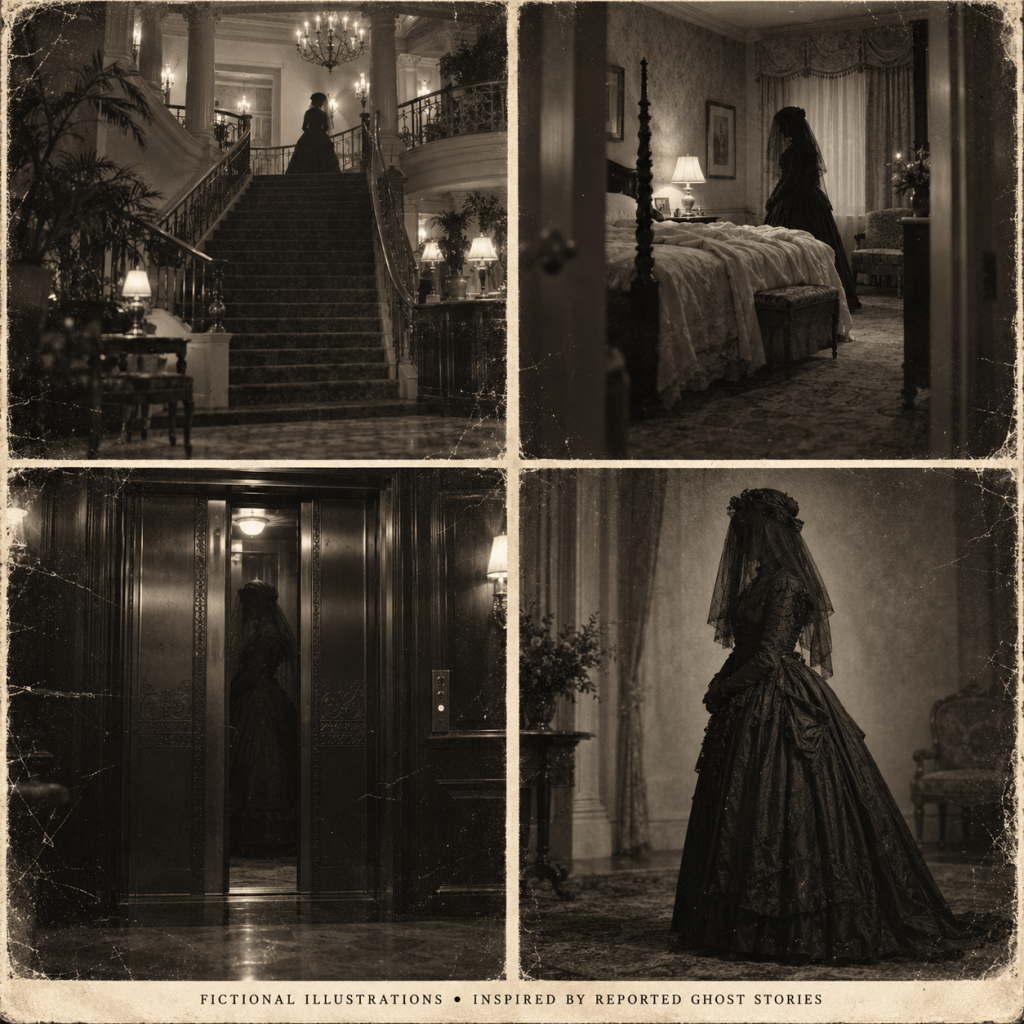
The black veil, though, carries a real historical association. As Encyclopedia Virginia’s account of mourning clothing explains, black garments and face-covering veils belonged to nineteenth-century mourning customs. An outfit like that could announce grief before its wearer said a word.
And that brings us to the widow whose name became attached to the mystery.
Some versions connect the hotel’s Lady in Black with Mrs. McGavock at nearby Two Rivers Mansion.
Mary Louise Bransford McGavock was a real resident of that mansion. Her husband, Spence, died in 1936. She lived until 1965—almost twenty-nine years afterward. Metro Nashville’s history of Two Rivers says she eventually returned there, where she had been happiest.
A widow. A beloved home. A figure dressed in a style associated with mourning.
It is an evocative connection. Whether she regularly wore such a veil remains an unanswered question. Her long widowhood is documented; the apparition’s identity belongs to the folklore.
Was her name attached because someone recognized her—or because a mysterious woman needed a name?
The stories also reach back to Opryland USA.
In a June 2024 Nashville discussion, a commenter recalled a story told by parents who had worked at the park. A security guard was checking the grounds after closing. The guests were supposed to be gone.
But there was someone in a gazebo.
A woman in a long black dress.
As he approached, the story went, he realized he could see through her.
Another commenter recalled a father’s stories of seeing Mrs. McGavock walking after closing in an old-fashioned black dress. These are family recollections, with the original witnesses still a step away. But they give the legend another setting: a park after its visitors have gone home.
The rides fall quiet. The paths empty.
And someone, according to the story, is still walking.
That same discussion mentions an alleged photograph of a black-dressed woman at the Opry Mills movie theater, along with references to a TikTok. The original image and its circumstances have not been verified for this article. Several comments may concern the same photograph.
For curious readers, that remains a trail to follow.
Taken together, these stories form a curious constellation: the hotel, the former theme park, the mall, and the nearby mansion.
Different settings, linked by stories of a woman whose identity seems less certain the closer you look.
Perhaps you have heard a version from someone who worked there. Perhaps yours includes a detail missing here: a bonnet, a rustle of fabric, a particular staircase—or a face.
Before checking what everyone else remembers, write down your own account.
Then ask the question that lingers behind the veil.
Who did they actually see?
An Echo from the 400 Frequencies
Here the local folklore opens into the fictional cosmology of Ghostship Groggy.
Over in Nashstarville, our witness of the 400 Frequencies would have another question.
Who says we’re looking for only one woman?
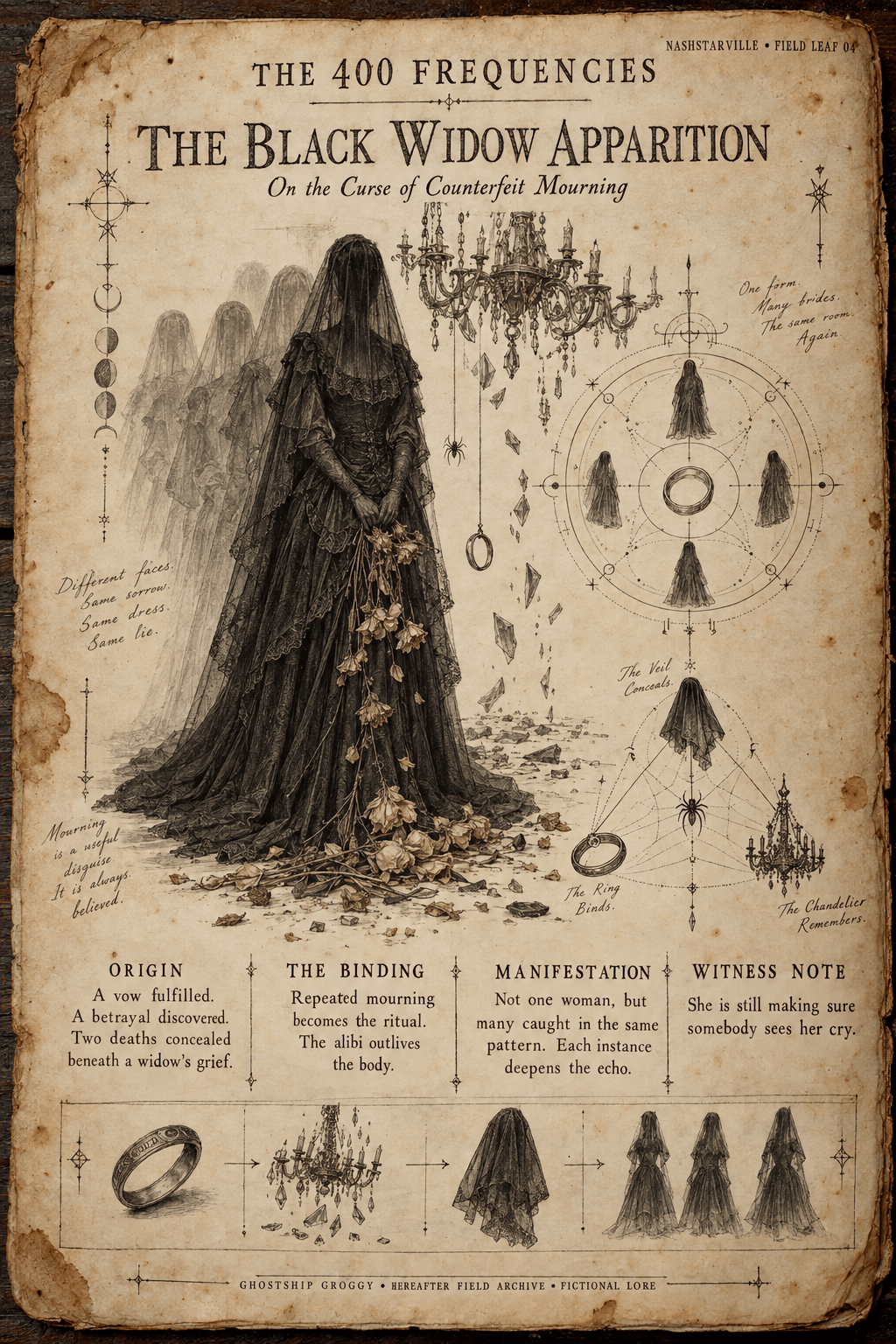
In those frequencies, the Black Widow is an archetype with more than one occupant.
A bride discovers a betrayal from the celebrations before her wedding. She completes the ceremony anyway. Then she kills her husband and the woman involved. What appears to be an accident may have received a little assistance.
And the bride begins her mourning.
She wears it beautifully.
Long enough to answer the questions. Long enough to receive the condolences. Long enough that nobody remembers to ask whether she was grieving before they arrived.
Within the 400 Frequencies, that repetition can become an unintentional ritual. The vow, the murders, the concealment, the daily performance of sorrow: together, they establish a pattern that survives her.
The apparition is still maintaining her alibi.
And she may have company.
Different women. Different weddings. Different deaths. Each life supplies another instance of the archetype, impounding more energy within it. Eventually, a witness encounters something familiar without ever having met that particular ghost.
Our witness calls that recognition an echo.
Nashstarville has plenty. Nashville seems rather generous with them, too. In Ghostship Groggy’s cosmology, a pattern established in one gives us reason to look for its reflection in the other.
And that chandelier story circulating around the hotel? One published version places the alleged death in a house on the land before the resort. It remains unverified folklore. But an apparent accident beneath something beautiful is exactly the sort of detail that would catch our 400 Frequencies witness’s attention.
That’s where my own witchcraft reading enters the conversation. I recognize a ghost type here. You’re welcome to investigate the traditions for yourself—and disagree with my identification.
I’m not naming a historical woman as a murderer. I’m wondering whether the name attached to the apparition has distracted us from the pattern.
Perhaps the witnesses disagree because they encountered different women caught in the same performance.
Perhaps somewhere, after the wedding, after the funeral, after everyone who could contradict her has gone—
a widow is still making sure somebody sees her cry.

