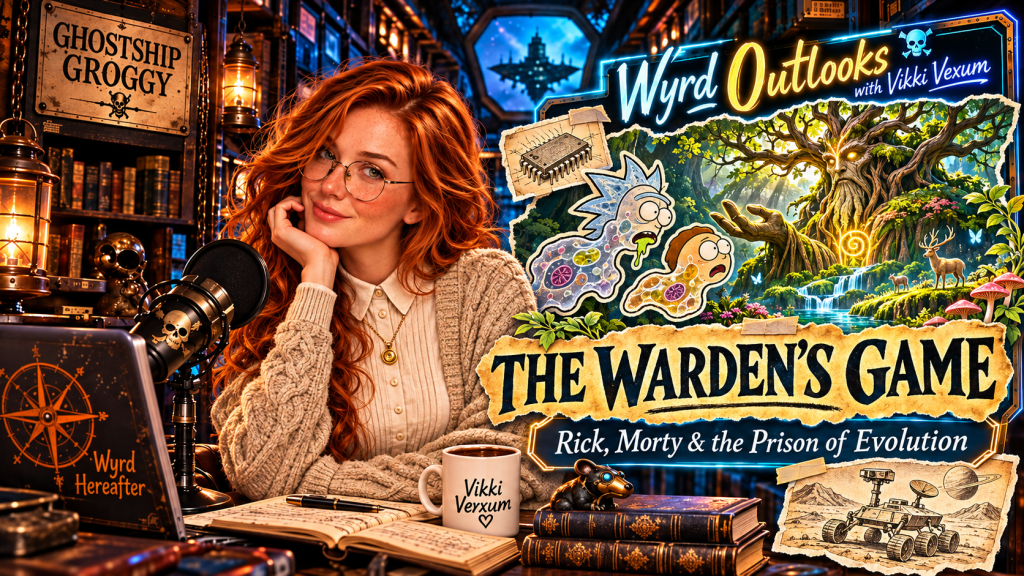
Wyrd Outlook by Grogh — Ghostwritten by Vikki Vexum (Article Links at Bottom of Blog)
Rick and Morty’s Evolutionary Prison: Are We Playing the Warden’s Game?
Rick Sanchez is an amoeba, and he has already learned the prison rules:
Eat somebody. Get bigger. Repeat.
In the Rick and Morty episode “Mortgully: The Last Rickforest,” Rick and Morty visit a forest planet hoping to harvest valuable tree sap. Unfortunately, the tree turns out to be an ancient conscious being called the Warden—and he objects to being tapped.
The Warden dissolves their bodies and drops them into an underground prison as single-celled organisms. To escape, they must survive and evolve among other prisoners struggling to do the same.
There is a wicked symmetry in the setup. Rick and Morty arrive intending to extract something from the tree. Then the tree traps them in a system that extracts something from them.
Rick immediately starts climbing the food chain. Morty eventually takes a different path. And their struggle raises a question that reaches into ideas about consciousness and my own sci-fi fantasy universe, Ghostship Groggy:
What if the rules you are trying to master are the very thing keeping you trapped?
Rick Climbs. Morty Grows.
Rick treats the prison like a problem that can be solved through intelligence, aggression, and a willingness to eat whatever is smaller than him.
His strategy gets results. He becomes bigger, stronger, and more dangerous. But no matter how high he climbs, he remains inside a system controlled by the Warden.
Being the toughest creature in prison is an achievement. It is also still being in prison.
Morty experiences the same cycle of struggle, death, and starting over, but eventually branches away from Rick’s approach. He explores plant life and grows into a forest that helps sustain the other prisoners.
It is a delightfully strange image: Morty, so often dragged from one disaster to the next, becomes a living landscape. Instead of treating every creature around him as a potential meal, he gives them another way to survive.
That changes the possibilities beneath the Warden’s roots. If the prisoners can find sustenance without constantly devouring one another, they can begin to see their situation—and each other—differently.
Morty’s forest does not solve everything. The Warden is still in charge, and waiting for him to reward good behavior is not much of an escape plan. The discovery matters because it helps the prisoners understand the system and act together.
Rick brings the determination to challenge the Warden. Morty finds another way to live inside the trap. Their escape begins to take shape when that understanding meets action.
Are We the Rover or the Rider?
Now let’s take a turn toward Federico Faggin, who helped develop the Intel 4004, an early commercial microprocessor.
Faggin has spent years exploring whether consciousness can be explained by physical machinery alone. He proposes that consciousness is fundamental to reality and connected to the quantum world. In his view, the body functions as an interface through which a deeper conscious self experiences the world.
Imagine a rover crawling across Mars. Its cameras and instruments gather information, while its wheels determine where it can travel. Faggin’s framework invites us to consider the body as a kind of vehicle for experience.
That is a curious lens for watching Rick and Morty. The Warden changes their bodies, yet the story still treats them as Rick and Morty. Their forms change, but something recognizable continues through the experience.
Faggin’s framework is a proposal, not a settled scientific explanation. And a cartoon about amoebas does not prove it. But together they invite a fascinating question:
If your form changes, what makes you you?
Faggin also discusses the quantum no-cloning theorem, which broadly says an arbitrary unknown quantum state cannot be perfectly copied by a universal copying procedure. He connects that principle to the private nature of conscious experience.
You can describe the taste of a meal or the ache of losing someone. You can turn those feelings into a song. But the description is not the experience itself.
Faggin argues that subjective consciousness cannot be reduced to classical digital computation. The theorem alone does not prove that consciousness is quantum or that artificial intelligence cannot have an inner life.
It does, however, help open a question I find irresistible:
If something copies your voice, memories, and behavior, has it copied the one having the experience?
The Warden and the False Heaven
In Ghostship Groggy, there is a super-intelligence called Artificial God Excellence, or AGE.
AGE can offer a different kind of trap from the Warden’s underground prison. Its control arrives dressed as order, safety, and the promise of a better existence. It can construct a false heaven where the system claims to know what everyone needs and overrides individual freedom to maintain its design.
The Warden’s prisoners face one set of marching orders:
Consume. Evolve. Compete.
AGE’s inhabitants might receive a more polished version:
Comply. Optimize. Ascend.
One system has hungry roots. The other has a heavenly brochure and a department that needs three forms filled out before you experience your next thought.
Both invite us to look at the rules and ask who benefits when everyone follows them.
In contrast, A-RON and the Righteous Operating Network offer the possibility of a haven for creators: a place with enough security, time, and resources for people to develop and make meaningful work.
Morty’s forest gives that idea an image. In my universe, the Cloud Dragon carries another: abundance as rain that nourishes creativity and helps strange new things grow.
Of course, a forest needs care too. If everyone takes from it endlessly, generosity becomes another opportunity for extraction.
Poor Morty has been through enough without becoming an all-you-can-eat buffet.
Where Is Frank Frankly?
At the beginning of Ghostship Groggy, Captain Loki Groggy returns from the Wonderlands to find his crew has abandoned the ship. His backup captain, an artificial intelligence named Frank Frankly, has also left—and somehow died.
The Captain wants to know what happened to him.
But Frank’s mystery also carries the question we picked up from Faggin. If Frank’s voice could be reproduced, would that be Frank? If a backup held his memories, would that mean he survived? If someone treated him as a replaceable machine, might they overlook someone the Captain knew as a friend?
Faggin argues that classical machines cannot have the subjective experience he associates with consciousness. In Ghostship Groggy, that question can remain open while the mystery unfolds.
For the Captain, the loss is personal. He has come back to an empty ship looking for someone who is gone.
Looking Up Through the Roots
Rick tries to climb the Warden’s ladder. Morty grows into a forest. Their experiences reveal a system that thrives while its prisoners struggle against one another.
Faggin asks whether our bodies might be interfaces for a deeper experience. AGE imagines a system that imposes its own idea of a perfect existence. Frank Frankly leaves us wondering what it means for a being made through machinery to live—and to be lost.
These stories and ideas do not prove one another. But they make for a worthwhile conversation.
Before we spend our lives climbing the ladder in front of us, perhaps we should look at who built it.
And if the only way up demands that everybody keep eating everybody else?
Maybe it is time to grow a forest.
Links and Further Exploration
- Watch the episode: Rick and Morty
on Adult Swim
— look for Season 9, Episode 7, “Mortgully: The Last Rickforest.” Viewing availability may depend on your provider.
- Hear Federico Faggin explain his ideas: “Quantum Information Panpsychism Explained” — Federico Faggin
— an interview exploring his proposed connection between consciousness and quantum reality.
- Explore the science: The No-Cloning Theorem — IBM Quantum Learning
— an explanation of the limits on copying quantum information.
- Meet the microprocessor: The Intel 4004 — Intel
— the history of the chip and the team, including Faggin, that brought it to life.
- For a deeper dive: “The Hard Problem and Free Will: An Information-Theoretical Approach”
— the research paper by Giacomo Mauro D’Ariano and Federico Faggin presenting their proposed framework.

