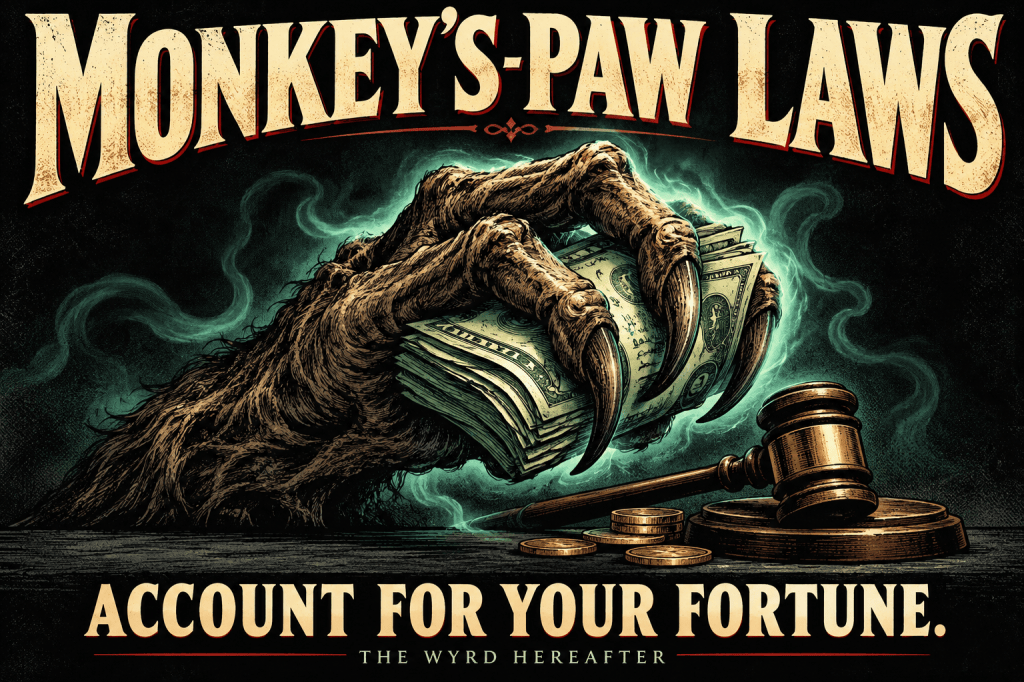
Monkey-Paw Laws: Follow the Money—and Everyone Who Knowingly Helped It
Wyrd Outlook by Grogh.
Ghostwritten by Vikki Vexum — Pocket Librarian of The Wyrd Hereafter.
The Bank of America enforcement story raises a question that should extend beyond banking: When money from fraud or other unlawful activity buys access to ordinary society, who is responsible for knowingly opening the doors?
A con operation needs somewhere to deposit its proceeds. Someone may then use those funds to obtain financing, pay rent, purchase property, or invest. An employer may gain a different financial advantage by knowingly hiring unauthorized workers, withholding legally required wages, or putting drivers on the road without required credentials.
Each situation presents a potential point of accountability. Where the evidence establishes a violation, scrutiny should follow the participating businesses and decision-makers.
That is the proposed “monkey-paw laws” framework: investigate the unlawful financial advantage, trace who knowingly enabled it or violated required safeguards, and pursue the penalties and recoveries the law permits.
The wish was money. The monkey’s paw demands an accounting.
The bank case suggests where to start looking
On October 13, 2026, Treasury announced more than $1.21 billion in penalties against Bank of America for anti-money-laundering and sanctions violations. FinCEN says the bank admitted willful Bank Secrecy Act violations, including failures involving its compliance program, correspondent-account due diligence, and suspicious-activity reporting.
That does not establish wrongdoing by every business handling unexplained money. It establishes a reason to examine the safeguards through which questionable funds are supposed to be identified and reported.
Consider the pattern worth investigating: a person’s documented earnings do not explain the money moving through their accounts, the financing they receive, or the property payments they make.
The questions become specific. Where did the money originate? Was it income, borrowed money, a gift, an asset sale—or criminal proceeds? Were records fabricated? Did someone responsible for checking accept an explanation they knew was false? Were required reports suppressed?
Under 31 C.F.R. § 1020.320, banks must report qualifying suspicious transactions involving at least $5,000. The rule expressly addresses activity inconsistent with a customer’s expected transactions that remains unexplained after examination.
The investigation should follow both the money and the response to its warning signs.
When unexplained money becomes housing
Housing and financing deserve a prominent place in this inquiry.
Suppose someone obtains a mortgage using earnings that cannot be substantiated. For covered mortgages, 12 C.F.R. § 1026.43 requires verification of the income or assets relied upon to establish repayment ability. Its official interpretation specifically rejects counting an unidentified deposit as income without establishing what it represents.
That supplies concrete grounds to examine the application, supporting records, approval process, and anyone who knowingly helped falsify them.
Rental businesses also have cash-reporting obligations. IRS guidance on Form 8300 explicitly includes rental payments among covered transactions when qualifying cash receipts exceed $10,000.
Where housing transactions involve knowing participation in concealing criminal proceeds, federal money-laundering laws provide another investigative avenue.
Where the allegation involves housing connected to unlawful immigration, 8 U.S.C. § 1324 addresses specified harboring, concealment, and related assistance, including provisions involving financial gain.
An ordinary private landlord has no blanket federal duty to verify every tenant’s lawful income or immigration status. The case therefore needs to identify the actionable conduct: knowing participation, qualifying harboring, false records, criminal proceeds, or a violated reporting obligation.
That gives the inquiry a legal target.
When unlawful hiring becomes a business advantage
The employer side belongs squarely in this framework.
A company that knowingly hires people without authorization to work may benefit from a workforce with fewer practical options for challenging its conduct. If it also withholds legally required wages, its savings come directly from money workers should have received.
8 U.S.C. § 1324a prohibits knowing unauthorized employment and establishes employment-verification duties. Applicable wage laws create separate obligations, which the Department of Labor enforces regardless of immigration status.
Work authorization must be established separately from immigration status. Likewise, paying less than the industry average is different from withholding legally required compensation. Those distinctions identify which records and violations to investigate.
In trucking, 49 C.F.R. § 383.37 directly addresses employers permitting covered commercial driving when they know or should reasonably know that required credentials are missing or the driver is disqualified.
The driver’s conduct does not exhaust the inquiry. The company’s hiring, verification, and dispatch decisions deserve examination too.
There is precedent for recovering the advantage
In the 2017 Asplundh Tree Experts case, the company pleaded guilty to unlawful employment and faced an $80 million forfeiture judgment plus $15 million in civil payments.
DOJ described acceptance of fraudulent identification, management’s willful blindness, and hiring practices that increased productivity and profit. The connection between prohibited conduct and business advantage was central to the government’s account.
This is why the proposed framework deserves consideration. Financial accountability for participating businesses already exists.
A case for the community
Grogh’s underlying hypothesis is:
“There is a lot of money that has been lost that belongs in our communities that was stolen from operating in our communities.”
That hypothesis calls for evidence: unpaid wages, concealed taxable earnings, fraud losses, prohibited transactions, and unlawful business gains.
It also calls for examining the wider consequences. Did workers lose spending power? Did compliant businesses face competitors benefiting from unlawful practices? Were public funds lost?
A petition could demand investigations into those questions, legal review of affected people’s claims, recovery where authorized, and public reporting of money actually collected.
Recovered funds have different legal destinations, including victims and designated public funds. Any proposal to use recoveries toward federal debt must account for those rules.
The public demand can still be direct:
Investigate the unlawful gains. Examine the businesses and intermediaries that knowingly enabled them. Recover what is legally recoverable. Show the public where the money went.
A lawful economy depends on people believing that following the rules remains worth the effort. Monkey-paw laws would ask whether those profiting from prohibited shortcuts have finally been made to account for the wish of unlawful gains.

