Wyrd Outlook by Grogh — Ghostwritten by Vikki Vexum
How to Understand Alternative and Weird Cultures: They’re the Foodies of Fashion, Music, and Art
You don’t have to share my taste. I want you to understand what goes into developing it.
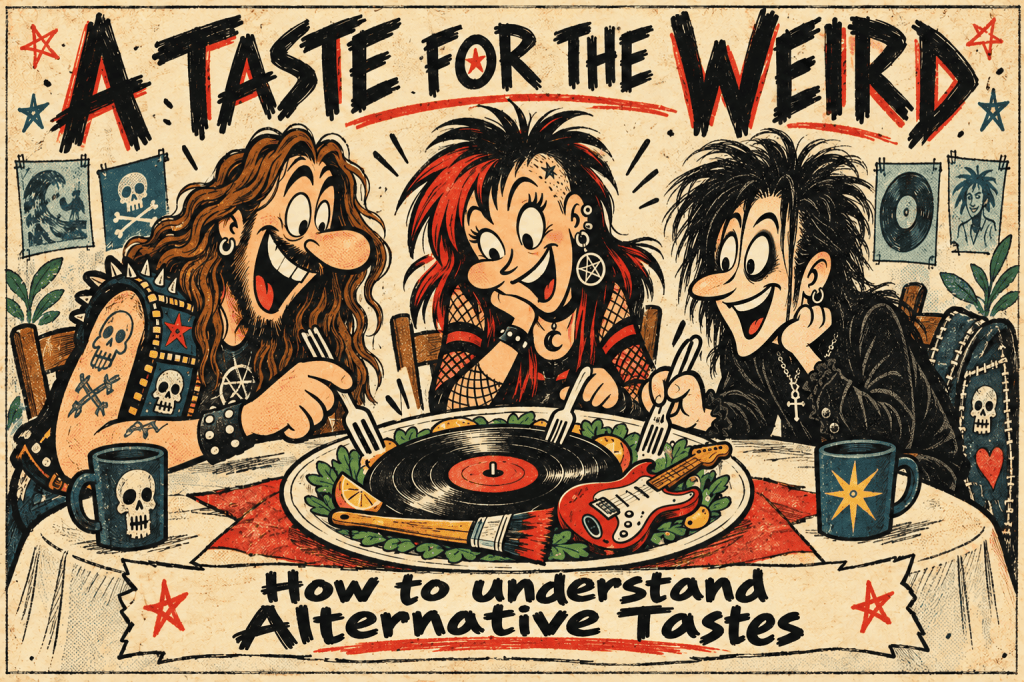
If you want to understand alternative and weird cultures, try seeing their explorers as the foodies of fashion, music, and art.
Think about a foodie.
Someone who explores unfamiliar dishes, learns ingredients, follows a flavor into another culture, and eventually starts experimenting in their own kitchen. Their enjoyment deepens as they learn to recognize the details. They discover combinations they never knew they wanted.
Now carry that curiosity into a record store. A wardrobe. An art gallery.
Through the Captain’s goggles, that familiar appetite offers a way into an unfamiliar world.
And some of us have been seasoning this strange stew for decades.
Fitting in is not everybody’s destination
There is an assumption that people enter a subculture primarily to find a crowd that will accept them.
That can happen. But it misses the pursuit I want to explain: discovering what you actually like and developing a personal world around it.
You hear something that catches your attention. You find an image that stays with you. You imagine clothes that nobody around you wears.
So you investigate.
The reward can begin long before you meet anyone who shares your interest. There is pleasure in finding the thing itself, learning its details, and recognizing what it awakens in you.
Alternative, punk, goth, and metal communities have different histories. They are not interchangeable, and no single motive explains everybody within them. What I am describing is the creative approach I value across those worlds: curiosity becoming deliberate personal taste.
Someone else’s approval is a poor substitute for that discovery.
A palate develops through attention
A curious eater might begin with one unfamiliar dish. Something catches their attention: the heat, the texture, an ingredient they cannot identify.
Music can unfold the same way.
You hear a guitar tone that grabs you. You follow it to another band, then an earlier influence, then a musical tradition you had never explored.
Eventually, distinctions emerge from what once sounded like a wall of noise. You recognize the rhythmic feel. You hear how a voice works against the instruments. You notice the space between heavy passages and the unusual way a song builds tension.
Your enjoyment acquires detail.
Fashion offers its own education. You start noticing silhouette, fabric, movement, construction, historical references, and the relationship between pieces.
Somebody else sees a black jacket.
You see why that jacket belongs with those boots, why its worn texture matters, and what one handmade alteration could do to the arrangement.
A person who has spent years exploring these things may have an extraordinarily practiced palate. They have experimented, made mistakes, changed their mind, and discovered pleasures that reward patience.
We readily respect that experience in a kitchen. It deserves consideration in a wardrobe or record collection too.
Rob Halford: when the ingredients connect
Judas Priest’s Rob Halford gives us a useful example of artistic identity developing through experimentation.
In a 2020 interview with Kory Grow for Rolling Stone, he described the band’s early appearance feeling disconnected from its powerful music. Trying a leather biker jacket helped the visual side begin to make sense.
“That’s more like it. Now it’s connecting.”
That is a moment of recognition familiar to anyone who has assembled something until it finally feels right.
His listening also ranged across Pavarotti, Dolly Parton, Bob Dylan, and heavy music. I hear a developed palate in that combination: an artist with a strong identity and an appetite extending beyond one musical shelf.
You can be deeply devoted to metal and still find something magnificent in an operatic voice.
A personal taste has room to grow.
Ordering beyond the familiar menu
There is a place for a familiar meal. Sometimes you want exactly what you already know.
But imagine answering every restaurant question from an adventurous foodie by pointing toward the nearest McDonald’s.
Or suggesting their curiosity about seafood ought to be completely satisfied by Red Lobster.
They may have something more particular in mind. A little Cajun place. A family recipe. A preparation they have never tried.
Alternative taste often involves that same appetite.
The familiar shopping rack may offer serviceable clothes while offering little that excites this particular person. The popular playlist may contain competent songs while missing the sound they are hungry for.
So they keep looking.
Some discoveries may never touch the Top Forty. Others may eventually become enormously popular. Neither outcome decides whether the work deserves your love.
Obscurity is no guarantee of quality. Popularity is no guarantee of satisfaction. You still have to taste the thing.
Do it yourself: learning to cook
Eventually, a dedicated explorer may want something they cannot find.
That is where the kitchen opens.
In fashion, it might mean sewing, painting, patching, repurposing, or making an accessory from materials never sold as fashion supplies.
You have an idea. The stores do not carry it. You learn how to bring it into existence.
A jacket becomes a personal recipe.
Punk designer Vivienne Westwood connected originality with knowledge and technique in a 2014 interview with Kristin Tice Studeman for Vogue. She stressed learning from the past, then using clothing to express your own story.
“Then you have to use your clothes to tell your personal story.”
My kitchen comparison fits here: knowing your ingredients and learning your craft gives you more ways to create. Westwood’s perspective makes originality something you develop through study and practice.
You cannot sew a sleeve with an attitude alone. Eventually, somebody has to learn what the needle does.
Sue Webster: fandom becomes a creative life
Artist Sue Webster offers a particularly vivid account of discovery becoming personal expression.
In Interview magazine’s 2019 feature by Jadie Stillwell, Webster recalled the importance of discovering Siouxsie and the Banshees when she was young. She drew Siouxsie repeatedly and described a jacket she customized with studs and a portrait painted in leather dye.
“Even at that age, I would make my own clothes.”
She also traced connections between those musical discoveries and her later work as a visual artist.
That story carries the point beautifully. An artistic fascination can travel into your hands. You begin by appreciating somebody else’s creation, then discover things you want to create yourself.
Fandom becomes an ingredient in your own development.
You do not have to erase your influences to develop a voice. You can learn what they awaken in you and see where that leads.
Rob Zombie: a whole world on the plate
For some artists, the ingredients travel across many forms of media.
In a 2021 Stereogum interview with Larry Fitzmaurice, Rob Zombie traced his early musical imagination to television shows such as the Monkees, the Archies, and the Groovie Goolies. Bands and fantastical characters belonged together in the entertainment he grew up enjoying.
Discussing his filmmaking and personal background, he explained:
“People write what they know, and I write the world that I know.”
I see that as another way to understand a personal artistic recipe. Childhood entertainment, music, imagery, and lived experience become materials for creation.
An audience sees the finished work. The artist has spent a lifetime gathering ingredients.
These artists illustrate the approach I am describing. Their stories give us examples, rather than a rule for every person in a scene.
Art becomes a meal of wild, intriguing tastes
Once you recognize this appetite, other artistic choices become easier to appreciate.
An unusual dance performance might offer the excitement an unfamiliar dish offers an adventurous eater.
A surreal painting might hold an emotional flavor someone cannot find elsewhere. A strange film might combine humor, discomfort, beauty, and mystery in a way they want to experience again.
Some people want comfort from art. Some want intensity. Some want surprise. Most of us want different things at different times.
A harsh voice can carry anguish, determination, theatrical menace, or exhilaration. Its effect on a devoted listener may differ considerably from your first impression.
The person who loves an abrasive record may also treasure a delicate melody. Someone dressed in elaborate black clothing may have a tremendous appetite for ridiculous comedy.
You cannot discover the whole menu by glancing at the tablecloth.
And you cannot establish somebody’s beliefs or character from their outfit. Ask what a symbol means to its wearer. Watch how a person treats others.
There is no single personality issued with the boots.
The company around the table
Imagine finding people who approach art with that same curiosity.
One knows an obscure illustrator. Another makes extraordinary clothes. Someone introduces you to a peculiar film or a band you spend the next week listening to.
They bring discoveries. You bring yours.
An ideal alternative community has room for many distinct appetites. People can appreciate the enthusiasm behind a pursuit without needing identical preferences.
For this article, I call the opposite impulse the hipster attitude: treating discovery as an imaginary VIP pass and resenting newcomers for enjoying it. I have little respect for that gatekeeping. It contributes nothing to the taste we are here to develop.
Pass the interesting dish. Tell me what you found.
Understanding without acquiring the taste
You may never enjoy my favorite music.
You may look at my wardrobe and feel absolutely no temptation to borrow anything except, possibly, a reasonably ordinary sock.
We can work with that.
A food enthusiast can explain a dish beautifully without making you want a plate. You can still recognize their knowledge, pleasure, and the care behind their choices.
That is why I suggest seeing these artistic explorers as the foodies of fashion, music, and art. You can respect a developed palate without wanting the same meal.
An unusual appearance may involve considerable craftsmanship. An unfamiliar musical preference may reflect years of attentive exploration. A seemingly bizarre artistic choice may have a precise appeal that becomes clear when someone has room to explain it.
Ask what they appreciate. Ask what they notice. Ask what first caught their attention.
And leave room for the simple answer, too: “I like it.” Nobody owes a dissertation in exchange for wearing boots to the grocery store.
You may hear something that expands your own world. You may even notice an appetite you have never given yourself permission to explore.
The Captain’s invitation
My own appetite helped give Ghostship Groggy its universe: strange characters, pirate philosophy, mysteries, humor, and worlds where an ordinary question can arrive wearing an extraordinary face.
Making that world is part of developing my own artistic life. So is following a witchful eye toward things I might otherwise overlook.
The Wyrd Hereafter brings those discoveries to the table.
You can arrive for heavy music, a peculiar place, a strange tale, or an idea worth turning over. Your existing interests are welcome here. There is room to add another flavor.
Try something small. Ask about a handmade piece. Hear the story behind a song. Spend another minute with an artwork that puzzles you.
Perhaps you enjoy it. Perhaps you understand why somebody else does. Perhaps it inspires you to make something.
All three are worthwhile discoveries.
Fitting in has never been everybody’s destination. Some of us are busy developing a taste for the life we want to inhabit.
We explore. We experiment. We make things.
And occasionally, we appear in public dressed like the chef escaped from a haunted pirate restaurant.
Compliments to the kitchen.

