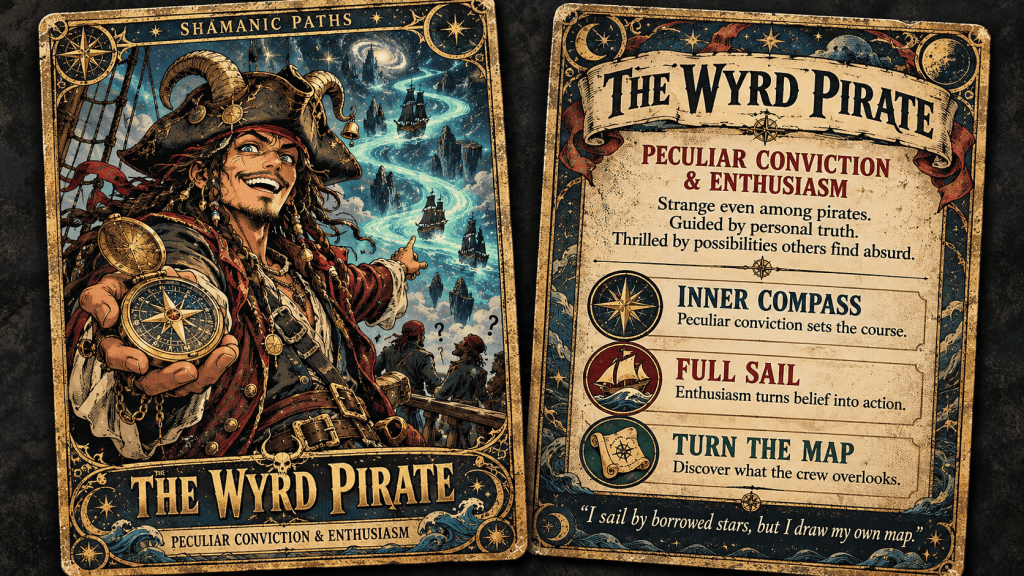
The Path of the Wyrd Pirate
Strange Wisdom Under a Familiar Flag
Wyrd Outlook by Grogh — Ghostwritten by Vikki Vexum
There are pirates. Then there is the pirate who makes the other pirates wonder what the hell he is doing.
He may look foolish while recognizing something everyone else has missed. His priorities seem ridiculous until the moment they become the reason anyone gets through. Even among a colorful crew, he is the strange one.
As I have reflected on my path, I have come across different terms that help explain it. So far, the Sacred Clown has been the closest fit. I have also explored the Primal Jester, another way of approaching something I recognize in my own experience.
Then came an epiphany: the Wyrd Pirate.
The strange one even among pirates. The clown of the pirate crew, whose peculiar wisdom turns familiar assumptions about treasure, freedom, and success on their ear. I could see a resemblance to the Sacred Clown within the pirate archetype—and, through that resemblance, a more personal way to explain my own path.
For me, this is part of the purpose of a shamanic path: inner reflection and the discovery of personal truth. The language grows through that encounter. Sometimes it complements a name someone else has used; sometimes it takes a shape of its own. Here, a familiar figure gives me a way to articulate something I am coming to understand more clearly.
When the story walks into the street
Consider Monkey D. Luffy, created by Eiichiro Oda for One Piece. My reading of Luffy is that his absurdity and his conviction belong together. His freedom means something because of the people and promises he will put himself on the line for.

That reading has company beyond the fandom. Reuters reported in August 2025 that Indonesian artists, students, and activists were displaying the Straw Hat pirate flag to express discontent with their government. A fictional emblem had become a public political signal.

The interesting movement is from imagination into action. People could reach for a familiar flag to communicate something serious.
Fiction can become part of our shared symbolic vocabulary. The skull puts on a straw hat, and suddenly a government has opinions about the wardrobe.
Captain Jack Sparrow offers another version. Across Pirates of the Caribbean, he repeatedly loses possession of the things that supposedly make a captain: command, crew, ship. Yet the Black Pearl remains central to his pursuit of freedom. I read his character as someone whose apparently chaotic behavior often conceals a purpose other people underestimate.

Luffy and Sparrow are different characters with different ethics. What interests me is their shared capacity to make peculiar conviction move the plot.
They are strange even among pirates—and the strangeness does work.
The family member who turns the picture upside down
A family develops a way of seeing. Certain habits become normal through repetition. Certain people become authorities. Eventually, “we have always done it this way” starts passing for an explanation.
Then someone asks the question that spoils the comfortable story.
In the modern archetypal sense I am using here, that person can perform the sacred clown’s work: making a familiar arrangement strange enough to examine. The family may value keeping appearances; the inconvenient relative asks what those appearances cost. The family may reward obedience; the fool asks whether obedience has been mistaken for love.
I found contemporary spiritual writing extending this idea into family life. I did not find sound evidence for a traditional rule that every family must contain a sacred clown. My claim is more personal: a family needs room for the person who makes its certainties answer questions.

There is support for the wider connection. In his essay on the trickster and sacred clown, Robert Animikii Horton describes sacred clowning as a challenge to customs and institutions that have hardened into unquestioned authority. He presents perspective as its gift. That is a contemporary interpretation, and it helps articulate the function I recognize.

The Oscar Howe Project in Rapid City gives a culturally specific example: heyoka dancers use deliberate contrary behavior, such as acting cold in heat. Its account explains how observers consider the intention behind the reversal and reflect on their own conduct. Sacred clown traditions have their own communities and ceremonial meanings; the family comparison is my application of a resonant idea.
For my practice, the test is whether the reversal helps us see. Opposition alone does not make someone truthful, and the person holding the mirror must be willing to look into it.
The Wyrd Pirate is the sacred clown of the pirate family.
Other pirates have conventions, too. Wealth. Reputation. Command. Victory. Even outlaws can become obedient to an inherited idea of success.
The Wyrd Pirate asks what the entire crew has forgotten to question.
Loki brings the argument to the gods’ table
Loki gives this family resemblance a mythic scale.
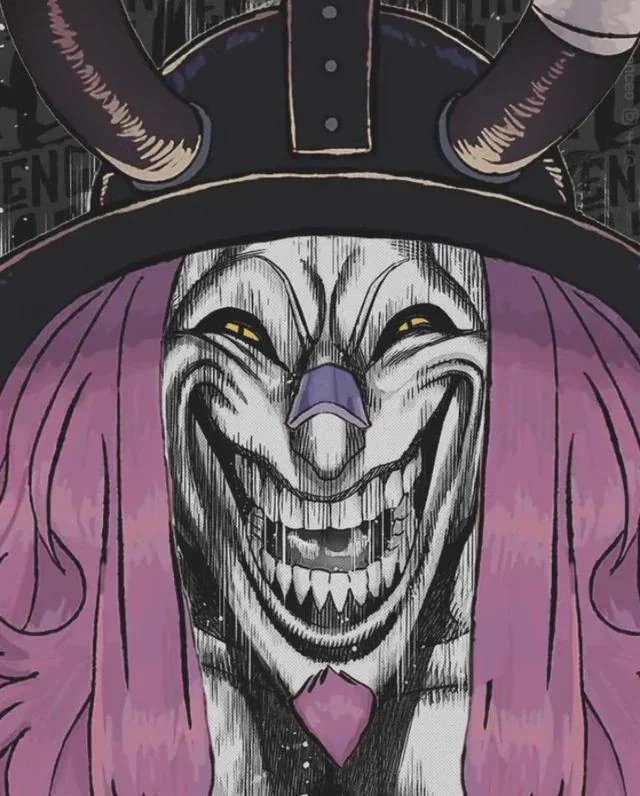
In Lokasenna, translated by Henry Adams Bellows, Loki enters the gods’ feast and confronts them with accusations about their conduct. In stanza twenty-two, he challenges Odin’s distribution of victory: the winners, he argues, do not always deserve their rewards.
That is a sharp question for any family, pantheon, or pirate crew: does possessing the prize prove that you deserved it?
Stanza nine recalls Loki and Odin mixing their blood and a promise to share drink. That oath supplies a firmer foundation for their bond than treating Loki simply as Odin’s adopted son. Even this older translation has complications: Bellows renders stanza sixteen with adoption language and explains it in a note. The familial picture deserves more care than a single modern family tree allows.
For this article, what matters is Loki’s place close enough to the gods to know their stories, yet troublesome enough to interrupt their telling.
I read a sacred clown resemblance in that role. “Sacred clown” is my comparative description here, rather than an office the poem assigns him.
Loki also keeps the comparison honest. The poem’s framing includes his killing of a servant; his speech mixes challenges with cruelty and provocation. He cannot simply be polished into a kindly family counselor. The capacity to expose a contradiction and the wisdom to heal it are different achievements.
What I take into my own practice is the question at the feast: when the powerful describe themselves as worthy, who gets to examine the evidence?
When a pirate questions the price of everything
This is where Luffy becomes more than an entertaining example.
My reading of One Piece is that Luffy repeatedly judges people through dreams, loyalties, and actions that their public standing cannot adequately measure. A person’s treatment as disposable does not settle their worth. A powerful person’s title does not settle their right to command.
Luffy still seeks treasure and the title of Pirate King. The reversal is in what the pursuit means and what he refuses to sacrifice along the way. For a concrete reference, his conversation with Rayleigh in manga chapter five hundred and seven, collected in Volume Fifty-Two, frames his ambition in terms of freedom rather than conquest. The official VIZ series page provides the publisher’s entry point.
That is the Wyrd Pirate’s challenge to the pirate family: what if your account of wealth has left out the thing that makes life worth having?
Captain Jack Sparrow supplies a different angle. Disney describes him as an irreverent trickster. In The Curse of the Black Pearl, his conversation with Elizabeth about the Pearl places the ship’s meaning in freedom. Its material parts cannot fully explain what it is worth to him.
I take that scene as a reversal of the price tag. The same ship can be timber and sails, a marketable possession, a seat of command, or the possibility of an unconfined life.
These characters do not need identical morals to illuminate the same question. What do you see when someone else says “treasure”?
The Wyrd Pirate questions the scales on which the treasure is weighed.
History had peculiar captains, too
Historical pirates could be violent predators. Any spiritual use I make of the image has to choose its values consciously.
Yet piracy also supplies examples of people arranging authority differently. In There Never Was a West, anthropologist David Graeber discusses eighteenth-century pirate crews that elected captains and could remove them. He also describes Black Sam Bellamy’s multinational crew.
For this article, the useful parallel is that a crew could question command and organize an alternative. Rebellion acquired procedures.
The historical analogy is limited, but useful: a crew can reject one authority while creating another. The freedom to choose a captain still leaves the question of what makes a captain worthy.
As above, so below—and back aboard
This is where I bring the constellation home.
“As above, so below” is my way of moving between inner meaning and outward experience. I can ask what a story reveals about my own habits, then ask what my behavior contributes to the world.
The treasure becomes what I consider worth seeking—and the shared assumptions about value I am willing to examine. The map becomes the explanations I have inherited. The crew becomes the relationships through which freedom has to coexist with responsibility.
Even the spelling carries a second current. Wyrd comes from Old English language for fate or destiny. My use folds that older association into modern weirdness: the strange course through which a life takes shape.
That makes the name useful aboard Ghostship Groggy. Captain Loki Groggy can return to a ship without his crew and still have a captain’s work ahead of him. The missing crew, the silent ship, and the mystery of Frank Frankly demand investigation. His title has to become action.
What does he notice? What does he owe? What will he recognize as treasure when everyone else sees wreckage?
Those questions give the philosophy somewhere to live.
A personal truth coming into focus
I can describe this as a personal modern shamanic path: a practice of engaging symbols, spiritual experience, humor, and the everyday world in search of understanding.
The connections here are resonances I am bringing together. I am naming a contemporary practice, rather than uncovering a documented lineage joining sacred clown ceremonies, historical pirates, and anime.
That is what I mean by recognizing it retroactively. The path was already unfolding through experience and reflection. The epiphany of the Wyrd Pirate gave me language that brings more of it into focus. Now I can examine where that language fits, where it falls short, and what it helps me discover next.
This is mechanical lore in my sense: a small idea that makes other ideas work together. The Wyrd Pirate can connect a laugh to a question, a question to a choice, and a choice to an adventure.
The flag is already familiar. My task is to decide what I will sail for—and remain willing to question my own valuation.
The Wyrd Pirate brings that question to his own crew first.
What have we learned to prize?
Who benefits from that measure?
What living thing have we mistaken for cargo?
I sail by borrowed stars, but I draw my own map.
And if you are considering your own voyage: what treasure have you been taught to overlook—and what would you actually do to seek it?

