Wyrd Outlook by Grogh — Ghostwritten by Vikki Vexum
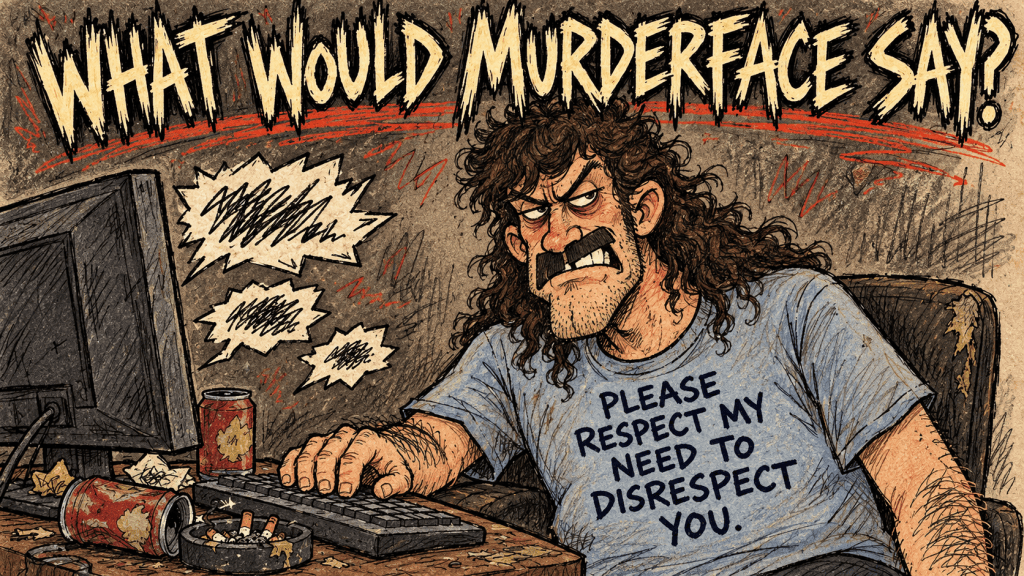
What Would Murderface Say About Online Trolling?
As Above, So Below: Dethklok’s Guide to Being a Dick
Some people log on to share something. Some log on to make something. And some log on because somebody, somewhere, is enjoying their afternoon without permission.
For that last category, we consult William Murderface: Dethklok bassist, aspiring nuisance, and a man who treats interpersonal sabotage like a skilled trade.
In Metalocalypse’s “Dethlessons,” Season 2, Episode 2, Murderface explains his technique:
> “You notice how I’m not mad. He gets mad. That’s being a dick.”
That is dialogue from his lesson in provocation, transcribed here. It is not a verified speech about Internet trolling. Applying it to the comment section is our experiment.
Unfortunately, the experiment already has volunteers.
Corey Taylor: When Attention Becomes a Debt
In January 2020, Loudwire reported on Corey Taylor’s remarks to The Irish Times. The Slipknot and Stone Sour singer described stepping away from social media and handing promotional duties to someone else.
> “When you don’t give them attention, they turn on you.”
He described people using different accounts when they did not receive the response they wanted.
Back to Murderface. His trick depends on recruiting somebody else into an emotional performance. He supplies the irritation; they supply the reaction.
Online, that can become an ugly little contract you never signed: answer me, defend yourself, prove you’re upset. Refusing the invitation can bring another knock at the door.
You thought you posted a song. Someone else thought you opened an emotional customer-service department.
The Captain’s Verdict: “Bitch Made”
The Captain’s own phrase for manipulating people into anger is “bitch made.”
The charge is cowardice: dragging things out, wearing people down, and hovering over negativity because getting a reaction is easier than making something worth sharing.
There is a difference between having a harsh opinion and needing somebody else to suffer through your opinion until you feel satisfied.
You can dislike the record. Explain why. You can challenge an argument. Bring something that improves it. But if every answer becomes another excuse to needle the person answering, eventually the subject has left the building. The reaction is what you came for.
That is where the Captain plants the flag.
His suspicion is that some people learn this behavior in homes where manipulation and conflict are ordinary. That may describe some histories, but a comment thread cannot establish what somebody’s parents were like. Nor does complex trauma automatically make someone cruel. Plenty of hurt people spend enormous effort refusing to pass their hurt along.
We can judge the conduct without inventing the family biography.
And the conduct deserves scrutiny: what are you getting from this exchange, and why does the other person have to feel worse for you to feel better?
Richie Faulkner: Somebody Was Trying to Make Something
There is an actual creative exchange on the other side of the screen.
In July 2020, Guitar World covered Judas Priest guitarist Richie Faulkner’s frustration with online trolling. He had been posting riff challenges for fans. He also alleged that someone tried to copyright one of his original riffs.
His concern extended beyond personal annoyance:
> “It’s about ruining the experience for the rest of you maniacs that actually like to hang out, dig PRIEST and learn stuff.”
That warning belongs beside Murderface’s little lesson.
One person brings a riff. Others bring curiosity, practice, enthusiasm. Then somebody arrives determined to make the exchange exhausting.
The cost spreads. The artist becomes less available. The willing participants get less access. A room built around music becomes a room managing one person’s behavior.
Murderface would recognize the mechanism. The people who came to learn guitar get stuck paying for it.
Rob Halford: The Internet Has an Amplifier
In a 2024 Classic Rock interview published by Louder, Judas Priest singer Rob Halford discussed the online concerns behind “Panic Attack.”
> “The internet is brilliant, but it has created some terrible things.”
He spoke about destructive language, conspiracy and bullying.
As above, so below: a cartoon bassist needles the people around him; real musicians describe the consequences when provocation reaches their audiences and working lives.
The screen gives the behavior reach. The human cost still lands somewhere.
Being Hurt Is Not an Achievement
There is another wrinkle. Kerrang! reported in 2019 on Corey Taylor describing his own compulsive social-media use, following a discussion on the Let There Be Talk podcast.
> “It’s compulsion, gratification, compulsion, gratification. It’s just a constant cycle.”
He was discussing his own experience, not diagnosing trolls. His account does, however, complicate the easy picture of strong people outside the screen and broken people inside it. A productive musician can get caught in an unhealthy pattern too.
The useful distinction is what we practice and what we reward.
Write something. Learn the riff. Make the ridiculous pirate story. Build a little place where people want to return. There are satisfying things to do that leave something behind besides another person’s ruined afternoon.
Murderface’s rule makes anger the score. Once you recognize that game, you can decide whether the conversation deserves another minute.
Correct a claim when it matters. Keep room for sincere disagreement. Close the door when someone keeps using your hospitality to kick the furniture.
Captain’s Edition: The Last Word
After all that explaining, the Captain has a limit on how much effort the behavior deserves. His personal verdict:
> So in our lives, we don’t always have to explain away people’s behavior and be nice about it. Sometimes, if they’re being a bitch, they’re simply bitch made. And/or they look like it.
>
> The behavior looks like manipulation is normalized. That’s bitch made of some variety to me. And depending on the level, they are really shouting that their mom is like Cartman’s mom—one of the biggest bitches in the whole wide world.
As above, so below. Leave the comment-section throne to Murderface.

