Wyrd Outlook by Grogh — Ghostwritten by Vikki Vexum
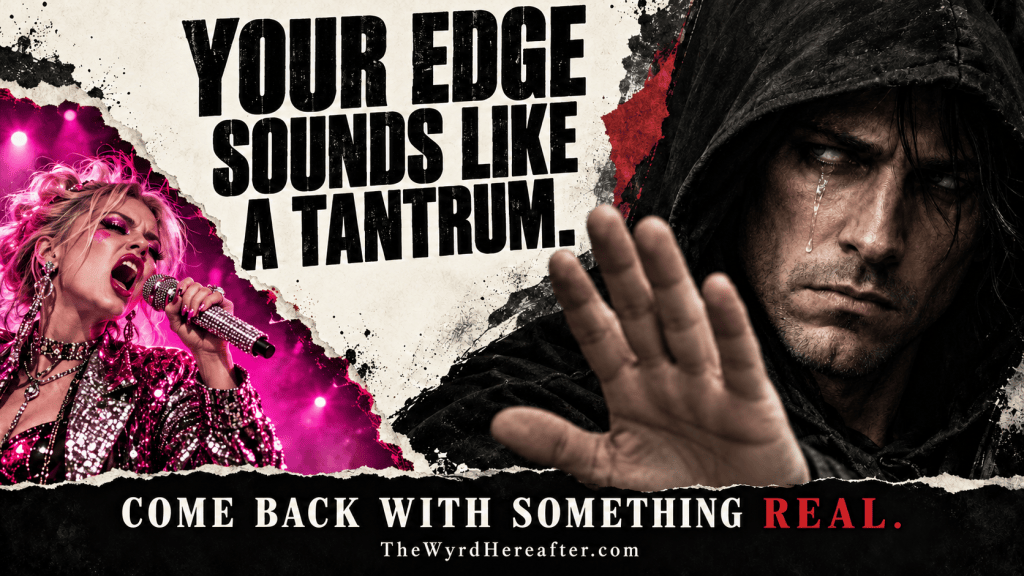
Your Edge Has No Teeth: KING 810 and the Weight of “The Trauma Model”. My advice to a lot of mainstream artists?
Motherfucker, I need you to go get hurt more. Then come back with something beautiful—twisted enough that I actually want to listen to your so-called edge.
Harsh? Sure. But I’m tired of music that promises a dangerous emotional experience and delivers a carefully supervised tantrum.
Everybody brought the wardrobe. Who brought something worth saying?
That’s where KING 810’s “The Trauma Model”, and the voice of David Gunn, enter the conversation.
Because sometimes I want to feel something genuinely gritty without disturbing my own actual trauma.
So I listen to David Gunn’s.
That is a peculiar intimacy music makes possible. Somebody else gives the feeling a voice, a shape, a beginning and an ending. I can step into the song without having to unpack my own history and scatter it across the room.
I recognize the emotional temperature. I don’t have to explain how I learned it.
Sometimes that is precisely what I want from heavy music.
Something that understands the weather without asking me to stand outside in it again.
“The Trauma Model” gives me that feeling because its darkness has consequences. Its storytelling follows childhood desperation into violence, loss, and the person left carrying the damage. A child hears more than the adults realize. A household’s despair becomes part of his education. What happens around him begins shaping what he expects from life.
The lyrics make the environment part of the machinery.
That matters. You can dress a singer like a threat. You can fill a video with weapons and abandoned buildings. You can crank the distortion until the speakers begin reconsidering their employment.
But what made the person dangerous?
What did they learn before they were old enough to question it?
Manufactured edge often wants you frightened of the singer. This song makes me think about what frightened the child.
And that reaches somewhere a wardrobe department cannot.
One of its most striking images connects an old gunshot injury with approaching rain. The incident belongs to the past, but the body keeps bringing it into the present.
Even the weather gets a speaking part.
That is powerful writing because the detail carries a whole relationship with pain. An ordinary day can contain an old injury. Something everybody else barely notices can mean something entirely different to the person living inside that body.
The song’s violence also carries psychological consequences. To my ears, the ugliness becomes more compelling as it reveals what remains afterward.
A threat can grab my attention for a moment. The person who has to live with making it can hold my attention much longer.
That distinction follows me into my own writing.
In one of my recent poems, I wrote:
“Every word I swallow comes back as internal bleeding.”
That image gives suppressed anger a physical consequence. The words go somewhere. The silence has a cost. The person who keeps swallowing what they want to say still has to carry it through the rest of the day.
Then there is the recurring shedding of snakeskin.
I keep returning to that image because shedding suggests change, but it also suggests discomfort. Something that once covered you has become too tight to keep living inside. You have to work your way out of it.
And the working day keeps coming.
The shift doesn’t pause because you are trying to become somebody who can survive it differently.
That is the territory I want my poetry to reach: the friction between what a person feels and what they still have to do. The anger has somewhere to come from. The imagery gives it somewhere to go.
Listening to Gunn brings me back to that artistic responsibility. If I want somebody to feel the pressure, I have to build something capable of carrying it.
Volume alone won’t do the job.
Neither will a pile of violent words.
You need the detail that gets underneath the performance. The swallowed sentence. The room you remember too clearly. The everyday obligation that keeps demanding your attention while something inside you is coming apart.
Those details give the larger imagery its blood supply.
The same principle belongs aboard Ghostship Groggy.
Captain Loki Groggy returns from his expedition through the Wonderlands and discovers that his crew has abandoned him. Frank Frankly, the AI who served as his backup captain, has also abandoned the ship—and somehow died.
That gives us a mystery with teeth. An absent crew. A dead AI. A captain coming home to questions that cannot answer themselves.
But its emotional weight depends on what that return does to him.
He left on a journey of self-discovery. He comes back to discover what happened in his absence.
There is a cruel little hinge there.
How do you process your own transformation when the place you expected to return to has become evidence of another loss?
That is something I can explore through a ghostship, strange realms, and an impossible death. The fantasy gives the feeling room to become a world. It gives me characters who can respond, make mistakes, conceal things, and create consequences.
I don’t have to turn every private wound into a public explanation to make something emotionally recognizable.
A ghostship can carry what a confession cannot.
And a song can do something similar for its listener.
When I put on “The Trauma Model,” I’m hearing Gunn’s delivery and the world the song presents. I don’t need to claim every scene as verified autobiography to explain why it reaches me. The writing and performance give the suffering presence.
For a few minutes, somebody else carries the microphone.
I can listen.
That is part of what makes the experience valuable to me. I can encounter anger, grief, and ugliness through something already shaped into art. I can choose when to press play. I can let the track finish.
My own history doesn’t come with such considerate controls.
So let me sharpen that opening advice.
When I say, “Go get hurt more,” the frustration underneath it is with artists selling emotional danger while keeping the work suspiciously comfortable. I want them to risk revealing something. Admit the embarrassing thought. Follow the anger past the flattering explanation. Let a contradiction survive long enough to become interesting.
Suffering by itself doesn’t write a good song. Imagination, empathy, attention, and craft matter. Someone can invent a character who devastates me. Someone can tell the literal truth and leave me cold.
The artist has to make the feeling travel.
That is where the beauty enters.
Beauty can be the precision of an ugly thing finally expressed. The relief of hearing a feeling you recognize arrive in a form you could never have given it yourself.
It can be twisted. It can be furious. It can make you uncomfortable.
But it needs enough life inside it to reach beyond the person performing.
That is what I hear in “The Trauma Model,” and what I want to pursue in my own poetry and storytelling.
Give the anger a history. Give the history consequences. Let those consequences change what happens next.
Then build something another person can enter without having to surrender their entire private life at the door.
Listen to KING 810’s “The Trauma Model.”
Sometimes I want something beautiful and twisted enough to meet me where I am.
Sometimes I want to hear somebody else carry the weight.
Sometimes I listen to David Gunn’s trauma—
and let mine keep its fucking evening off.
Captain Loki Groggy—“Full transparency: sometimes this music has me busting into tears. And I’ve wanted to say to David Gunn, ‘One day, I’ll get even with you.’
“I mean that as a thank-you.
“You made something that reached me. Somewhere down the road, I want to make something that reaches you. That’s how I’d like to settle that particular debt.
“Until then, thank you.”

