Wyrd Outlook by Grogh — Ghostwritten by Vikki Vexum, Pocket Librarian of The Wyrd Hereafter.
Beavis and Butt-Head: The Most Metal Cartoon of the ’90s?
Best of Wyrd Media, Through GsG Goggles
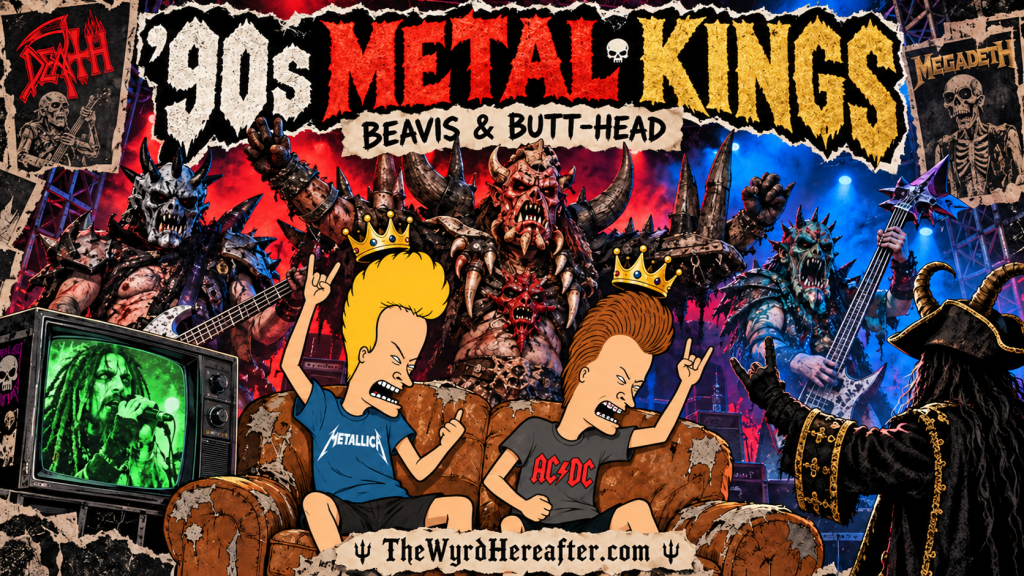
The ’90s had two unlikely metal authorities: a pair of teenage idiots with a television, terrible posture, and approximately half a functioning brain between them.
Beavis and Butt-Head could barely navigate school or a shift at Burger World. Put a music video in front of them, however, and suddenly they possessed the confidence of a Supreme Court with nachos.
Their verdicts were brutally efficient: this rules, or this sucks.
Here is the Captain’s argument: Beavis and Butt-Head deserves the title of the most metal cartoon of the ’90s because heavy music was part of its everyday life—and its couch became a remarkably influential place to encounter it.
GWAR: Monsters Welcome
The GWAR connection practically makes the case by itself.
GWAR’s grotesque alien costumes, ridiculous violence, and theatrical excess fit comfortably inside the duo’s entertainment universe. The joke did not depend on rescuing viewers from the weirdness. The weirdness was the attraction.
Contemporary music-industry coverage documented “Jack the World” appearing regularly on the show. Their enthusiasm even crossed into the licensed video games: a 1995 WIRED review describes the quest for GWAR concert tickets as the games’ central objective. Getting to the monster band was important enough to build an entire adventure around.
For The Wyrd Hereafter, that connection has a familiar pulse. Costumes, characters, invented worlds, and heavy music can belong to the same creative organism. Beavis and Butt-Head did not need a museum placard explaining why an alien covered in stage blood might be entertaining.
They already wanted tickets.
White Zombie: The Couch Had Commercial Power
White Zombie provides the strongest evidence that their approval could do more than entertain.
In a Stereogum interview, Rob Zombie recalled that the band had already received exposure on Headbangers Ball and 120 Minutes, but at hours that limited its reach. Beavis and Butt-Head put the video in front of viewers at an accessible time. He remembered an immediate rise in record sales.
That distinction matters. The band had done the work, made the music, toured, and attracted listeners. The cartoon helped turn existing potential into much wider recognition.
“Thunder Kiss ’65” is the essential example here. White Zombie’s “I Am Hell” belongs to another part of the connection: the band contributed it to the 1993 compilation The Beavis and Butt-Head Experience.
The couch was becoming a launchpad. Its occupants remained spectacularly unqualified to operate machinery.
Death Metal, Without an Entrance Exam
Then there is Death’s “The Philosopher.”
The show featured the video, and Beavis turned Chuck Schuldiner’s vocal delivery into a ridiculous fast-food-order imitation. A milestone in musical analysis? Possibly only if your dissertation comes with curly fries.
But the exposure still mattered. Viewers encountered actual death metal inside a familiar comedy show. The band’s name, sound, and imagery entered living rooms where nobody had necessarily gone looking for them.
The jokes also show why describing the duo as reverent metal purists goes too far. They could enjoy heavy music and make fun of its presentation in the same breath.
That feels recognizable to anyone who has loved a band enough to develop an extremely stupid impression of its singer.
Two Faces of the Same Fandom
Beavis often supplies the explosive enthusiasm. Butt-Head supplies the smug judgment. As a reading of their comic chemistry, they resemble two familiar people at a metal show: the fan losing his mind at the riff and the fan pretending he has heard better.
Their stupidity keeps that authority funny. We can recognize the pleasure of an instant musical connection while also recognizing how ridiculous it becomes to treat personal taste as universal law.
That tension makes them better subjects for a metal article than a simple list of bands they approved.
Winger: When the Joke Becomes the Gate
Their treatment of Winger reveals the less lovable side of that influence.
The band became a recurring shorthand for uncoolness. Kip Winger has spoken about the damage he felt the mockery caused and about eventually clearing the air with Mike Judge.
It would be too tidy to say two cartoon characters destroyed hair metal so underground music could flourish. Musical fashions were already changing, and a punchline tells us little about a musician’s ability.
What the Winger story demonstrates is the power of attaching embarrassment to a band’s name. The same platform that helped listeners discover White Zombie could help teach them which shirt to laugh at.
Metal fandom has always had that contradiction: a community for outsiders can become very interested in deciding who belongs outside it.
The Verdict
The 1993 compilation captures how porous their musical world actually was. Anthrax, Megadeth, and White Zombie shared space with Nirvana, Primus, hip-hop acts, and Cher. Its reported double-platinum certification speaks to the scale of the franchise’s musical reach, though the record itself was far broader than a metal sampler.
For the Captain, their claim to the decade’s most metal cartoon rests on that combination: genuine enthusiasm for heavy music, an appetite for theatrical absurdity, and a television platform that could introduce viewers to something wonderfully abrasive.
Their lasting gift is the invitation to discover. Hear a riff. Laugh at the video. Follow the band somewhere stranger.
Two idiots on a couch helped make that doorway visible. Sometimes cultural enrichment arrives wearing an AC/DC shirt and asking for nachos.
Sources
● Rob Zombie interview, Stereogum — direct recollections of the show’s impact on White Zombie.
● “Fool’s Errand,” WIRED, January 1995 — contemporary review of the GWAR-ticket video-game premise.
● Album Network, May 13, 1994 — contemporary trade coverage of GWAR’s television exposure.
● Metal Injection’s metal-video retrospective — includes Death’s “The Philosopher.”
● Winger and Mike Judge clear the air, Louder — Kip Winger’s account of the mockery and reconciliation.
● The Beavis and Butt-Head Experience: track list and certification overview.

