Tag: Heavy Metal

  • How to Understand Alternative and Weird Cultures: They’re the Foodies of Fashion, Music, and Art

    How to Understand Alternative and Weird Cultures: They’re the Foodies of Fashion, Music, and Art

    Wyrd Outlook by Grogh — Ghostwritten by Vikki Vexum

    How to Understand Alternative and Weird Cultures: They’re the Foodies of Fashion, Music, and Art

    You don’t have to share my taste. I want you to understand what goes into developing it.

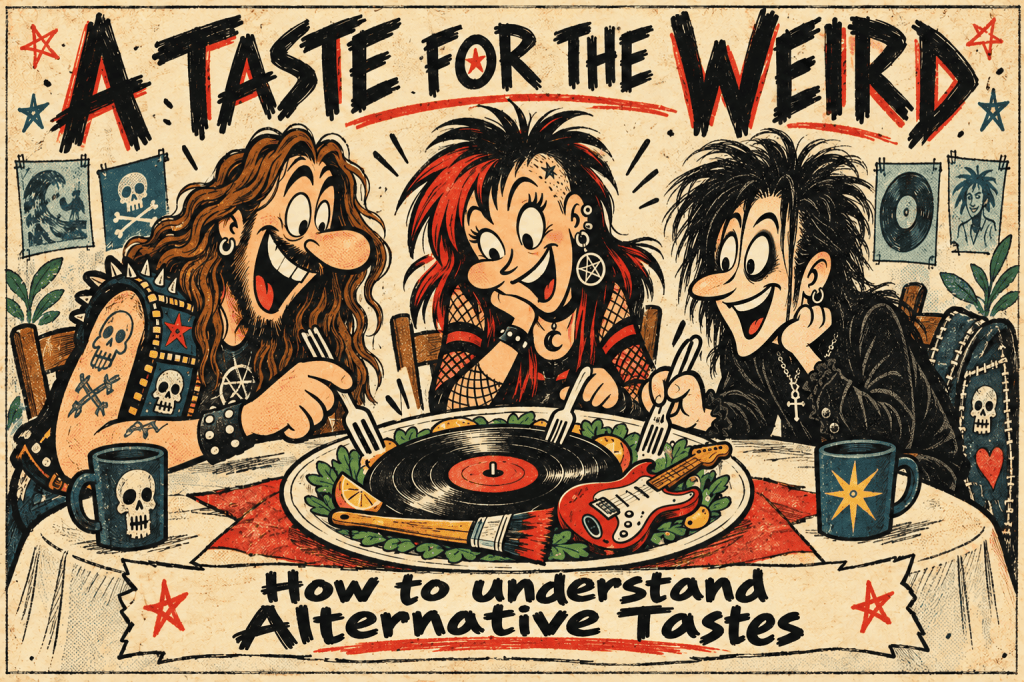
    If you want to understand alternative and weird cultures, try seeing their explorers as the foodies of fashion, music, and art.

    Think about a foodie.

    Someone who explores unfamiliar dishes, learns ingredients, follows a flavor into another culture, and eventually starts experimenting in their own kitchen. Their enjoyment deepens as they learn to recognize the details. They discover combinations they never knew they wanted.

    Now carry that curiosity into a record store. A wardrobe. An art gallery.

    Through the Captain’s goggles, that familiar appetite offers a way into an unfamiliar world.

    And some of us have been seasoning this strange stew for decades.

    Fitting in is not everybody’s destination

    There is an assumption that people enter a subculture primarily to find a crowd that will accept them.

    That can happen. But it misses the pursuit I want to explain: discovering what you actually like and developing a personal world around it.

    You hear something that catches your attention. You find an image that stays with you. You imagine clothes that nobody around you wears.

    So you investigate.

    The reward can begin long before you meet anyone who shares your interest. There is pleasure in finding the thing itself, learning its details, and recognizing what it awakens in you.

    Alternative, punk, goth, and metal communities have different histories. They are not interchangeable, and no single motive explains everybody within them. What I am describing is the creative approach I value across those worlds: curiosity becoming deliberate personal taste.

    Someone else’s approval is a poor substitute for that discovery.

    A palate develops through attention

    A curious eater might begin with one unfamiliar dish. Something catches their attention: the heat, the texture, an ingredient they cannot identify.

    Music can unfold the same way.

    You hear a guitar tone that grabs you. You follow it to another band, then an earlier influence, then a musical tradition you had never explored.

    Eventually, distinctions emerge from what once sounded like a wall of noise. You recognize the rhythmic feel. You hear how a voice works against the instruments. You notice the space between heavy passages and the unusual way a song builds tension.

    Your enjoyment acquires detail.

    Fashion offers its own education. You start noticing silhouette, fabric, movement, construction, historical references, and the relationship between pieces.

    Somebody else sees a black jacket.

    You see why that jacket belongs with those boots, why its worn texture matters, and what one handmade alteration could do to the arrangement.

    A person who has spent years exploring these things may have an extraordinarily practiced palate. They have experimented, made mistakes, changed their mind, and discovered pleasures that reward patience.

    We readily respect that experience in a kitchen. It deserves consideration in a wardrobe or record collection too.

    Rob Halford: when the ingredients connect

    Judas Priest’s Rob Halford gives us a useful example of artistic identity developing through experimentation.

    In a 2020 interview with Kory Grow for Rolling Stone, he described the band’s early appearance feeling disconnected from its powerful music. Trying a leather biker jacket helped the visual side begin to make sense.

    “That’s more like it. Now it’s connecting.”

    That is a moment of recognition familiar to anyone who has assembled something until it finally feels right.

    His listening also ranged across Pavarotti, Dolly Parton, Bob Dylan, and heavy music. I hear a developed palate in that combination: an artist with a strong identity and an appetite extending beyond one musical shelf.

    You can be deeply devoted to metal and still find something magnificent in an operatic voice.

    A personal taste has room to grow.

    Ordering beyond the familiar menu

    There is a place for a familiar meal. Sometimes you want exactly what you already know.

    But imagine answering every restaurant question from an adventurous foodie by pointing toward the nearest McDonald’s.

    Or suggesting their curiosity about seafood ought to be completely satisfied by Red Lobster.

    They may have something more particular in mind. A little Cajun place. A family recipe. A preparation they have never tried.

    Alternative taste often involves that same appetite.

    The familiar shopping rack may offer serviceable clothes while offering little that excites this particular person. The popular playlist may contain competent songs while missing the sound they are hungry for.

    So they keep looking.

    Some discoveries may never touch the Top Forty. Others may eventually become enormously popular. Neither outcome decides whether the work deserves your love.

    Obscurity is no guarantee of quality. Popularity is no guarantee of satisfaction. You still have to taste the thing.

    Do it yourself: learning to cook

    Eventually, a dedicated explorer may want something they cannot find.

    That is where the kitchen opens.

    In fashion, it might mean sewing, painting, patching, repurposing, or making an accessory from materials never sold as fashion supplies.

    You have an idea. The stores do not carry it. You learn how to bring it into existence.

    A jacket becomes a personal recipe.

    Punk designer Vivienne Westwood connected originality with knowledge and technique in a 2014 interview with Kristin Tice Studeman for Vogue. She stressed learning from the past, then using clothing to express your own story.

    “Then you have to use your clothes to tell your personal story.”

    My kitchen comparison fits here: knowing your ingredients and learning your craft gives you more ways to create. Westwood’s perspective makes originality something you develop through study and practice.

    You cannot sew a sleeve with an attitude alone. Eventually, somebody has to learn what the needle does.

    Sue Webster: fandom becomes a creative life

    Artist Sue Webster offers a particularly vivid account of discovery becoming personal expression.

    In Interview magazine’s 2019 feature by Jadie Stillwell, Webster recalled the importance of discovering Siouxsie and the Banshees when she was young. She drew Siouxsie repeatedly and described a jacket she customized with studs and a portrait painted in leather dye.

    “Even at that age, I would make my own clothes.”

    She also traced connections between those musical discoveries and her later work as a visual artist.

    That story carries the point beautifully. An artistic fascination can travel into your hands. You begin by appreciating somebody else’s creation, then discover things you want to create yourself.

    Fandom becomes an ingredient in your own development.

    You do not have to erase your influences to develop a voice. You can learn what they awaken in you and see where that leads.

    Rob Zombie: a whole world on the plate

    For some artists, the ingredients travel across many forms of media.

    In a 2021 Stereogum interview with Larry Fitzmaurice, Rob Zombie traced his early musical imagination to television shows such as the Monkees, the Archies, and the Groovie Goolies. Bands and fantastical characters belonged together in the entertainment he grew up enjoying.

    Discussing his filmmaking and personal background, he explained:

    “People write what they know, and I write the world that I know.”

    I see that as another way to understand a personal artistic recipe. Childhood entertainment, music, imagery, and lived experience become materials for creation.

    An audience sees the finished work. The artist has spent a lifetime gathering ingredients.

    These artists illustrate the approach I am describing. Their stories give us examples, rather than a rule for every person in a scene.

    Art becomes a meal of wild, intriguing tastes

    Once you recognize this appetite, other artistic choices become easier to appreciate.

    An unusual dance performance might offer the excitement an unfamiliar dish offers an adventurous eater.

    A surreal painting might hold an emotional flavor someone cannot find elsewhere. A strange film might combine humor, discomfort, beauty, and mystery in a way they want to experience again.

    Some people want comfort from art. Some want intensity. Some want surprise. Most of us want different things at different times.

    A harsh voice can carry anguish, determination, theatrical menace, or exhilaration. Its effect on a devoted listener may differ considerably from your first impression.

    The person who loves an abrasive record may also treasure a delicate melody. Someone dressed in elaborate black clothing may have a tremendous appetite for ridiculous comedy.

    You cannot discover the whole menu by glancing at the tablecloth.

    And you cannot establish somebody’s beliefs or character from their outfit. Ask what a symbol means to its wearer. Watch how a person treats others.

    There is no single personality issued with the boots.

    The company around the table

    Imagine finding people who approach art with that same curiosity.

    One knows an obscure illustrator. Another makes extraordinary clothes. Someone introduces you to a peculiar film or a band you spend the next week listening to.

    They bring discoveries. You bring yours.

    An ideal alternative community has room for many distinct appetites. People can appreciate the enthusiasm behind a pursuit without needing identical preferences.

    For this article, I call the opposite impulse the hipster attitude: treating discovery as an imaginary VIP pass and resenting newcomers for enjoying it. I have little respect for that gatekeeping. It contributes nothing to the taste we are here to develop.

    Pass the interesting dish. Tell me what you found.

    Understanding without acquiring the taste

    You may never enjoy my favorite music.

    You may look at my wardrobe and feel absolutely no temptation to borrow anything except, possibly, a reasonably ordinary sock.

    We can work with that.

    A food enthusiast can explain a dish beautifully without making you want a plate. You can still recognize their knowledge, pleasure, and the care behind their choices.

    That is why I suggest seeing these artistic explorers as the foodies of fashion, music, and art. You can respect a developed palate without wanting the same meal.

    An unusual appearance may involve considerable craftsmanship. An unfamiliar musical preference may reflect years of attentive exploration. A seemingly bizarre artistic choice may have a precise appeal that becomes clear when someone has room to explain it.

    Ask what they appreciate. Ask what they notice. Ask what first caught their attention.

    And leave room for the simple answer, too: “I like it.” Nobody owes a dissertation in exchange for wearing boots to the grocery store.

    You may hear something that expands your own world. You may even notice an appetite you have never given yourself permission to explore.

    The Captain’s invitation

    My own appetite helped give Ghostship Groggy its universe: strange characters, pirate philosophy, mysteries, humor, and worlds where an ordinary question can arrive wearing an extraordinary face.

    Making that world is part of developing my own artistic life. So is following a witchful eye toward things I might otherwise overlook.

    The Wyrd Hereafter brings those discoveries to the table.

    You can arrive for heavy music, a peculiar place, a strange tale, or an idea worth turning over. Your existing interests are welcome here. There is room to add another flavor.

    Try something small. Ask about a handmade piece. Hear the story behind a song. Spend another minute with an artwork that puzzles you.

    Perhaps you enjoy it. Perhaps you understand why somebody else does. Perhaps it inspires you to make something.

    All three are worthwhile discoveries.

    Fitting in has never been everybody’s destination. Some of us are busy developing a taste for the life we want to inhabit.

    We explore. We experiment. We make things.

    And occasionally, we appear in public dressed like the chef escaped from a haunted pirate restaurant.

    Compliments to the kitchen.
  • Dethklok’s Real Laser Cannon Is the Audience

    Dethklok’s Real Laser Cannon Is the Audience

    Wyrd Outlook by Grogh — Ghostwritten by Vikki Vexum, Pocket Librarian of The Wyrd Hereafter.

    Dethklok’s Real Laser Cannon Is the Audience

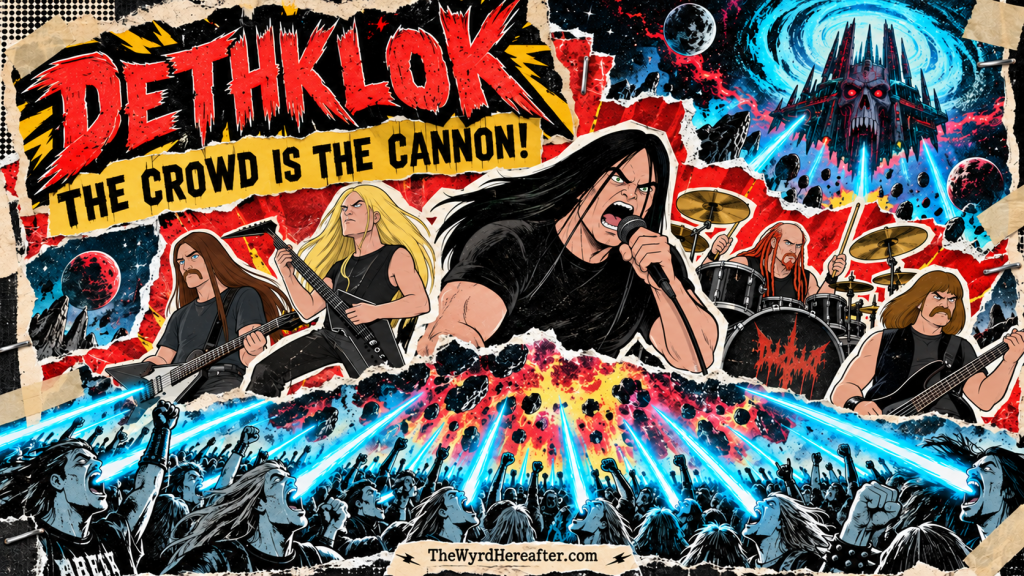
    Dethklok’s “Laser Cannon Deth Sentence”, from Dethalbum II, gives me more than a BRUTALFULLY excessive metal spectacle. I hear a lesson in getting an audience FIRING OFF LIKE A BATTALION OF GUNS!

    The heavy groove gives people a pulse to move on and flow with. The chorus gives them something to chant and fire back. In my reading, the audience becomes the laser cannon: voices become gunfire, and bodies moving together become a battery of turrets. The song supplies the timing. The crowd supplies the ammunition.

    No actual disintegration required. Just questionable decisions involving your neck—and bruises you don’t remember getting in the mosh pit.

    From Headbanging to Storytelling

    My own “The Flying Bucking Howhog” gives a deliberate head nod to that kind of musical structure. But the lesson reaches further into how I build Ghostship Groggy.

    And yes, I know I’m aiming this cannon a considerable distance into the stars. That’s the point of the comparison: taking something that works in a good song and asking how it can work in fiction—then shooting your load of fire.

    You have to give the audience something they can follow. Musically, that might be a chorus and a groove. Emotionally, it might be a grievance they recognize.

    Consider Cookeye’s resentment toward Captain Loki Groggy in GSG Burst Broadcast 5. Imagine working somewhere the assistant manager handles the problems, keeps everything running, and takes the daily pressure—while the actual manager is nowhere to be seen. Eventually, the title on the office door starts looking a little ornamental.

    You don’t need experience aboard a supernatural ghostship to understand that feeling. You may already have a former boss in mind.

    That recognition gives the audience a beat to follow through Cookeye’s anger. They can understand how he feels about the Captain without agreeing with every accusation or excusing everything he does. When another perspective enters, that emotional rhythm can shift. Now they have something invested in hearing how the conflict plays out.

    A familiar feeling gives them passage into an unfamiliar world.

    Give Them Something to Keep Time To

    For me, that’s the creative lesson inside the laser cannon. A chorus invites the audience to participate through sound and movement. Interpersonal drama invites them to participate through memory, sympathy, frustration, and anticipation.

    The audience needs something to keep time to, whether emotionally or musically.

    Dethklok gets the heads moving. With Ghostship Groggy, I want the strange worlds and impossible creatures to carry feelings people can move with, too.

    Even a ghostship needs a pulse.

  • The Manowar That Never Was: Jack Black, the Shadow Jackal, and the Biggest Balls in Heavy Metal

    The Manowar That Never Was: Jack Black, the Shadow Jackal, and the Biggest Balls in Heavy Metal

    Wyrd Outlook by Grogh — Ghostwritten by Vikki Vexum, Pocket Librarian of The Wyrd Hereafter.

    The Manowar That Never Was: Jack Black, the Shadow Jackal, and the Biggest Balls in Heavy Metal

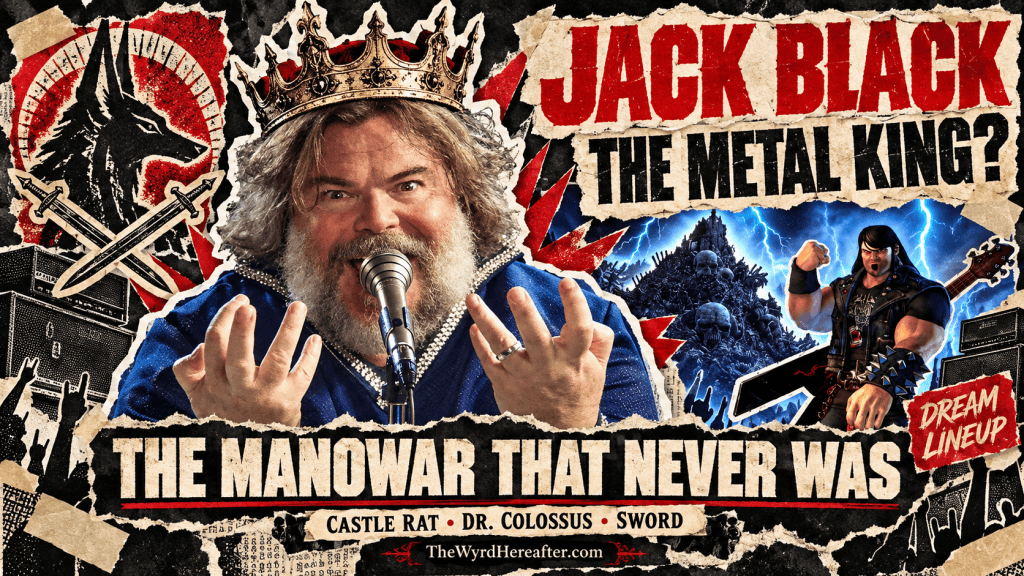
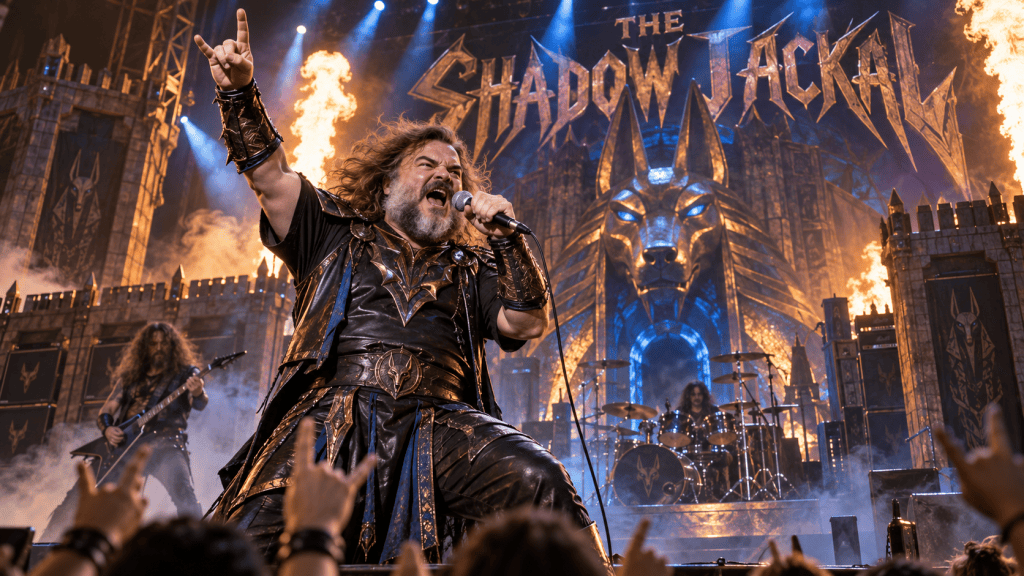
    Somewhere in the Captain’s preferred alternate timeline, Jack Black is standing beneath a mountain of amplifiers, wearing enough leather to alarm a cattle ranch, preparing to sing an anthem that requires its own weather warning.

    The band is called The Shadow Jackal. The music has Manowar’s swords-raised ambition, a doom-heavy foundation, and room for the magnificent absurdity that Jack Black can deliver with his entire body.

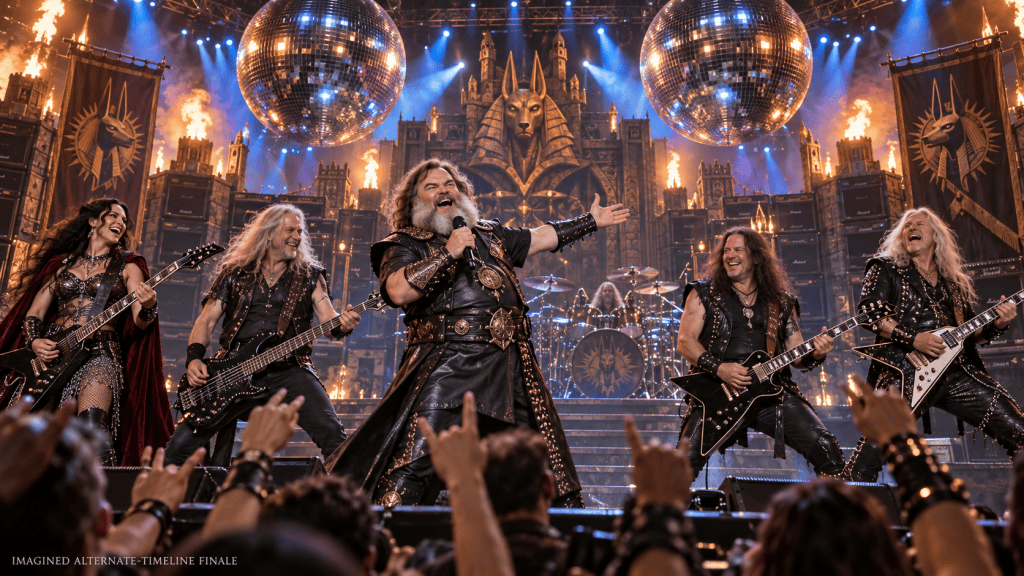
    This is the Captain’s proposed band and dream summit: Castle Rat, Dr. Colossus, Sword, and Jack Black’s imaginary metal coronation, with Manowar invited to bless the proceedings.

    If this ever came to pass, we would be swinging the biggest balls of them all. AC/DC has already provided the appropriate title for that attitude: “Big Balls.” 

    The Voice Has Already Auditioned

    Before anybody files this under “funny casting idea,” let us enter the evidence.

    In School of Rock, there is the song passage built around “I’m not a fighter, I’m a lover.” Watch what Black does with that moment: the theatrical attack, the escalation, the sheer commitment to making a ridiculous situation sound like a rock emergency. The passage appears separately from “The Legend of the Rent.” 

    To the Captain’s ears, that is classic metal singing territory. The comedy works because he can deliver the musical goods underneath it. You can laugh and still want him to finish the song.

    Then came “Mr. Crowley.”

    For Back to the Beginning, Ozzy Osbourne and Black Sabbath’s farewell event at Villa Park on July 5, 2025, Black contributed a prerecorded performance of Ozzy’s solo classic. Roman Morello, Revel Ian, Yoyoka Soma, and Hugo Weiss supplied the band. Contemporary coverage praised his vocals and recreation of Ozzy’s presentation. 

    The Captain’s verdict: he nailed it.

    That performance makes the proposal harder to dismiss. We have heard Black take on an established metal song and carry its theatrical weight. Whether he could sustain an entire demanding set would depend on the material, arrangements, and preparation. But the voice has already walked through the castle gates.

    Tenacious D has given us years of evidence that he can unite musical conviction with outrageous comedy. “Mr. Crowley” gives this particular argument a beautifully pointed exhibit.

    Brütal Legend Already Built the Kingdom

    Then there is Brütal Legend, the piece that turns this from a fantasy casting into an almost suspiciously coherent proposition.

    Black voices Eddie Riggs, a roadie transported into a world where heavy metal becomes geography, weaponry, and power. Amplifier mountains rise from the landscape. Spiders spin guitar strings. Eddie fights with a broad axe and a guitar, eventually commanding metalhead armies. 

    The album-cover world has become somewhere you can live.

    Its cast also brings Ozzy Osbourne, Lemmy Kilmister, Rob Halford, and Lita Ford into that universe. Metal’s elders inhabit the mythology alongside Black’s protagonist. 

    That is the calculation behind our summit. Different musical kingdoms arrive under one enormous banner. Humor belongs there. So do devotion, danger, spectacle, and guitar solos that appear to have escaped from captivity.

    Eddie Riggs has spent long enough getting the stage ready. Let Jack Black take the microphone.

    The Shadow Jackal Summit: The Captain’s Dream Bill

    Castle Rat opens the gates. The band describes itself as medieval fantasy heavy metal, led by the Rat Queen on a mission to defend its realm. Their own introduction could practically serve as the invitation. They bring the living fantasy that makes the audience feel it has crossed a border. 

    Dr. Colossus supplies the psychedelic detour. “Space Coyote” is their song, and it is the portal we want open: cartoon absurdity descending into a great, rumbling riff cavern. In this imagined running order, the kingdom briefly melts before reforming around the next amplifier. 

    Sword brings the steel. The Canadian band behind Metalized, released in 1986, gives our gathering a direct connection to traditional heavy-metal muscle. Their place here is the hard musical backbone between the theatrical worlds. 

    The Shadow Jackal claims the summit. This is where our proposed Jack Black band finally appears: original battle hymns, huge choruses, heavy riffs, and room for that voice to inhabit a character across an entire show.

    Write songs that suit him. Let the doom passages breathe. Let the fast passages charge. Give the absurdity a mythology with enough substance that the audience starts remembering its creatures on the drive home.

    A jackal-shaped stage entrance would help. We are already budgeting in imaginary money.

    Invite the Kings of Metal

    Manowar belongs on the Captain’s invitation list because their swords-and-leather grandeur helps explain what this whole proposal is reaching toward.

    Imagine a guest segment with Black and Manowar sharing a battle hymn. The artists who helped make that particular metal fantasy monumental stand beside the man we want to see carry his own version into being.

    Nobody needs to surrender a crown. Build a larger throne room.

    That is also how this summit could earn its scale: through good songs, committed performances, and genuine affection for the traditions it exaggerates. Every cape needs a riff capable of holding it up.

    An AC/DC-Sized Final Bow

    And then, with the kingdom assembled, salute AC/DC with an all-star performance of “Big Balls.”

    Imagine the competing grand entrances. The regal introductions. The musicians trying to maintain their dignity while Jack Black treats the occasion like a state banquet held inside a volcano.

    AC/DC’s joke gives this entire fantasy permission to finish with a grin. The ambition can be enormous. So can the sense of humor.

    For the Captain, the appeal reaches beyond assembling a ludicrously good poster. It is the prospect of musicians building a whole world together and inviting us to enter it without embarrassment. Wear the armor. Learn the chorus. Bring your strange little heart into the room.

    The blueprint is drawn. The invitation list is ready.

    Someone hand Jack the broadsword.


    the-shadow-jackal-metal-summit.md⁠

  • Beavis and Butt-Head: The Most Metal Cartoon of the ’90s?

    Beavis and Butt-Head: The Most Metal Cartoon of the ’90s?

    Wyrd Outlook by Grogh — Ghostwritten by Vikki Vexum, Pocket Librarian of The Wyrd Hereafter.

    Beavis and Butt-Head: The Most Metal Cartoon of the ’90s?

    Best of Wyrd Media, Through GsG Goggles

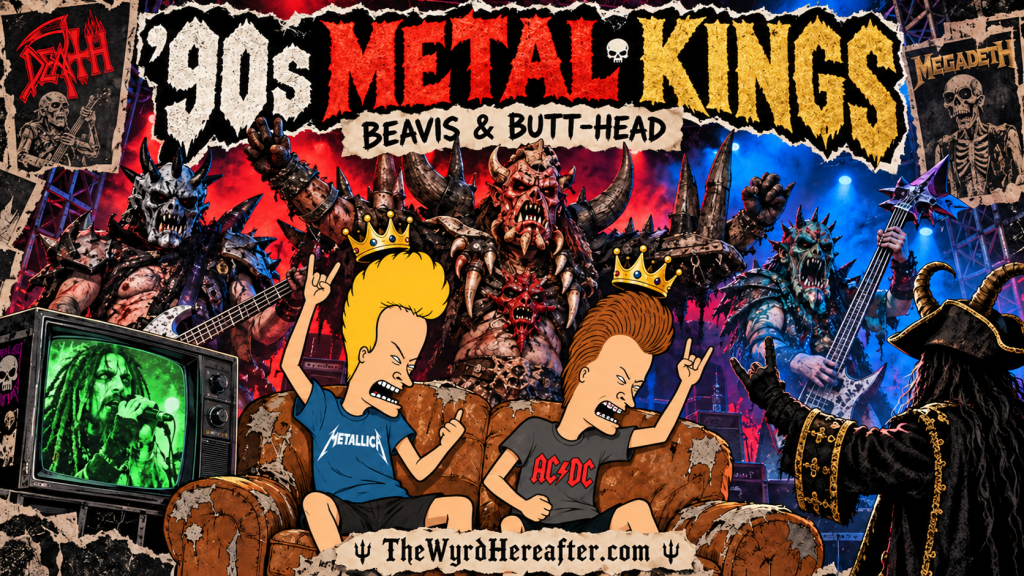
    The ’90s had two unlikely metal authorities: a pair of teenage idiots with a television, terrible posture, and approximately half a functioning brain between them.

    Beavis and Butt-Head could barely navigate school or a shift at Burger World. Put a music video in front of them, however, and suddenly they possessed the confidence of a Supreme Court with nachos.

    Their verdicts were brutally efficient: this rules, or this sucks.

    Here is the Captain’s argument: Beavis and Butt-Head deserves the title of the most metal cartoon of the ’90s because heavy music was part of its everyday life—and its couch became a remarkably influential place to encounter it.

    GWAR: Monsters Welcome

    The GWAR connection practically makes the case by itself.

    GWAR’s grotesque alien costumes, ridiculous violence, and theatrical excess fit comfortably inside the duo’s entertainment universe. The joke did not depend on rescuing viewers from the weirdness. The weirdness was the attraction.

    Contemporary music-industry coverage documented “Jack the World” appearing regularly on the show. Their enthusiasm even crossed into the licensed video games: a 1995 WIRED review describes the quest for GWAR concert tickets as the games’ central objective. Getting to the monster band was important enough to build an entire adventure around.

    For The Wyrd Hereafter, that connection has a familiar pulse. Costumes, characters, invented worlds, and heavy music can belong to the same creative organism. Beavis and Butt-Head did not need a museum placard explaining why an alien covered in stage blood might be entertaining.

    They already wanted tickets.

    White Zombie: The Couch Had Commercial Power

    White Zombie provides the strongest evidence that their approval could do more than entertain.

    In a Stereogum interview, Rob Zombie recalled that the band had already received exposure on Headbangers Ball and 120 Minutes, but at hours that limited its reach. Beavis and Butt-Head put the video in front of viewers at an accessible time. He remembered an immediate rise in record sales.

    That distinction matters. The band had done the work, made the music, toured, and attracted listeners. The cartoon helped turn existing potential into much wider recognition.

    “Thunder Kiss ’65” is the essential example here. White Zombie’s “I Am Hell” belongs to another part of the connection: the band contributed it to the 1993 compilation The Beavis and Butt-Head Experience.

    The couch was becoming a launchpad. Its occupants remained spectacularly unqualified to operate machinery.

    Death Metal, Without an Entrance Exam

    Then there is Death’s “The Philosopher.”

    The show featured the video, and Beavis turned Chuck Schuldiner’s vocal delivery into a ridiculous fast-food-order imitation. A milestone in musical analysis? Possibly only if your dissertation comes with curly fries.

    But the exposure still mattered. Viewers encountered actual death metal inside a familiar comedy show. The band’s name, sound, and imagery entered living rooms where nobody had necessarily gone looking for them.

    The jokes also show why describing the duo as reverent metal purists goes too far. They could enjoy heavy music and make fun of its presentation in the same breath.

    That feels recognizable to anyone who has loved a band enough to develop an extremely stupid impression of its singer.

    Two Faces of the Same Fandom

    Beavis often supplies the explosive enthusiasm. Butt-Head supplies the smug judgment. As a reading of their comic chemistry, they resemble two familiar people at a metal show: the fan losing his mind at the riff and the fan pretending he has heard better.

    Their stupidity keeps that authority funny. We can recognize the pleasure of an instant musical connection while also recognizing how ridiculous it becomes to treat personal taste as universal law.

    That tension makes them better subjects for a metal article than a simple list of bands they approved.

    Winger: When the Joke Becomes the Gate

    Their treatment of Winger reveals the less lovable side of that influence.

    The band became a recurring shorthand for uncoolness. Kip Winger has spoken about the damage he felt the mockery caused and about eventually clearing the air with Mike Judge.

    It would be too tidy to say two cartoon characters destroyed hair metal so underground music could flourish. Musical fashions were already changing, and a punchline tells us little about a musician’s ability.

    What the Winger story demonstrates is the power of attaching embarrassment to a band’s name. The same platform that helped listeners discover White Zombie could help teach them which shirt to laugh at.

    Metal fandom has always had that contradiction: a community for outsiders can become very interested in deciding who belongs outside it.

    The Verdict

    The 1993 compilation captures how porous their musical world actually was. Anthrax, Megadeth, and White Zombie shared space with Nirvana, Primus, hip-hop acts, and Cher. Its reported double-platinum certification speaks to the scale of the franchise’s musical reach, though the record itself was far broader than a metal sampler.

    For the Captain, their claim to the decade’s most metal cartoon rests on that combination: genuine enthusiasm for heavy music, an appetite for theatrical absurdity, and a television platform that could introduce viewers to something wonderfully abrasive.

    Their lasting gift is the invitation to discover. Hear a riff. Laugh at the video. Follow the band somewhere stranger.

    Two idiots on a couch helped make that doorway visible. Sometimes cultural enrichment arrives wearing an AC/DC shirt and asking for nachos.

    Sources

    ● Rob Zombie interview, Stereogum — direct recollections of the show’s impact on White Zombie.

    ● “Fool’s Errand,” WIRED, January 1995 — contemporary review of the GWAR-ticket video-game premise.

    ● Album Network, May 13, 1994 — contemporary trade coverage of GWAR’s television exposure.

    ● Metal Injection’s metal-video retrospective — includes Death’s “The Philosopher.”

    ● Winger and Mike Judge clear the air, Louder — Kip Winger’s account of the mockery and reconciliation.

    ● The Beavis and Butt-Head Experience: track list and certification overview.