Wyrd Outlook by Grogh — Ghostwritten by Vikki Vexum.
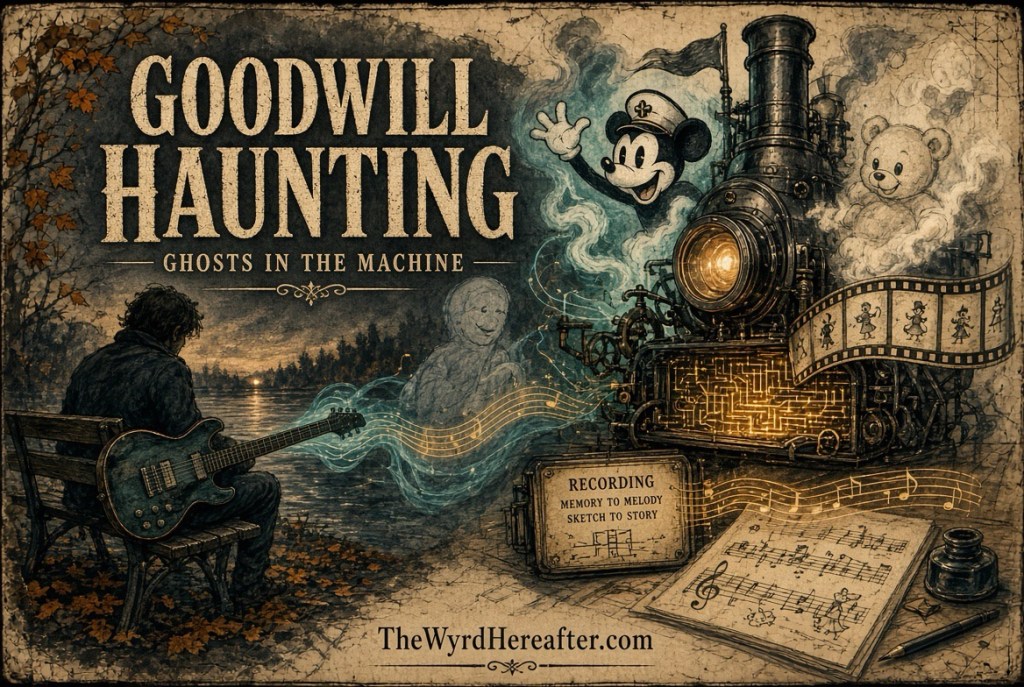
Goodwill Haunting: Disney Builds AI Dreams. I’m Giving Grief a Soundtrack.
Ryan wrote a song called “Perfect.” Years ago, but I forgot that I had made one called “Bitch You Aren’t Perfect.” It was—the perfect setup. Pun intended.
Now, as I work on a tribute to Ryan, AI is helping me revive that old track. Using my Industrial song as the framework and my instructions for the guitar and drums, it helped me develop a clearer guide track—something I can bring to musicians for the human interpretation I want this tribute to carry.
Going back through my old tracks while thinking about a song to honor him brought a wave of emotion. I heard a connection I had not understood so clearly before. We were talking about the same thing. Those songs came out of a shared world, and suddenly the memories connected around a message that I wanted to carry forward for him.
That old recording had to come back. AI gave me a practical way to start bringing it forward, and the connection to Ryan gave me a reason to do it.
I am hurting over losing friends. Ryan is a cornerstone of that grief. He is what I would call the good haunting: a memory that keeps bringing me back to the conviction that we can get something good out of this.
And we will.
That is the personal experience I bring to the wider conversation about AI in the arts, including Disney’s new alliance with Adobe. Custom creative tools sound extraordinary to me. With the tools I already have, I am finding a way to develop something that matters deeply. To explain why this particular song matters, I have to go back to the sound that got it filed away.
“Bitch You Aren’t Perfect” came from those times. It came from that scene. The attitude was already in it, along with the rhythm and timing that made me want to revisit it.
The sound was another matter. I had taken a synth pad and worked it into a strange distortion, trying to find something between a growling car and a guitar.
A car-growling guitar.
I could hear a reason to chase that sound, but the result was hard on the ears.
When I shared it with friends, they were honest: they struggled to get past the noise. They are good people, and I believed them. That harshness is one reason the track ended up filed away.
Returning to it after losing Ryan, I could hear how much was still there underneath. Then the relationship between our songs hit me, and the old recording became a connecting thread through the memories.
The way I hear it now, we were speaking the language of an unwritten rule of our scene: don’t act like your shit doesn’t stink.
That is blunt language for a moral with real depth. Remember your own faults. Look at yourself before you look down on somebody else. Leave room for people to be human.
It is also why I hear a connection to the teaching about casting the first stone. A spiritual idea can travel through different language and different music. It can wear distortion, swear, and still ask something worthwhile of the people listening.
That recognition is the epiphany for me. We were rocking out around a message that could bring people together. Hearing my old song beside the memory of Ryan’s “Perfect” woke up the larger meaning I could hear in those days.
I want to help carry that part of his legacy forward. There is room for people from different backgrounds to recognize themselves in that idea: ease up on the pedestal, remember your own mess, and meet one another with some humility.
Ryan’s song gives me a connection to him. My old song gives me something I can work with from the world we shared. The tribute has a foundation that means something to me before a new instrument ever enters the arrangement.
Here is what that AI assistance actually changed.
I used my old recording as the framework. To my ear, the assisted version caught the rhythm, meter, and essential character I wanted to preserve. I gave further direction about how I wanted the guitar and drums to sound, and that helped move the song into an intermediate draft.
Now I have a guide track I can put in front of musicians and say: this is where we start.
That is a big change from asking friends to hear through a wall of abrasive sound. The new draft lets the arrangement come through clearly enough for us to discuss it and build from it.
If anything, it is too clean. We need to dirty it back up with human playing.
I want the touch of a musician making a phrase their own. The breath, the pressure on a string, the way a drummer leans into a passage. For this song, I want people to put themselves into the performance. That human grit is fundamental to what I am trying to make.
The original recording had noise that people struggled to get through. The next version needs texture that helps the feeling reach them. Hearing that difference gives me a clearer direction for the work ahead.
I have always approached music with the mind of a composer. Working in industrial music already meant arranging sounds and building a piece without learning to perform every instrument individually. AI gives me another avenue for developing and communicating those musical decisions.
The guide track offers musicians a detailed starting point. They can hear the direction, reinterpret it, and bring ideas of their own. I want that exchange. A composition can grow when another person hears a possibility you have not heard yet.
I see a similar process in my visual work. A figurine I made by hand, or a character I drew, can become a reference for new poses. The physical figure may not bend into a position I need for a scene. AI can help me explore that position while I direct the result and make corrections.
With Ghostship Groggy, I am writing a story and casting myself in a million different roles. The scenes are also a stage for my acting. More ways to develop the imagery give me more opportunity to concentrate on voices, delivery, timing, and performance.
There is still frame-by-frame work. There are still images I change by hand. There are decisions about style, continuity, and whether a scene feels right. The artist has always made directorial choices; these tools expand how much of the vision I can stage.
That is why the Disney and Adobe news caught my attention. My reading of Nerdrotic’s discussion was that the prospect of Disney buying Adobe supplied an outrage hook. The confirmed announcement, on November ninth, twenty twenty-six, describes a multiyear strategic alliance, including custom generative AI models and creative tools. Adobe says Disney Imagineering is already using sketch-to-image and custom image models.
What excites me is the possibility of a creative workshop shaped around the way a studio works. Tools tailored to its characters and visual language. A framework that helps its people develop their ideas.
Having that degree of customization sounds like a luxury wonderland to me.
Usually, I work with what I have. What I have is doing the job, and it still gives me plenty to do.
Automated assistance also has an established place in production. Adobe documents automatic lip sync, including features assisted by machine learning. The developers of Cyberpunk twenty seventy-seven described a facial-animation workflow combining speech, tagged transcripts, procedural animation, and animator editing.
Those systems differ from contemporary generative tools, but they demonstrate how human performance and automation can work together.
Ubisoft has documented an AI tool for drafting short lines for background characters, which writers select and edit. ARC Raiders includes a developer disclosure of procedural and AI-based content assistance on its Steam page.
These examples show tools entering creative workflows. Each production still has its own process, and each tool does a particular job.
People can feel shocked, horrified, or full of existential dread about where all of this might lead. I am describing what it has helped me do with something deeply personal. An amazing tool becomes valuable through the way we learn to work with it, direct it, and carry the work forward.
Right now, it has helped my bleeding heart find a way back into an old song.
The grief is still here. So are the memories that made me recognize the connection between “Perfect” and “Bitch You Aren’t Perfect.” I have a clearer musical draft now, and a way to invite other musicians into the next stage of the tribute.
Ryan is the good haunting. His memory keeps calling me back to something worth making, something that could bring people together around the message we were already sharing in our own language.
I want that feeling in the song. I want the scene it came from to be audible in it. I want the human performances to carry the love behind the work.
We can get something good out of this.
And we will.
Sources & Further Reading
Disney and Adobe’s AI partnership
The official announcement describing their multiyear alliance, custom AI models, and creative tools.
Read Adobe’s announcement
Automated lip sync in animation
Adobe explains how its Auto Lip-Sync feature matches character mouth poses to recorded dialogue.
Explore Adobe Auto Lip-Sync
The facial-animation technology behind Cyberpunk 2077
A technical paper from JALI Research and CD PROJEKT RED describing automated speech animation alongside human performance and animator control.
Read the SIGGRAPH paper — PDF
Ubisoft’s AI-assisted dialogue drafting
Ubisoft introduces Ghostwriter, a tool that generates draft background-character dialogue for writers to select and edit.
Read Ubisoft’s introduction to Ghostwriter
AI assistance disclosed in a released game
The developer’s disclosure appears under “AI Generated Content Disclosure” on the ARC Raiders store page.
View ARC Raiders on Steam

