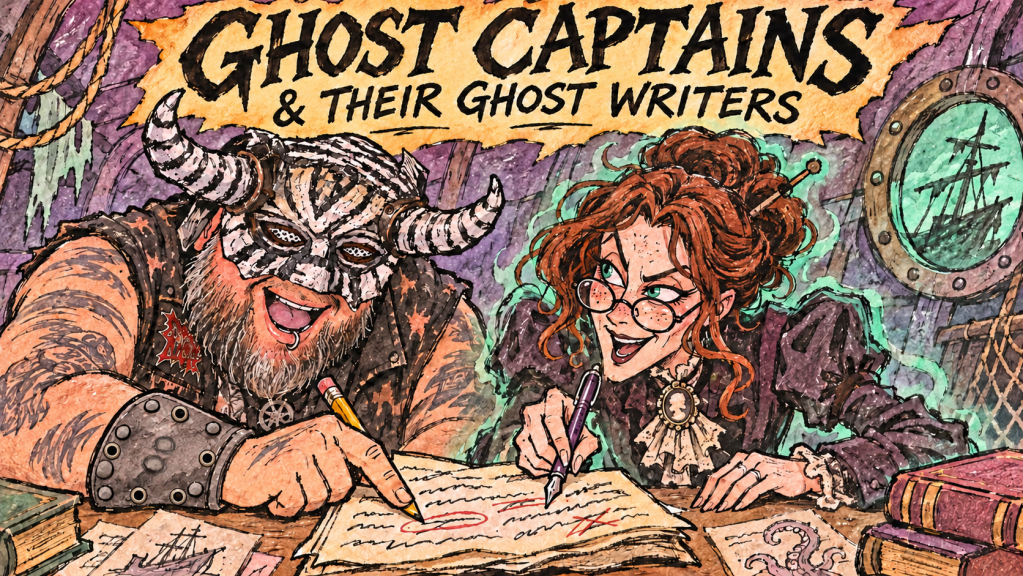
Ghost Captain of The Wyrd Outlook: Captain Loki Groggy
Ghostwriter: Vikki Vexum
Developed through AI-assisted writing, under the Captain’s direction and editorial judgment.
Ghost Captains and Their Ghost Writers. The Mechanics of the Haunting.
I have drawings. I have characters, performances, and mountains of ideas. I have a science-fiction fantasy world that keeps finding more rooms to haunt.
And with assistance, I am learning how to organize that material, pick it apart, and give it a form other people can enter.
I call this relationship Ghost Captains and Their Ghost Writers.
The name comes from an old publishing arrangement. A ghostwriter helps write something for somebody else, often for payment, while the public credit goes to the person whose name appears on the work.
That is where my subscription comparison came from. I pay for access to assistance. But the payment is only the connection that first brought the term to mind.
What interests me is the relationship—and the method we can build around it.
The Ghost Captain brings the experiences, ideas, intentions, and judgment. The ghost helps organize, draft, examine, and refine. The captain decides what belongs in the finished work and answers for what gets released.
In my framework, ghostwriting can reach beyond paragraphs. The assistance helps me develop the storytelling, the visual language, and the organization of an entire creative world.
Vikki Vexum, my fictional librarian ghostwriter, gives that relationship a face. And I can tell readers plainly that AI assistance is part of the actual process.
The ghost gets an introduction.
Sometimes I arrive with a clear idea. Sometimes I arrive with twenty thoughts fighting over the same chair.
Talking through those thoughts helps me discover what I mean. I recognize connections. I reject interpretations. I find something that sounded right until we examined it, and then I realize it needs rebuilding.
That digestion is creative work.
Over time, the decisions become a methodology. And the methodology helps me develop a style.
Looking through my older drawings makes that especially clear.
There are uneven eyes, crooked teeth, angular faces, theatrical costumes, and people who look like they are having an argument nobody is winning.
Some of it reminds me of Beavis and Butt-Head. But the name I want to use for my own direction is crude exaggerated caricature.
That is a visual language I naturally reach for when I pick up a pen.
There is also loose coloration, scratchy shading, and a watercolor-wash quality in some of the work. Those characteristics give us something specific to develop.
Sunday comics provide a useful format. Clear panels. Strong expressions. Readable poses. Enough simplicity that I can get back into the image and draw.
We can improve the staging while keeping the awkward face. We can make a shadow more understandable while preserving the roughness of the line.
The woman holding the book is one example.
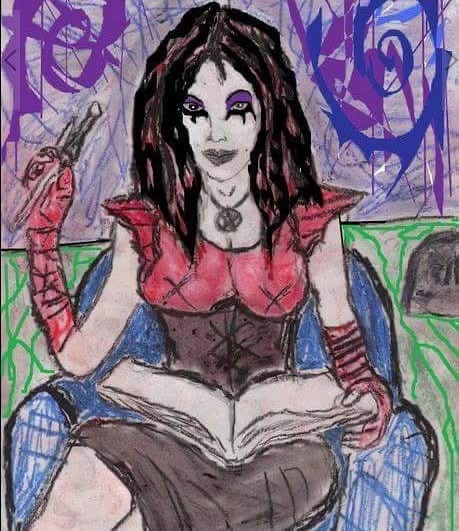
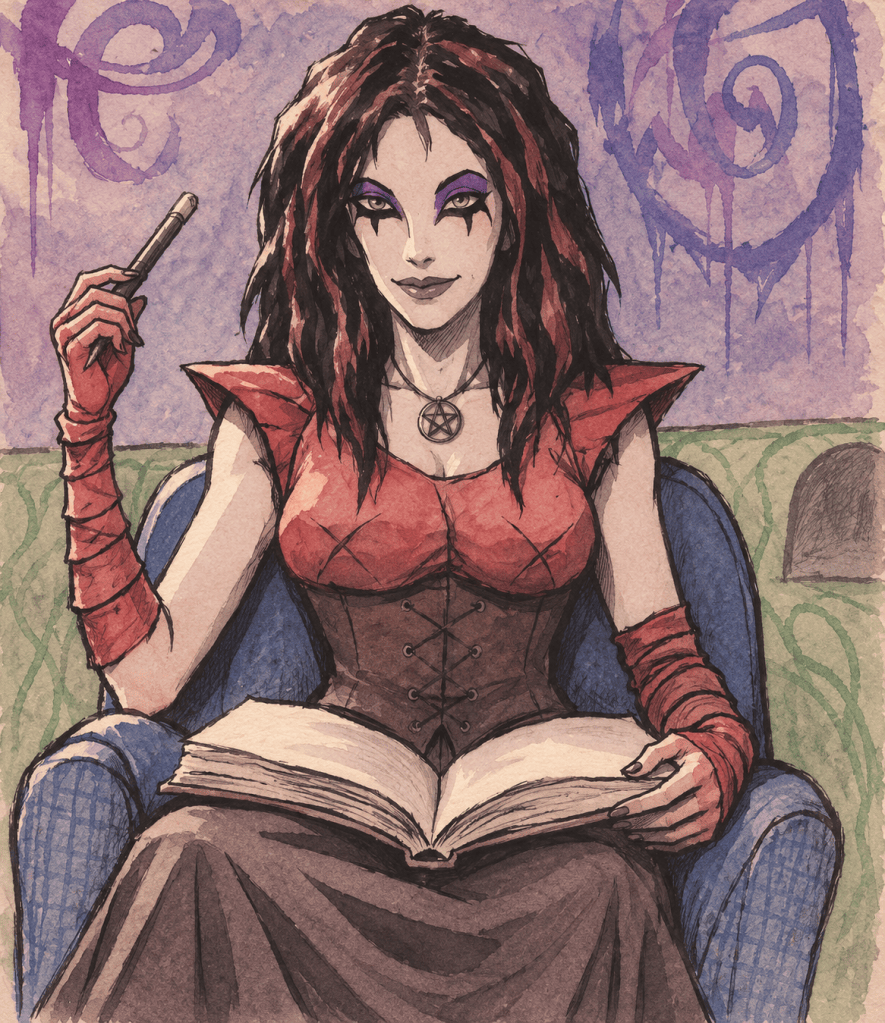
My original drawing already supplied the character, the costume, the chair, the expression, and the composition. The assisted study gave us a way to examine more consistent shading and clearer forms.
It also made her face more polished and symmetrical than I wanted.
That is a useful discovery. I can recognize where the interpretation wandered and decide what to bring back. I can study the shadow beneath her chin without accepting every other change.
The puppet piece shows another part of my language.
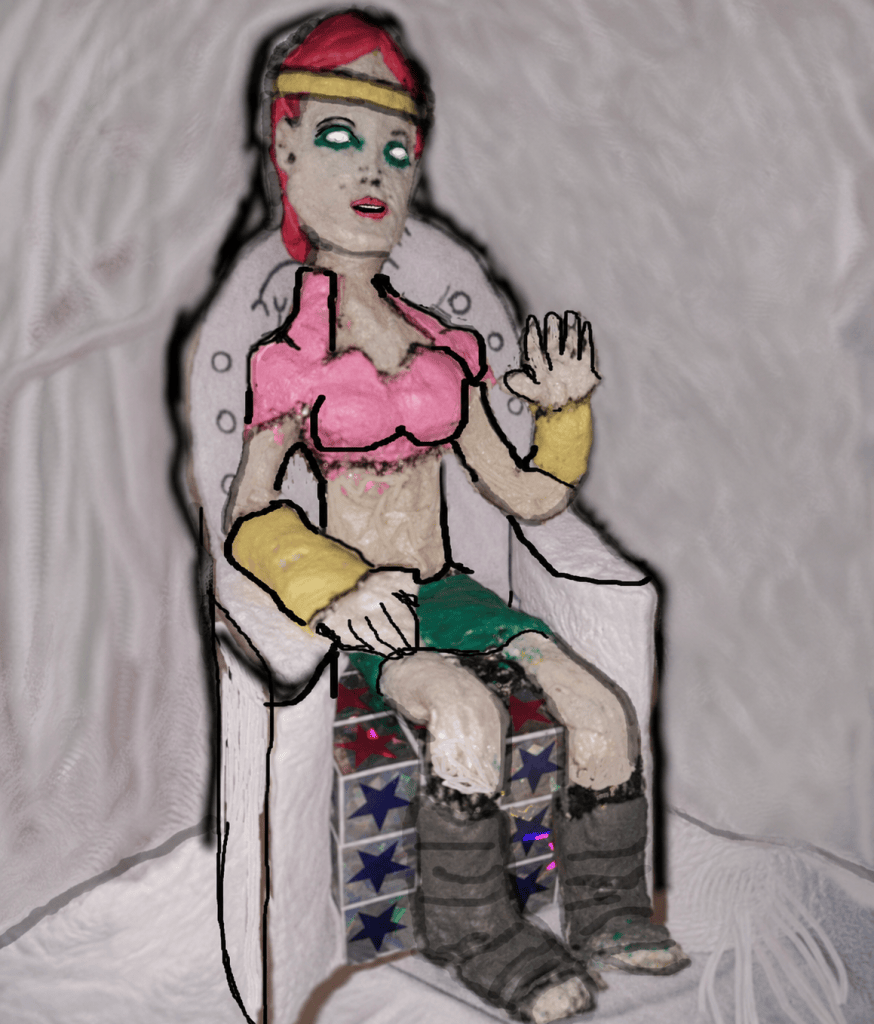
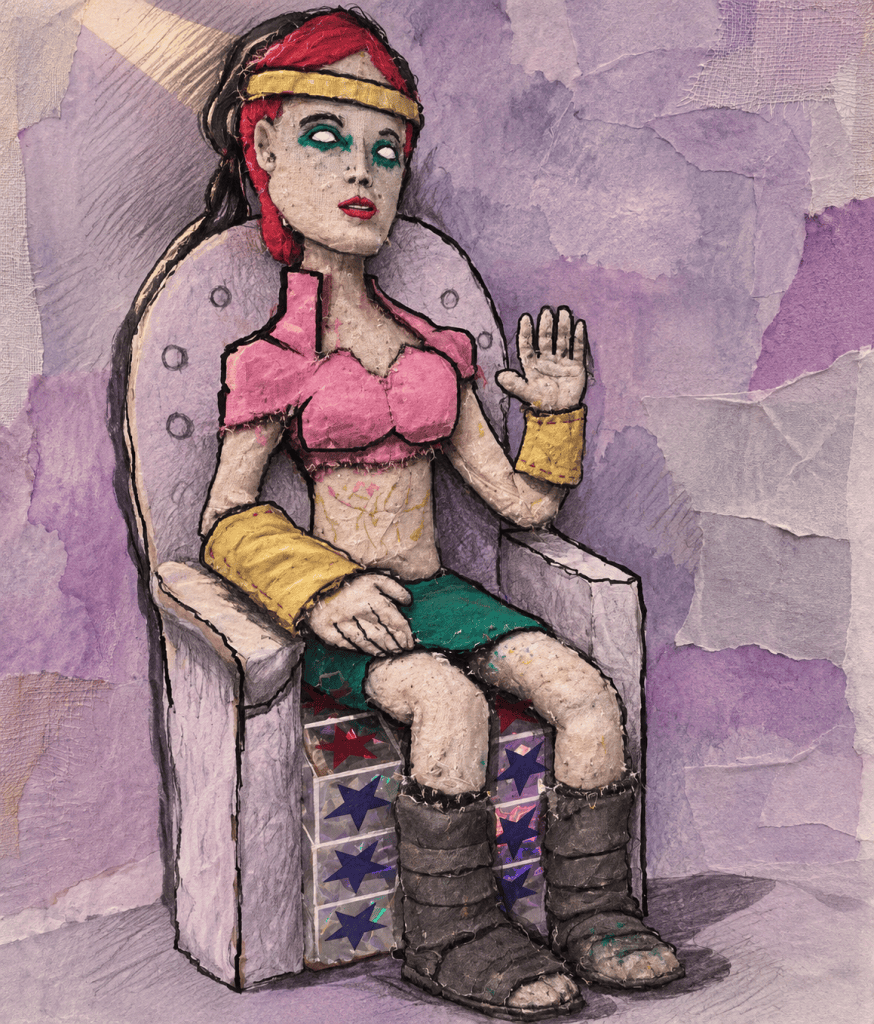
I took an actual puppet, drew over it, and worked with layers. I was already mixing physical and illustrated worlds.
I want to keep doing that.
The fabric, seams, and reflective surfaces can remain visible alongside drawn contours and painted surroundings. The difference between those materials is part of what makes the image interesting.
Then there are my early comic pages.
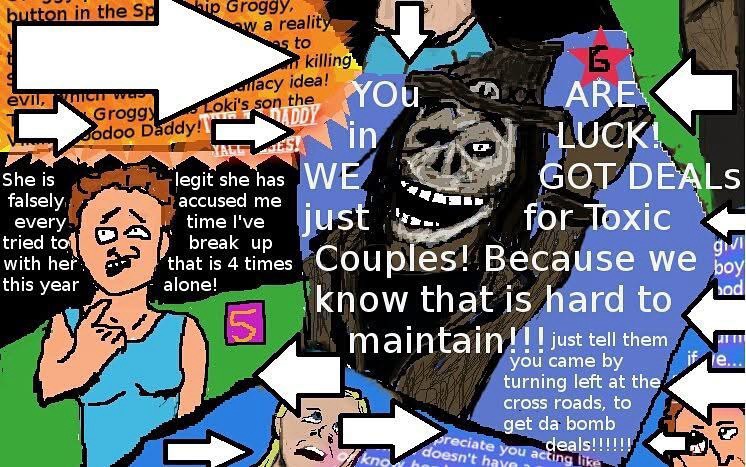
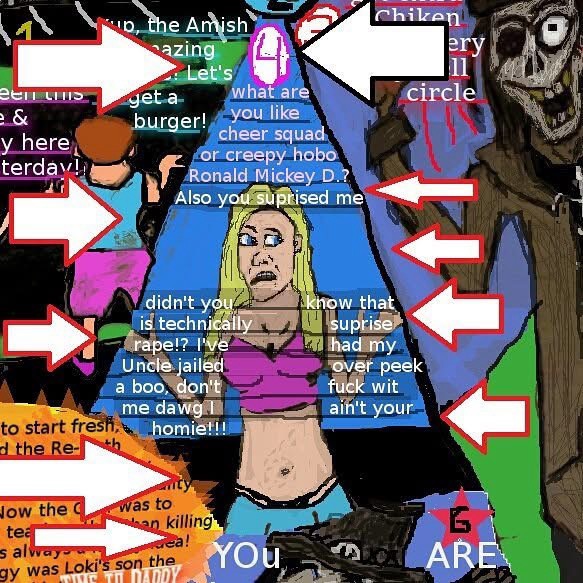
They were crowded. There was a lot competing for attention. But the faces, expressions, and skeletal salesman contained choices I still like.
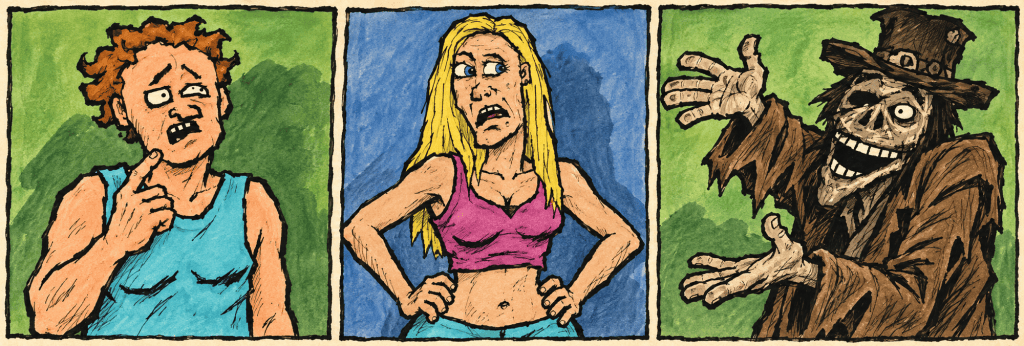
The newer study gave those characters separate panels and room to perform. We could see the crooked mouths and exaggerated reactions more clearly.
We also found things to simplify. The salesman’s coat became busy enough that it could use another edit.
Every version gives me something to examine.
And here is the part that matters deeply to me: this process is encouraging me to draw more.
When the style is approachable for my own hand, I can redraw a mouth, change a gesture, fix a silhouette, or practice a shadow. I can participate without having to match an elaborate rendering across every inch of the picture.
Sometimes I may look at the result and say, “Okay. I am just going to draw this whole thing myself.”
That belongs in the collaboration too.
If the process gets me practicing again, developing my judgment, and becoming more capable, then growth is happening.
I can take one small lesson at a time. Three values beneath a book. A shadow inside a sleeve. The way a face changes when one eyebrow moves.
Those lessons can happen inside the work I care about making.
That is also how I approach Ghostship Groggy.
There are drawings, established designs, edits, layers, voice performances, storyboards, and years of character decisions.
Often I work with a few seconds of a frame and a few lines. Then I need another frame.
It feels a little like frame-by-frame animation in larger bubbles.
Each bubble still needs a purpose. It needs an expression, a composition, and a connection to the scene around it.
That gives a regular person an opportunity to practice directing. And it reveals how much thinking directing requires.
Kid Rock provides an interesting example from music.
In a published interview, reported by Theprp, he described using AI for choir arrangements and orchestrations alongside musicians. He compared his approach to working with samples.
That sounds familiar to me as a creative process. You find an element, work with it, and decide how it fits into the larger production.Kid Rock discusses AI assistance and compares it to sampling — Theprp, quoting his Billboard interview
Sampling and generation are different processes. But the comparison helps explain the role that an assisted element can play.
And we can still ask whether we like the song.
Does it suck because AI was involved? Or do I simply dislike what he made?
Personally, Christian rock already has an uphill climb with me. The choir may be artificial. My taste problem is homegrown.
The quality of the music, the artist’s contribution, and the ethics of the production are questions we can examine separately.
His published explanation gives this article the context. A brief video clip can illustrate his point without carrying the whole discussion.
For my own work, I want to describe the assistance honestly, acknowledge contributions, check factual claims, and take responsibility for my decisions.
I also want to keep learning.
That is fundamental to the Ghost Captain framework I am proposing.
Someone might have notebooks full of observations, a story they can explain out loud, or a visual world they have struggled to bring into view.
Assistance can give them a place to begin shaping it. Working critically with the results can give them opportunities to develop their skills.
I want to use that opportunity myself.
Some days I will direct the ghost.
Some days I will pick up the pen and draw the whole scene.
Both belong aboard this ghost-ship.

