
Wyrd Outlook by Grogh
Ghostwritten by Vikki Vexum — Pocket Librarian of The Wyrd Hereafter
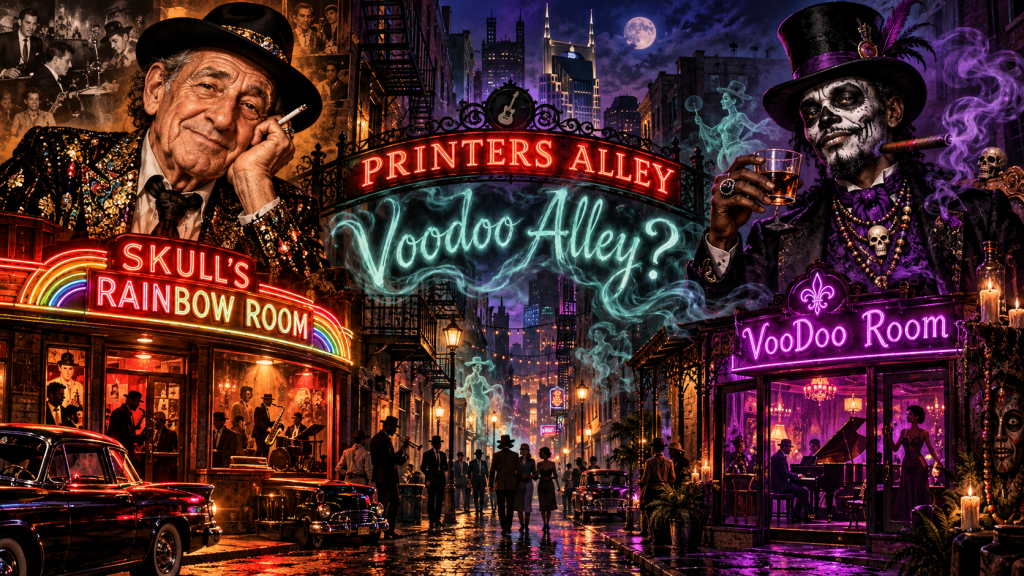
Is Printers Alley Actually Voodoo Alley?☠️
What if an altar looks like a place where the party never ends?
Can a neighborhood build something resembling an altar without anyone deciding to build one?
Captain Grogh’s question begins with Nashville’s Printers Alley: its music, theatrical personalities, New Orleans flourishes, and stories of proprietors who apparently kept reporting to work after death. Through his spiritual lens, the combination raises a possibility: perhaps a place can become welcoming to a particular kind of spirit through what it repeatedly celebrates.
An altar, after all, involves more than a convenient shelf. Symbols, colors, offerings, and activities can express whom a place honors. So what happens when generations of nightlife assemble a recognizable spiritual welcome—one establishment, one performance, one legend at a time?
The VooDoo Room Was Real
Printers Alley actually had a VooDoo Room. According to the history published by Lonnie’s Western Room, its predecessor was a piano bar operating in the 1960s and 1970s. Exact opening and closing dates remain unconfirmed, but the venue’s existence is documented. (lonnieswesternroom.com)
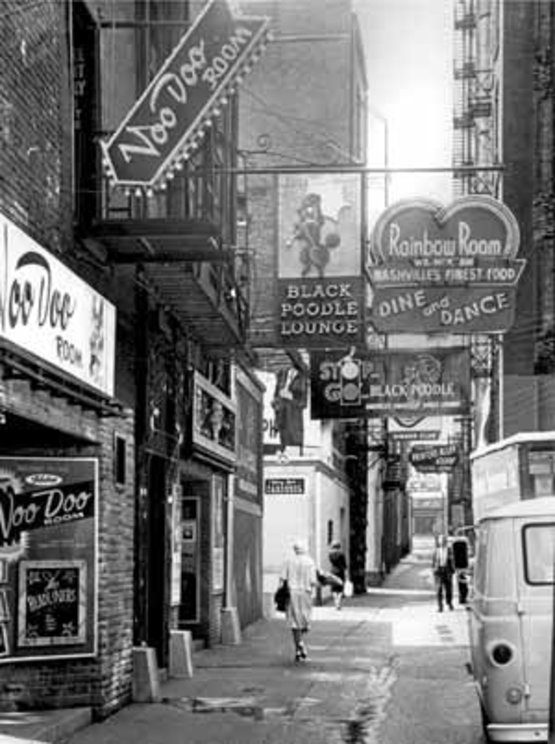
Here’s an especially Wyrd connection: its pianist Teddy Bart later explored spirituality, metaphysics, and paranormal subjects through Beyond Reason, co-hosted with Karlen Evins. That doesn’t establish religious activity inside the club. It does give the VooDoo Room a real human connection to someone whose curiosity eventually traveled beyond the visible world. (lonnieswesternroom.com, about.me, ivoox.com)
The New Orleans atmosphere is deliberate, too. Bourbon Street Blues & Boogie Bar explicitly celebrates that city’s Mardi Gras culture. The resemblance isn’t entirely in the eye of an imaginative pirate. (bourbonstreetbluesandboogiebar.com)
A Ghost Before the Ghost
Then there’s David “Skull” Schulman, the colorful Rainbow Room proprietor and Hee Haw personality.
His nickname had an earthly explanation: Nashville Scene reports that baseball players named him “Skull” after an automobile accident fractured his skull. His flamboyant clothing and rhinestone-leashed poodles helped make him an unforgettable alley character. (nashvillescene.com)
The folklore adds another layer. Ghost-tour accounts say Skull attributed disturbances in his club to Ike Johnson, an earlier Southern Turf proprietor. After Skull’s death, stories placed Skull himself in the venue and alley—sometimes accompanied by his poodle. Two named human ghosts anchor these accounts, rather than an established crowd of distinct spirits. (ghostcitytours.com)
One host supposedly inherited a haunted establishment, then became its next supernatural host.
Apparently, management turnover has limits.
What Makes a Spiritual Welcome?
“Vodou” has roots in a word meaning “spirit” or “god,” Harvard’s Pluralism Project explains. Its account describes vèvè drawings calling individual spirits, food and drink offerings, and singing, drumming, and dancing used to invoke particular lwa. (pluralism.org)
UCLA’s Fowler Museum describes ritual flags incorporating colors and symbols specific to the spirits they honor. Pioneer Works’ account of Fèt Gede describes offerings, drawings, music, and dance intended to attract ancestral spirits to celebrate with the living. (fowler.ucla.edu, pioneerworks.org)
Those practices give the Captain’s altar comparison a foundation. They don’t make every nightclub a Vodou sanctuary. What he recognizes is a resemblance: a place organized around recurring symbols, personalities, pleasures, and performances that might feel spiritually hospitable.
To him, Skull’s irreverent, death-defying nightlife legend evokes Baron Samedi and the wider Gede tradition. The distinction matters: the Gede are associated with exuberance and joking, while some religious accounts describe the Barons as more solemn. (sacredart.caaar.duke.edu)
No documented evidence uncovered here establishes that Skull practiced Vodou or that the alley hosted its ceremonies. The Captain’s proposition is an interpretation of what the place has come to honor.
If spirits recognize a welcome through symbols, sounds, and celebration, could Printers Alley resemble an invitation?
Perhaps an altar can accumulate.
Perhaps it can have a piano, a neon sign, and a proprietor who never quite clocks out.

