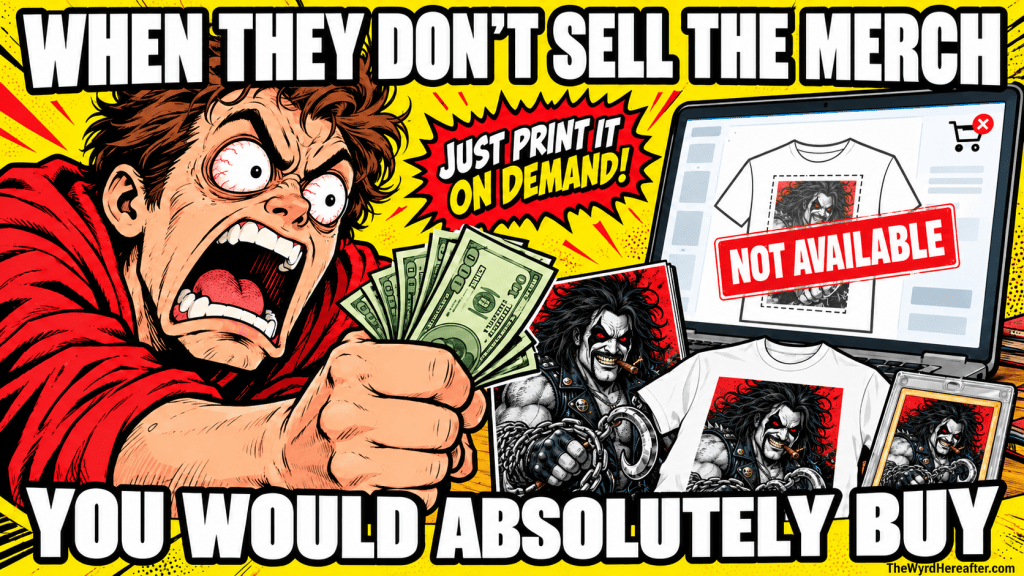
Wyrd Outlook by Grogh — Ghostwritten by Vikki Vexum, Pocket Librarian of The Wyrd Hereafter.
Why Can’t I Order That? A Proposal for On-Demand Comics and Fandom Gear
Every comic fan could probably point to something they would buy if somebody would make it. A missing back issue. A forgotten cover. A single panel that belongs on a shirt far more than the twentieth version of the same familiar logo.
Here is the Captain’s proposal: put comic reprints, approved fandom merchandise, and requests for new licensed products on one website. Let people order what is already available—and pay for the work of finding out whether something else can be made.
The price would need to cover the effort. That is part of the idea. If someone wants an unusual, officially authorized item enough to pay a profitable price for it, could a business make that desire worth answering?
This is a proposed combination of services. Several of its foundations already exist.
The machinery is already turning
Ka-Blam offers comic printing with no minimum order, including a single copy. Its related storefront, IndyPlanet, lets independent creators list comics, set their prices, and have Ka-Blam handle fulfillment.
That gives us a working foundation for comics manufactured when people want them.
For other products, Printful describes an operation in which a customer orders, then the company prints, packages, and ships the merchandise. It offers products including apparel and home goods without minimum order quantities.
Licensed fandom shopping also has an existing foothold. Zazzle’s brand-partner catalog promotes officially licensed products, and its stores include Marvel and DC.
Even cards have a manufacturing precedent: MakePlayingCards offers online design and print-on-demand services for playing cards and game cards.
These examples demonstrate separate capabilities. They do not establish that these companies will obtain permission for any comic panel a customer chooses, or that Marvel or DC has agreed to the platform proposed here. The interesting question is how much further those capabilities could go together.
One website, two ways to order
The first side would be straightforward: browse an approved catalog and buy.
Choose an authorized comic reprint, a permitted cover variation, a shirt, a poster, or a card product. See the price and production estimate. Place the order. The provider makes or arranges the item.
A clearly branded on-demand comic line could help readers understand what they are purchasing: a newly produced edition, identified as such. Someone who discovers a series halfway through could order its available earlier issues without waiting for another conventional print run.
The second side would offer something more adventurous: request an item that is not yet in the catalog.
“I would like this issue reprinted.”
“Could this cover become a poster?”
“Could this particular panel go on a shirt?”
The answer could begin with an estimated range and an explanation of what needs checking. The business would investigate permissions, artwork availability, manufacturing, and costs, then return with a firm offer when possible.
Fandom gets a request desk.
Pay for the footwork, too
Someone has to answer those inquiries, locate usable files, approach the appropriate people, and work out whether the item is practical.
Why should all that labor depend on a customer eventually deciding to buy?
A possible structure would offer a free preliminary screening, followed by a disclosed research fee for requests requiring substantial work. A separate production deposit could be refundable if the project proves impossible, under terms shown before payment.
The distinction matters. Money promised back in full cannot also be counted on to pay for unsuccessful research. Customers should know which payment funds the attempt, which funds manufacturing, and what happens if permission is refused.
The business should charge enough to make the service worth providing. An estimate would help customers decide whether to proceed; a firm quote would come before they commit to production.
If you are arranging permission, explore the possibilities
The thought behind this proposal is simple: fandom merchandise already requires decisions about artwork, authorization, products, manufacturing, and price.
Could a paid customer request help initiate those decisions?
And when a provider is discussing comic reprints with a publisher or creator, could it also explore permission for selected images on shirts, prints, or cards?
Those uses would need their own explicit coverage. The proposal is to negotiate a useful range of authorized options wherever the rights holders are willing, rather than assume a comic-printing agreement covers everything.
For Marvel, DC, and independent publishers alike, the opportunity would be a controlled way to discover what fans want beyond the usual merchandise selection. A pilot could begin with one willing publisher, a small archive, a few product types, and clear approval rules.
Nobody needs to unlock every vault on opening day.
Let the first request help the next fan
Here is where the platform might gain momentum.
The first request for an overlooked image could involve considerable preparation. If the agreement allows ongoing sales, that work could produce a permanent approved listing.
The next customer could order directly. The research, file preparation, and permissions would already be in place, within the agreement’s limits.
A successful request could therefore add something useful to the catalog. The website would gradually accumulate both products and knowledge about what can be made.
For expensive requests, fans could also register interest together. The platform might show a proposed product, an estimated price, and a participation threshold. Once enough buyers commit under clear terms, the provider could seek final approval and confirm the production price.
That would be a proposed feature, not a promise that every request becomes cheaper with enough clicks.
The rare-card feeling
There is an appeal here beyond simply owning another superhero shirt.
A fan could choose an obscure scene, a peculiar expression, or an illustration that never received its own merchandise. Something deeply specific to their affection for the work.
That has a little of the rare-Pokémon-card feeling: the pleasure of finding something unusual that matters to you.
The platform could offer genuinely limited, numbered editions where the agreement permits them. It could also sell open-ended on-demand products whose attraction is their unusual artwork or approved configuration.
The distinction should stay clear. An item available for unlimited future orders has no fixed scarcity. Neither kind needs a promise of resale value to be enjoyable.
Sometimes the treasure is simply that somebody finally made your wonderfully specific thing.
What would make this worth trying?
The selling price would need to cover production, permissions and agreed payments, preparation, service labor, transaction costs, fulfillment, and profit. Shipping and taxes would need to be visible before purchase.
The useful test would be a modest pilot: how many requests become approved orders, how much staff time they consume, whether customers accept the quoted prices, and whether approved items attract repeat sales.
A premium price can support a service only when enough people willingly pay it.
Still, the foundations make this worth asking. We can already point to comics printed individually, merchandise manufactured after purchase, licensed fandom storefronts, and custom card production.
Could one website combine those capabilities with a paid service for bringing new authorized items into existence?
Give fans a place to ask. Give creators and rights holders a way to approve and earn. Give the provider enough margin to make the effort worthwhile.
Somewhere, somebody wants one ridiculous comic panel on a shirt.
Let them ask what it would cost

