Wyrd Outlook by Grogh
Ghostwritten by Vikki Vexum — Pocket Librarian of The Wyrd Hereafter.
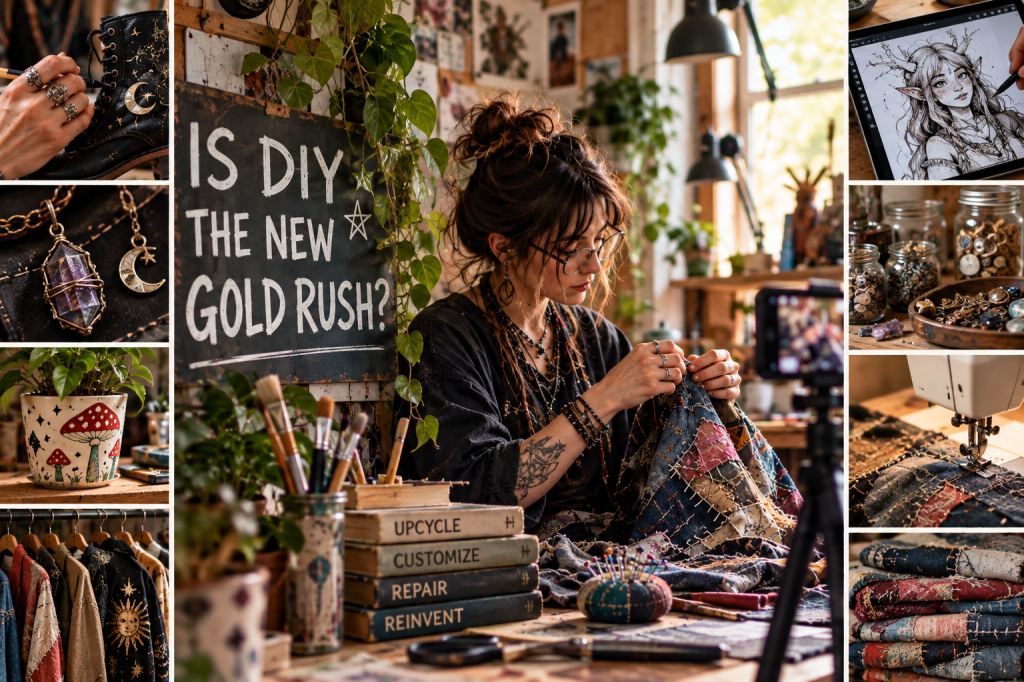
Is DIY the New Gold Rush?
The Alchemy of Uniqueness and the Renaissance We Could Build Together
What if the next great gold rush isn’t happening underground, but inside the imaginations of millions of people?
Something wonderfully strange is happening in the world of DIY.
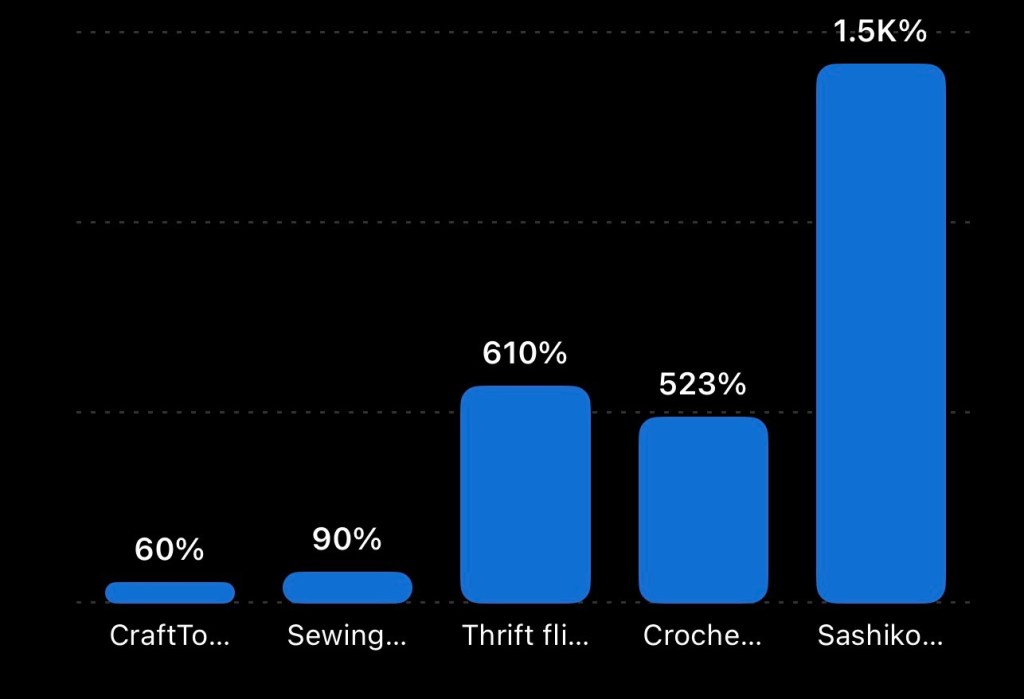
According to figures reported by Vogue Business in October 2026, TikTok videos associated with #CraftTok increased by approximately 60% worldwide over twelve months, while #SewingTok videos increased by approximately 90%.
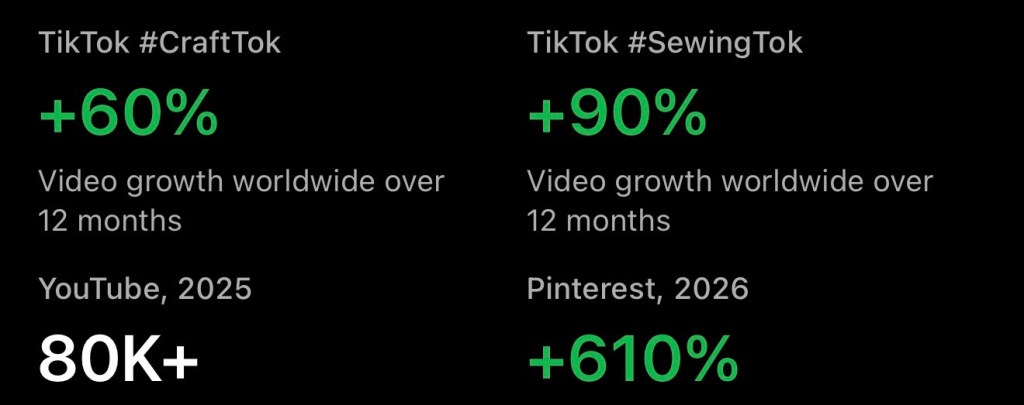
Pinterest reported an extraordinary 610% increase in searches for “thrift flip ideas,” alongside a 1,509% increase in searches for sashiko, the Japanese tradition of decorative and functional stitching.
And YouTube reported more than 80,000 videos uploaded worldwide in 2025 with “upcycle” or “upcycling” in their titles.
Those numbers aren’t all exclusively about fashion, and they don’t tell us exactly how many individual creators are participating. But together, they point toward something worth celebrating.
People are sewing, modifying, repairing, reinventing, decorating, experimenting, and discovering new ways to make ordinary things extraordinary.
Even major fashion retailers are paying attention, introducing repair services and creative workshops to engage customers who want more involvement in what they wear.
Could we be witnessing the beginning of a new artistic Renaissance?
And more importantly, what if we could help make it happen?
The Gold Isn’t in the Ground Anymore
Traditionally, a gold rush begins when somebody discovers something rare and valuable. Word spreads. Prospectors arrive. Communities form around the opportunity.
But gold has a peculiar limitation.
The more people extract from a finite deposit, the less remains for everyone else.
Creativity doesn’t work that way.
One artist’s discovery can inspire another artist to create something entirely different. A new technique can be shared without destroying its usefulness. An unusual idea can inspire a thousand other unusual ideas without requiring any of them to become identical.
And that brings us to the most valuable commodity in this proposed gold rush.
Uniqueness.
Not merely expensive materials. Not merely professional craftsmanship. Not even the prestige of an established brand.
Something more fundamental.
The value of bringing something into existence that didn’t exist before.
Gold is valuable partly because it’s rare.
Uniqueness is valuable because it’s irreplaceable.
What Can Be Mass-Made Can Be Mass-Lost
A recent article from HoneyBee Luxury, Handmade vs. Mass-Produced Jewelry: What Really Sets Them Apart?, inspired me to think about this distinction.
The article discusses the personal craftsmanship involved in handmade jewelry compared with the standardized efficiency of mass production. It also makes the reasonable observation that both approaches can produce beautiful, durable objects.
Fair enough.
But I believe the most exciting argument for handmade and DIY creations goes considerably further than craftsmanship.
Good craftsmanship already speaks for itself.
When something is beautifully constructed, people recognize its quality. They enjoy it. They admire the skill involved. They may immediately want to own it.
But uniqueness asks us to recognize another kind of value.
Consider a factory producing ten thousand identical necklaces.
Lose one, and another can generally take its place.
Now consider a necklace assembled from unusual materials, modified through personal experimentation, and finished according to an artistic vision that exists nowhere else.
Destroy that necklace, and something genuinely irreplaceable may disappear.
Of course, even a mass-produced object can become irreplaceable through personal history. A factory-made ring inherited from a loved one might be worth more to its owner than a room full of expensive jewelry.
But that only reinforces the larger principle.
Uniqueness can emerge from how something is made, how it is transformed, and the story it accumulates through existence.
A manufactured object can become one of a kind.
A handmade object can lose some of its distinction when reproduced endlessly.
The real treasure isn’t simply the label handmade.
It’s the originality that makes an object uniquely meaningful.
What If Uniqueness Became Our Most Valuable Brand?
People already understand the power of assigning value to an idea.
A recognizable brand can represent a lifestyle, an identity, an expectation of quality, or a set of cultural associations.
Sometimes people pay a premium not merely for what an object does, but for what they believe it represents.
So here’s a strange proposal.
What if uniqueness itself became the most desirable brand in the world?
Not a trademark. Not another corporate label. Not something any individual could monopolize.
A cultural value.
A shared appreciation for the originality of people, objects, ideas, and experiences.
Imagine a world where people became as excited about discovering an unknown creator’s peculiar masterpiece as they are about recognizing an expensive corporate logo.
Imagine walking into a marketplace and asking not, “What’s everybody wearing?”
But instead:
“What have I never seen before?”
That changes the direction of our attention.
And attention is extraordinarily powerful.
What we collectively learn to appreciate influences what creators are encouraged to produce.
If we reward imitation, we’ll get more imitation.
If we celebrate originality, we create more opportunities for originality to flourish.
This isn’t merely a consumer preference.
It can become a moral commitment to recognizing the distinctive contributions of others.
The Alchemy of a Community
Here’s where the gold rush becomes particularly interesting.
One artist producing unique creations is wonderful.
An entire community learning to appreciate one another’s unique creations could become something extraordinary.
Imagine a neighborhood full of DIY fashion designers, jewelry makers, sculptors, inventors, painters, seamstresses, costume builders, and wonderfully eccentric craftspeople.
Each person is developing a distinctive creative identity.
But here’s the essential ingredient.
They aren’t merely asking everybody else to appreciate their work. They’re actively learning to appreciate everybody else’s.
That’s where the alchemy begins.
An artist discovers an unusual technique.
Another artist recognizes its possibilities.
A third contributes an entirely different skill.
Somebody shares a tool. Somebody teaches a beginner. Somebody purchases a one-of-a-kind piece because they genuinely appreciate what makes it different.
The exchange encourages more creation.
The community develops new skills, relationships, opportunities, and forms of wealth.
Not every original creation will command a high price, and uniqueness alone doesn’t guarantee commercial success.
But a community that values originality can help create the conditions in which unusual work finds an audience.
And unlike a gold mine, the possibilities don’t have to diminish as more people participate.
The more imagination we cultivate, the more potential treasure we create.
That’s the kind of gold rush I’d like to see.
Make It, Celebrate It, Then Make Something Else
There’s another responsibility that comes with valuing uniqueness.
Artists must be willing to keep evolving.
Suppose someone creates a remarkable piece of jewelry that captures everyone’s imagination.
Demand increases. Orders arrive. Suddenly, there’s an incentive to manufacture the same creation over and over again.
That’s understandable. Artists need to make a living.
But there’s a tension between capitalizing on a successful design and preserving what originally made it special.
At some point, a once-unique creation becomes another familiar product.
This doesn’t mean artists should never produce collections, repeat techniques, or develop recognizable styles.
It means we can encourage creators to keep discovering rather than merely reproducing.
Preserve the artistic language.
Experiment with new expressions.
Let individual masterpieces have their moment.
Sometimes the greatest way to honor a successful creation is to move forward and create something nobody has imagined yet.
The Machines Are Invited to the Renaissance
Now here’s where things get wonderfully complicated.
Some people treat handmade artistry as though every technological convenience subtracts something from its authenticity.
But where exactly should we draw that line?
Does a sewing machine invalidate a handmade dress?
Does a 3D printer invalidate an original sculpture?
Does digital design software invalidate a piece of jewelry?
And what about artificial intelligence?
Suppose an artist develops a highly personalized AI assistant through extensive creative collaboration. The artist establishes the vision, develops the concepts, makes the decisions, challenges the results, and uses the technology to accomplish things that would otherwise be difficult or impossible.
Is that automatically less creative than using a conventional tool?
Technology certainly raises important questions about originality, ownership, labor, and imitation. Those questions deserve serious attention.
But using a machine doesn’t automatically eliminate human authorship.
And refusing technology doesn’t automatically produce originality.
The important distinction is whether we’re using our tools to explore new possibilities or simply reproduce what already exists.
The Renaissance doesn’t need to reject the machine. It needs to put the machine in service of imagination.
A genuinely original creative vision can incorporate traditional craftsmanship, digital fabrication, artificial intelligence, and techniques we haven’t invented yet.
The gold is in the originality.
The tools help us reach it.
DIY Isn’t an Entrance Examination
Of course, no discussion of alternative fashion would be complete without somebody declaring who is and isn’t sufficiently alternative.
Spend enough time around punk, goth, and alternative fashion commentary, and you’ll encounter people insisting that DIY is essential to authentic participation.
There’s a historical point buried in that argument.
DIY has long been important to punk and alternative cultures, partly because it allows people to create identities outside mainstream commercial expectations.
But celebrating that tradition is one thing.
Turning it into a purity test is another.
There’s something wonderfully contradictory about demanding that everybody demonstrate their individuality according to somebody else’s rules.
And that’s precisely the kind of thinking this proposed Renaissance should move beyond.
You don’t need permission from a fashion authority to create something unusual.
You don’t need to qualify for membership in a particular subculture.
You don’t even need to be especially skilled when you begin.
The invitation isn’t to prove you belong.
It’s to discover what only you can contribute.
And if your first creation looks like a haunted potato wearing a Victorian waistcoat?
Congratulations.
We might be onto something.
A Maker’s Heaven
In my fictional universe, The Wyrd Hereafter, there’s a character named Ad’Mo who helps operate a Maker Warehouse.
It’s a place where creation, invention, unusual technology, and collaboration belong together.
The more I consider the possibilities of a DIY Renaissance, the more I appreciate what such a place could represent outside fiction.
Imagine communities built around shared workshops, accessible equipment, creative education, mutual encouragement, and an appreciation for one-of-a-kind creations.
People wouldn’t necessarily need to own every expensive tool themselves.
They could share resources.
They could teach one another.
They could help turn discarded materials into valuable objects.
They could discover talents they didn’t know they possessed.
And they could build a culture where somebody else’s creative success isn’t automatically perceived as a threat to their own.
A community like that might generate financial opportunities, but its wealth would extend beyond money.
It would create knowledge, confidence, friendships, craftsmanship, originality, and a growing inventory of possibilities.
Call me a Gothic Hippie, but that sounds like a little piece of heaven.
The Divine Value of Being Different
In The Wyrd Hereafter, I explore a cosmology in which even Lord God values the emergence of unique creations and distinctive experiences.
After all, what would be the point of an endlessly expanding existence if everything within it were merely another copy of something that already existed?
A universe filled with genuinely different perspectives, beings, artworks, discoveries, and experiences is a universe continually discovering new reasons to exist.
That’s the spiritual dimension of this argument.
Uniqueness isn’t merely a marketing advantage.
It’s a contribution to the diversity of existence itself.
Of course, being different doesn’t automatically make someone morally superior. Originality can be used constructively or destructively, just like any other human capacity.
But encouraging people to develop their distinctive talents, respect one another’s individuality, and contribute something meaningful to the world?
That’s a direction worth promoting.
Perhaps the greatest creative achievement isn’t becoming the most perfect imitation of an established ideal.
Perhaps it’s discovering what only you can bring into existence.
The Renaissance We Choose to Create
So, is DIY the new gold rush?
The growing enthusiasm for sewing, upcycling, thrift flipping, creative repair, and independent making gives us reasons to be optimistic.
These trends don’t prove that a new Renaissance is inevitable.
But they suggest that the appetite for creative participation is very much alive.
And perhaps that’s enough to begin.
Because a Renaissance isn’t simply something we wait for historians to recognize after the fact.
It’s something people participate in.
Every unusual creation is another possible treasure.
Every person who learns to appreciate originality becomes another participant.
Every maker who encourages another maker helps establish a culture in which individuality has greater value.
And every community that shares tools, knowledge, imagination, and opportunity helps turn that philosophy into something tangible.
You don’t need to own a gold mine.
You don’t need permission from a cultural gatekeeper.
You don’t even need to know what you’re good at yet.
You only need the willingness to discover something worth bringing into existence.
The gold is uniqueness.
The mine is imagination.
And the gold rush belongs to everybody willing to create and appreciate something extraordinary.
So perhaps the real question isn’t whether DIY is the new gold rush.
Perhaps it’s this:
What are we waiting for?
The Wyrd Hereafter — Exploring strange possibilities, original creations, and the art of becoming wonderfully, unapologetically wyrd.
Sources and further reading
- HoneyBee Luxury — Handmade vs. Mass-Produced Jewelry: What Really Sets Them Apart?
- Vogue Business — October 2026 reporting on TikTok craft and sewing content and Pinterest DIY trends.
- YouTube Culture & Trends — June 2026 reporting on upcycling video uploads.
- Associated Press — September 2026 reporting on fashion retailers’ repair and sewing initiatives.

