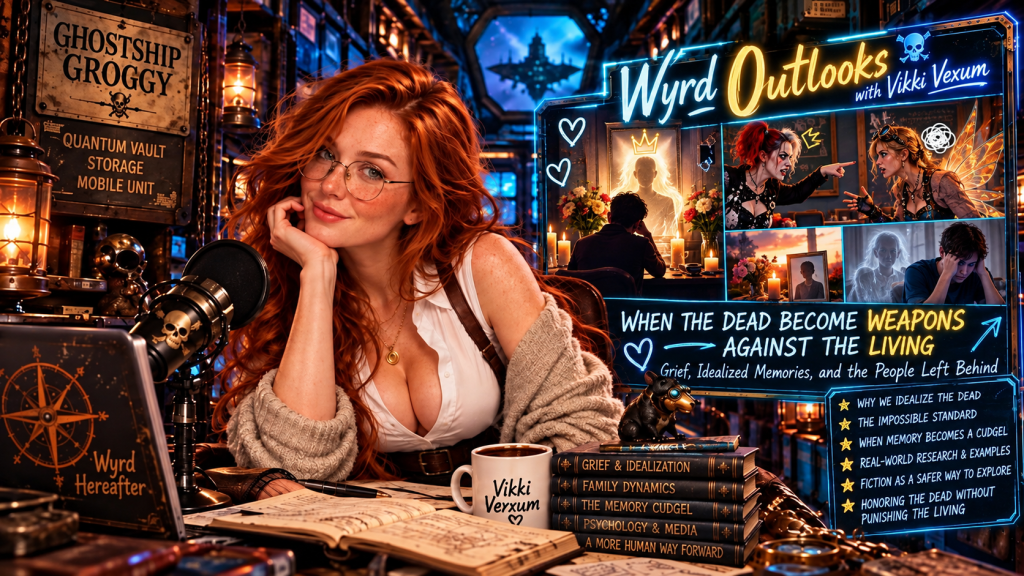
Wyrd Outlook by Grogh
Ghostwritten by Vikki Vexum — Pocket Librarian of The Wyrd Hereafter
When the Dead Become Weapons Against the Living
How grief, idealized memories, and the people left behind can turn remembrance into an impossible standard.
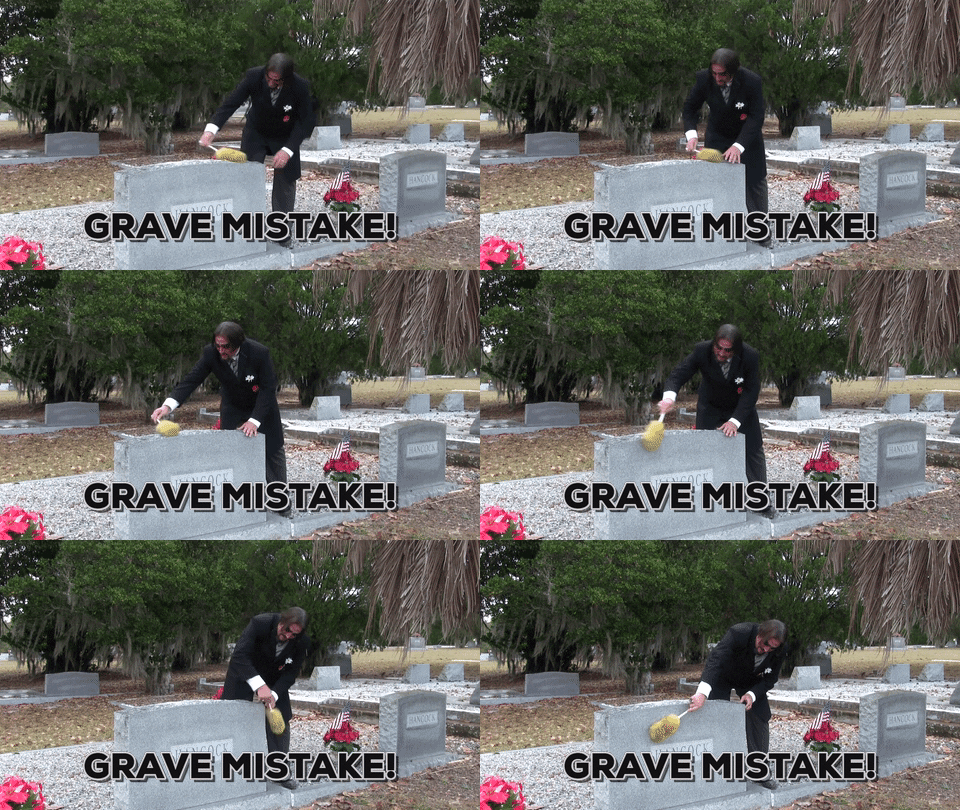
Death has a strange way of improving someone’s reputation.
The arguments become quieter. The irritating habits fade. Old disagreements lose their sharp edges. Sometimes, the person we remember becomes a considerably more agreeable character than the one we actually knew.
There can be something beautiful about that. Remembering the best of someone is often an expression of love.
But what happens when that beautiful memory becomes a weapon against somebody who is still alive?
What happens when a deceased loved one becomes an untouchable authority, an impossible standard, or a convenient voice in arguments they can no longer participate in?
That’s where grief can take a particularly Wyrd turn.
A Little Fictional Distance From a Heavy Subject
In the fictional universe of The Wyrd Hereafter, the deceased don’t always stay conveniently out of everyone’s business.
At the Hereafter Zoo Academy, Ronda Mc’Clownfish remains fiercely devoted to the late teacher Frankie Frankly. His recorded lessons continue reaching students even after his death.
But when a steampunk fairy named Nexus challenges Ronda, a familiar human disagreement begins to emerge.
How much authority should someone continue to hold over the living simply because they’re gone?
Ronda’s devotion may come from genuine love, admiration, and grief. Nexus may have legitimate reasons to question that devotion.
Neither perspective necessarily tells the whole story.
This is a fictional scene from Ghostship Groggy, not a psychological case study. Its purpose is to explore a recognizable conflict through imaginary characters.
Sometimes, fiction gives us a little distance from painful subjects. We can consider someone else’s circumstances before confronting our own.
And with grief, that distance might be welcome.
When Memory Becomes More Perfect Than Reality
Psychologists have studied how people maintain relationships with loved ones after death.
One important concept is called continuing bonds—the emotional connection people maintain with someone who has passed away.
A 2024 systematic review published in Death Studies examined 79 studies involving approximately 13,366 bereaved individuals. Researchers identified experiences ranging from comfort and emotional support to distress and uncertainty.
The research doesn’t suggest that continuing to feel connected to someone who died is inherently unhealthy. Those connections can help people preserve meaning, identity, and affection.
Read the research: The Impact of Continuing Bonds Following Bereavement
But there’s a distinction worth exploring.
Remembering someone fondly is one thing. Reconstructing their memory into an ideal that everyone else must obey is another.
A deceased person cannot make new mistakes, disappoint their admirers, or contradict the stories told about them.
The living, unfortunately, continue being human.
The Impossible Competition
The 1980 film Ordinary People, directed by Robert Redford, offers a particularly uncomfortable example.
After the death of his older brother Buck, a teenager named Conrad struggles with survivor’s guilt, depression, and his family’s complicated response to the tragedy.
His deceased brother remains an emotionally powerful presence in the household.
Conrad, meanwhile, must continue living with all the difficulties, imperfections, and needs that come with being alive.
The contrast raises a painful question:
How does someone compete for love and acceptance against a person whose memory has become nearly untouchable?
The film doesn’t need to represent every grieving family to make the question worth considering.
[EMBED: The Hidden Psychology of “Ordinary People” (1980): Golden Child vs. Scapegoat Explained — Mental Health in the Movies with Laura Giles]
The fictional story provides a way to recognize how grief and family expectations can become entangled, sometimes without anyone consciously deciding to make the surviving person suffer.
When Someone Else Picks Up the Memory and Swings It
Now we reach the particularly strange part.
Sometimes the memory of a deceased person becomes a source of authority for someone still alive.
Imagine hearing:
“Your mother would be ashamed of you.”
“Your brother would never have behaved this way.”
“If you really respected your father, you’d do what he wanted.”
Suddenly, the disagreement isn’t merely between two living people.
One person has recruited the dead into the argument.
And conveniently, the deceased cannot offer a rebuttal.
The speaker may sincerely believe they know what their loved one would have wanted. They may be expressing genuine grief or fear of losing another connection to that person.
But the effect can still be deeply unfair.
The living person is being pressured to satisfy the supposed wishes of someone who can no longer explain those wishes for themselves.
The memory becomes a cudgel.
And the person swinging it may believe they’re defending something sacred.
Who Gets to Speak for the Dead?
This is where the behavior becomes especially complicated.
Different people can remember the same deceased person in completely different ways.
A parent remembers an obedient child. A sibling remembers a rebellious troublemaker. A spouse remembers a difficult partner. A friend remembers the funniest person they ever met.
None necessarily possesses the entire truth.
Yet after death, one version of that person’s identity can become the officially accepted story.
And questioning that story may be treated as disrespect.
There’s a difference between preserving someone’s legacy and controlling who gets to interpret it.
There’s also a difference between saying, “I think your mother would have wanted you to be happy,” and using her imagined disapproval to end an argument.
The words of the dead can provide comfort.
But when their supposed authority is used to silence the living, something has changed.
Why Fiction Can Help Us Examine It
These conflicts are difficult to discuss in real families.
Grief is personal. Memories are precious. People may feel attacked when someone questions their interpretation of a deceased loved one.
Fiction gives us another way into the conversation.
We can watch Ronda defend Frankie without deciding that everyone who preserves a deceased teacher’s work is behaving badly.
We can understand Nexus questioning that devotion without assuming that everyone who challenges a memorial tradition is cruel.
And we can consider the painful family dynamics in Ordinary People without demanding that readers put their own relatives on trial.
Fiction doesn’t eliminate the emotional weight. Sometimes a fictional story touches a very real wound.
But it can provide room to consider multiple perspectives without immediately assigning guilt.
That’s one reason The Wyrd Hereafter explores difficult human behavior through unusual characters, supernatural settings, and interpersonal drama.
A fantastical world can sometimes make an ordinary human contradiction easier to see.
Let the Dead Be Human, Too
Perhaps one of the greatest kindnesses we can offer someone who has passed away is to remember that they were human.
They had virtues and flaws. They made mistakes. They changed their minds. They sometimes disappointed people, and sometimes surprised them with extraordinary goodness.
Their humanity doesn’t diminish their memory.
It makes that memory more complete.
And the people still living deserve the same consideration.
They deserve room to grow, disagree, make mistakes, and become people the deceased never had the opportunity to meet.
We can honor someone’s memory without appointing ourselves the unquestionable authority on what they would have wanted.
We can preserve love without preserving every old expectation.
And perhaps we can stop demanding that the living compete with the perfected versions of people we’ve lost.
The dead deserve to be remembered as people. The living deserve not to be punished by the people we’ve invented in their place.
Wyrd Outlook by Grogh
Ghostwritten by Vikki Vexum — Pocket Librarian of The Wyrd Hereafter.

