Wyrd Outlook by Grogh
Ghostwritten by Vikki Vexum — Pocket Librarian of The Wyrd Hereafter
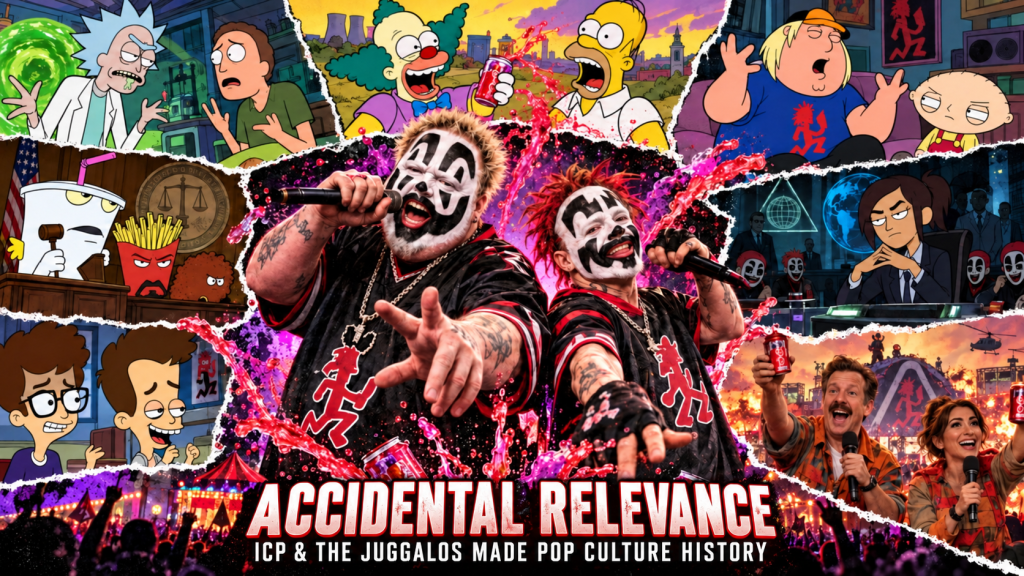
The Accidental Relevance: How Insane Clown Posse and the Juggalos Became Pop Culture History
Best of Wyrd Media, Through GsG Goggles

You do not have to like Insane Clown Posse. That argument can stay in the parking lot, preferably somewhere outside the Faygo splash zone.
The more interesting question is whether you can explain American pop culture without eventually having to acknowledge them.
A Detroit horrorcore duo built a world of painted faces, grotesque characters, dark morality tales, and fiercely loyal fans. Along the way, that world became material for television comedy, federal litigation, a march on Washington, and legal scholarship.
That is an unusual résumé for two wicked clowns.
Through the GsG Goggles, the story looks like accidental relevance: a subculture that became historically unignorable while much of the mainstream was still deciding how hard to laugh at it.
They built the carnival. The rest of America kept showing up.

Violent J and Shaggy 2 Dope did not accidentally build an audience. ICP’s independent operation, Psychopathic Records, their Dark Carnival mythology, and the Gathering of the Juggalos reflect sustained work at creating a world fans could enter together. A 2010 Wired profile documented the business and community that had grown around the music.
The “accidental” part is the destination.
Building your own scene is one thing. Becoming a recurring reference for television writers—and the subject of a federal appeals court opinion—is another.
The music matters to this story. So does what grew around it: a shared identity recognizable beyond the people buying the records. Critics could dismiss the songs and still recognize the face paint. A television audience could understand a Juggalo joke without knowing the track list.
Recognition travels differently from approval.
When the FBI entered the Dark Carnival
In its 2011 National Gang Threat Assessment, the FBI-administered National Gang Intelligence Center described Juggalos as a “loosely-organized hybrid gang.” The report discussed criminal activity by some subsets, but its use of the broader fandom’s name created the central dispute: what happens when a label for music fans becomes a label used in policing?
In January 2014, ICP and four individual Juggalos filed suit against the Department of Justice and FBI with the help of the ACLU of Michigan. They argued that the designation violated their rights to expression, association, and due process, and alleged consequences including police harassment and problems with military recruitment. The ACLU’s account of the litigation explains the challenge and its early appeal.
One allegation brings this story straight onto a road I recognize.
Mark Parsons ran a small Utah trucking business called Juggalo Express LLC. According to the court’s account of his allegations, a Tennessee state trooper detained him because the Hatchetman logo on his semi, combined with the gang designation, prompted suspicion that he belonged to a criminal gang.
A working truck. A music-related logo. A question about whether that identity makes its owner suspicious.
For those of us who earn a living behind a windshield, that makes the dispute considerably less abstract.
A consequential fight, with an important limit
The plaintiffs won an appeal in 2015 establishing their standing to challenge the designation. In December 2017, however, the Sixth Circuit upheld a later dismissal: the report did not constitute “final agency action” reviewable through the Administrative Procedure Act.
That was not a ruling declaring the designation unconstitutional. It was also not a finding that every Juggalo was a gang member.
In its open letter following the decision, the ACLU reported that government attorneys distinguished criminal subsets from the wider fanbase during the litigation. It also noted that the subsequent gang reports it discussed did not mention Juggalos, while criticizing the FBI’s refusal to issue a corrective statement to local police.
The constitutional challenge ended without the sweeping courtroom victory fans had sought. Its cultural significance extended beyond that outcome.
On September 16, 2017, Juggalos marched in Washington to protest the gang classification. The identity that brought people together around music had become a basis for public organizing over civil liberties.
And the dispute really did enter legal scholarship. A note in the Cornell Journal of Law and Public Policy, “Clowning Around with Final Agency Action,” used the Juggalo case to examine the barriers to challenging government actions whose consequences arise through other agencies and officials.
The clowns made the law journal.
At that point, “just a weird band” becomes a fairly incomplete description.
Television kept saving them a seat
The television evidence tells a different part of the story.
These references vary. A title pun is lighter evidence than a whole episode, and a parody does not automatically express affection. Taken together, though, they show writers repeatedly finding ICP and Juggalo culture useful as recognizable material.
Rick and Morty: the easy target becomes the joke
In “Raising Gazorpazorp,” Jerry invokes Insane Clown Posse while discussing something apparently harmless becoming dangerous. Rick responds by mocking how dated and easy the target is.
That is the particularly delicious layer: the scene makes fun of making fun of ICP.
The writers expect enough recognition for both the reference and the criticism of the reference to work. Through these goggles, that illustrates how established the joke had become.
Somewhere along the road, the underground clowns became familiar enough that a smarter-than-thou cartoon scientist could complain about the quality of the clown jokes.
Saturday Night Live: the underground gets a recurring commercial
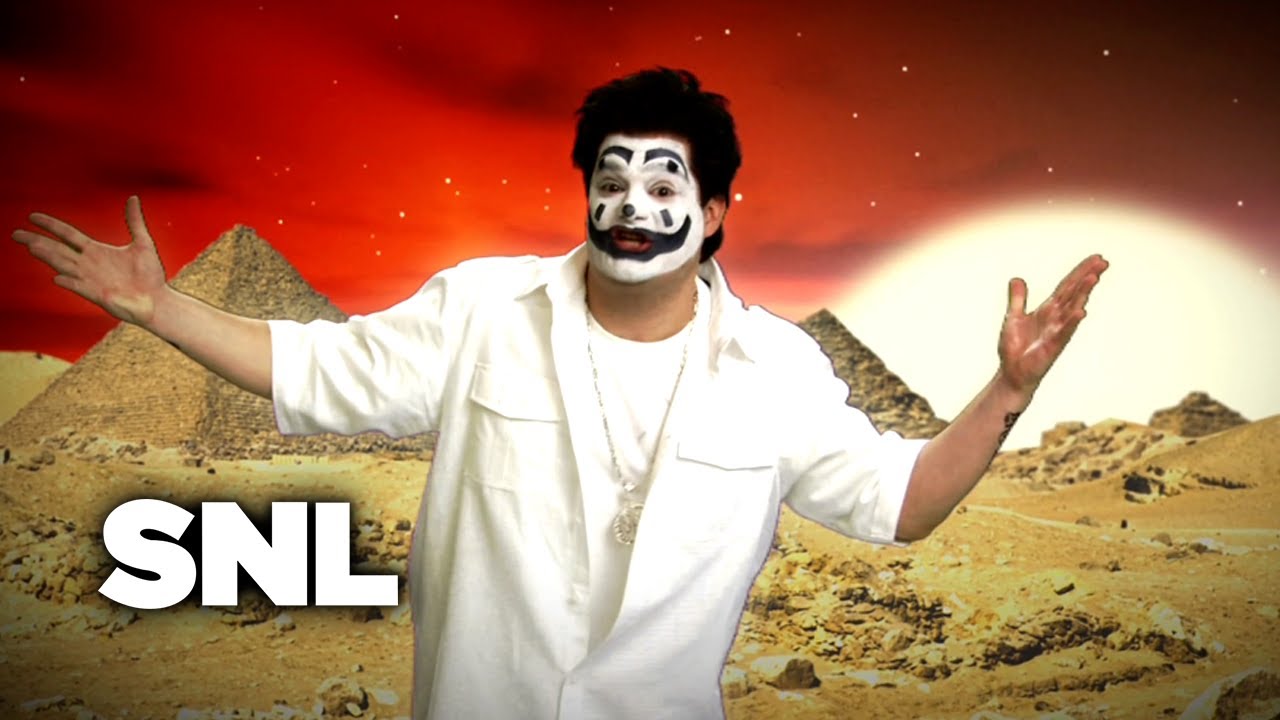
SNL’s Kickspit Underground Rock Festival sketches exaggerated the promotional style of the Gathering of the Juggalos into a barrage of absurd attractions, outrageous names, and escalating festival chaos. The original sketch aired in December 2009, and the recurring sketch history traces its return appearances.
The show also parodied ICP’s “Miracles” video in a sketch aired April 17, 2010. An official SNL upload preserves it under the title “Outrageous Clown Squad (Kickspit Dirt Festival).”
That gave the comedy two routes into the same world: the event around the music and the music itself.
The carnival supplied enough recognizable material to bring the joke back.
Aqua Teen Hunger Force: the clowns enter the cartoon

Aqua Teen Hunger Force went beyond a passing name-drop with an episode titled “Juggalo,” featuring Violent J and Shaggy 2 Dope as themselves.
Adult Swim lists the episode in its catalogue, and the Houston Press’s review of the show’s musical guests describes ICP’s involvement in its courtroom storyline.
Here, the duo becomes part of the absurd machinery of the episode.
A reference can pass by in seconds. An appearance makes the clowns participants in the cartoon’s own history.
Family Guy: Chris has very specific musical requirements
In Family Guy’s “Chris Has Got a Date, Date, Date, Date, Date,” a conversation about Taylor Swift reveals Chris Griffin’s musical priorities.
If an act is “neither insane, nor clowns, nor a posse,” he is not interested.
The joke turns the band’s name into a checklist for his taste. No biography required.
It is a small reference, but it demonstrates the point neatly: the writers trust the name to do the work.
The Simpsons: a title-sized footprint
The Simpsons was making a title joke out of the name back in 2000.
“Insane Clown Poppy” is season 12, episode 3, originally aired November 12, 2000. Its story concerns Krusty’s discovery that he has a daughter, as the episode listing describes.
This is a title pun rather than an ICP guest appearance or a story about Juggalos. Even at that smaller scale, it belongs in the record: the name was recognizable enough to become part of the show’s wordplay.
The clown shoes have been leaving footprints for a while.
Big Mouth: the fans keep the scrapbook
Fans also circulate a clip titled “Insane Clown Posse // Big Mouth,” adding that show to their scrapbook of animated references.
This is a smaller, less firmly documented example than the direct dialogue and guest appearances above. The “Octagon of Death” scene associated with the reference is a fight in “Sleepover: A Harrowing Ordeal of Emotional Brutality.” The episode transcript establishes that context; it is not an ICP concert.
Its inclusion here rests on the fan-circulated visual reference.
The collecting itself is part of the story. Fans notice, archive, and share moments that might otherwise disappear into an episode’s background. They are assembling a scattered cultural history that television itself rarely gathers in one place.
Inside Job: promoted to the shadow government
Inside Job takes the premise considerably further. In “How Reagan Got Her Grove Back,” Juggalos appear among the secret societies exercising power behind the scenes. Coverage of the episode highlights the show’s joke that they secretly control global finance.
The episode also plays with their outsider identity: characters who feel disregarded find an unexpectedly welcoming pitch from the painted posse.
The humor depends on the collision between a ridiculed subculture and an elite conspiracy. The people treated as society’s punchline turn out to have seats at the table where the world gets managed.
From the GsG deck, that is a delightful promotion.
For a sampling of the animated appearances and references that prompted this discussion, there is also the fan compilation “Insane Clown Posse Appearances/References in Cartoons, Part 2.”
The strange immortality of being the punchline
The combined footprint is what makes the case for this accidental relevance.
There is an independently built music community. There is a federal report and the litigation challenging it. There is a Washington protest. There is legal scholarship. There are television references stretching across different shows and different forms of comedy.
Those are distinct places where the culture has left a record.
And here is the irony: mockery can help preserve the thing being mocked.
A joke sends a name into another audience. A parody preserves recognizable habits and imagery. A cartoon cameo leaves the artists inside an episode people can revisit years later. The audience does not have to become fans for the reference to keep traveling.
That does not turn every insult into a compliment. It does make ridicule an unreliable method of making somebody disappear.
What the goggles pick up
For a creator building a strange universe, this is the part worth studying.
ICP built symbols, characters, shared language, events, and a place for people to gather. The broader culture kept reacting to what that community made visible.
The legal conflict also asks something bigger than whether the music is good: how carefully should institutions distinguish an unfamiliar cultural identity from evidence of criminal conduct?
And the television trail asks a smaller, sneakier question: if something is so irrelevant, why do we keep expecting everyone to recognize it?
You do not have to enjoy Insane Clown Posse to recognize their place in American culture.
At some point, explaining why they do not matter requires explaining an awful lot of American culture.
The accidental relevance has a sticky floor.
Watch your step. Somebody brought Faygo…….
So as you can imagine the Captain of the Ghostship Groggy, recognizing this pattern… I at least flip it on its ear by including things I find relevant into my broadcasts… & Jelly Roll sadly is a my current pop culture parody… & Alex Jones 🙈

