Wyrd Outlook by Grogh
Ghostwritten by Vikki Vexum — Pocket Librarian of The Wyrd Hereafter
Super Trains Before Tesla Trucks &
Super Truckers at the Captain’s Wheel
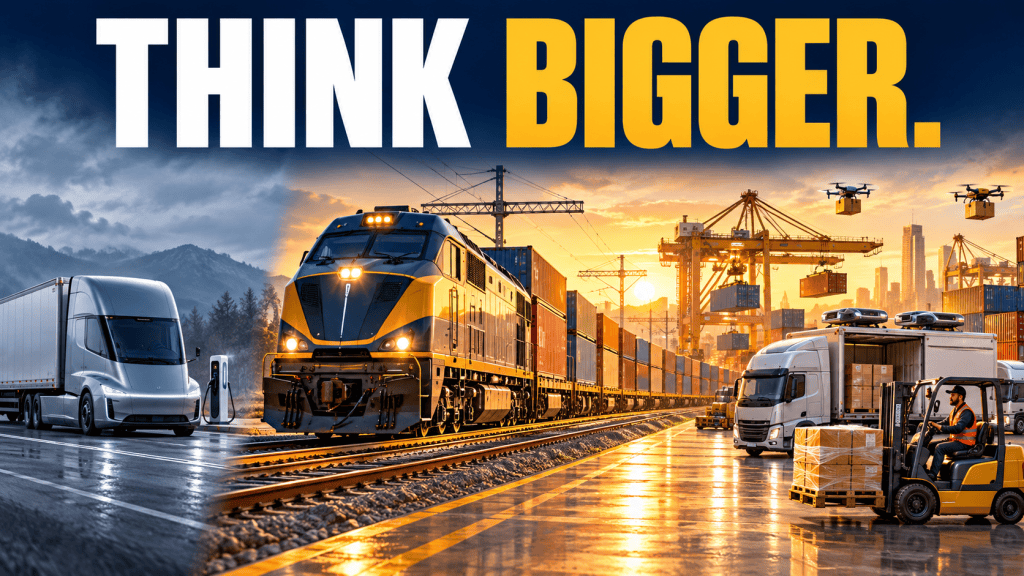
We keep imagining the truck of the future. I want us to imagine the transportation system of the future—and give the people operating it a future worth showing up for.
As a trucker, I have a proposal: make a major investment in super trains, build super trucks to connect with them, and develop super truckers capable of commanding the whole operation.
Move more freight. Make the equipment smarter. Make the people more capable. Pay them for that capability.
There is an enormous opportunity here for engineers, manufacturers, transportation workers, and inventors willing to think beyond replacing whoever currently occupies the driver’s seat.
Start Where the Bulk Belongs
If we want to maximize transportation over land, rail deserves a much bigger place in our imagination.
We already put shipping containers on trains, double-stack them, and connect those movements with trucks. Intermodal transportation—the movement of freight between rail, road, and ships—is an established foundation we can build upon. (aar.org)
My hypothesis is that we should push that foundation much further.
Imagine high-capacity freight corridors with intelligently coordinated departures, continuous equipment monitoring, efficient transfer terminals, and truck appointments synchronized with arriving loads. Every stage would be designed around moving useful freight through the entire journey.
That is what I mean by a super train system.
Speed belongs in that ambition. So do capacity, reliability, maintenance, and rapid transfers. A magnificent train that arrives at a clogged terminal has delivered its cargo to the next traffic jam.
The goal should be more freight delivered dependably for the resources we invest.
Put Intelligence Across the Network
Automated freight trains already exist in specialized settings. Rio Tinto’s AutoHaul operates heavy-haul trains between mines and ports in Western Australia. That is a real example of automation working within a controlled rail network, although it does not establish that the same approach fits every route. (riotinto.com)
It gives us somewhere concrete to begin.
A fixed route creates an opportunity to coordinate the vehicle, track, signals, maintenance, and destination as one system. Advanced intelligence could help plan loads, anticipate equipment problems, organize transfers, and reduce unnecessary waiting.
The question becomes bigger than whether a machine can steer a truck.
How much better could transportation become if we intelligently coordinated the entire movement of freight?
“Tesla Trucks” in this headline represents that race toward futuristic vehicles. Electric trucks and driverless trucks are separate choices. My challenge concerns where we place our ambition and investment—especially when removing the driver becomes the centerpiece of the sales pitch.
Build the Super Trucker Alongside the Super Truck
At the regional end of this network, I envision a highly capable transportation professional.
The trucker drives, understands the equipment, manages cargo, and works with intelligent assistance. More freight moving by rail could support more local and regional driving opportunities. Making those good jobs—with professional pay and more opportunities to return home—should be an explicit design goal.
Then build the truck around that professional.
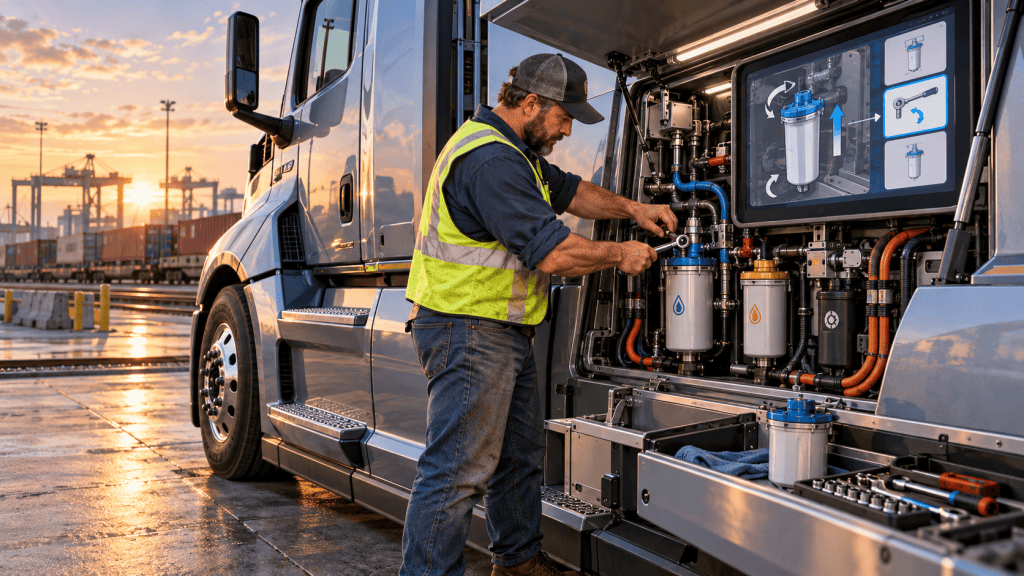
Make routine maintenance accessible. Label components clearly. Provide straightforward service points and replaceable modules where practical. Give the operator useful diagnostic information and instructions they can actually follow.
The trucker should not need to memorize an entire technical library. Onboard intelligence could bring up the appropriate procedure, explain what a reading means, and guide maintenance within the operator’s training.
Keep essential instructions available when the connection disappears, too. A truck should not need excellent cellular reception to explain why it is having a bad afternoon.
Specialist mechanics remain essential. The opportunity is to give operators a larger, clearly defined ability to care for their equipment—and recognize when expert help is needed.
Build a vessel its captain can learn to know.
Give Delivery Trucks Serious Cargo-Handling Capability
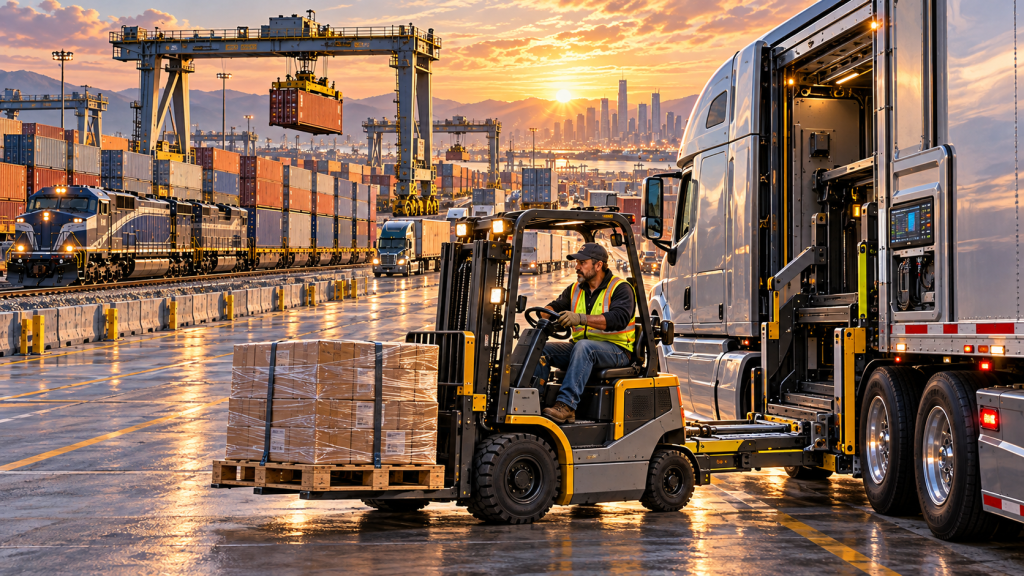
That ambition should extend to loading and unloading.
I have operated a truck-mounted forklift, and that experience left me wanting something substantially better. There is room for invention here.
Imagine delivery trucks designed from the beginning with excellent cargo-handling equipment: machinery that stores intelligently, deploys easily, maneuvers effectively, and can be maintained by a properly trained operator.
Perhaps that means a superior onboard forklift. Perhaps an integrated lifting system, a different trailer arrangement, or an invention somebody reading this has already begun sketching.
The mechanism is open. The objective is clear: give suitable delivery trucks dependable self-loading and unloading capability, with equipment worthy of the professional using it.
Different freight will require different solutions. Drivers who work at actual delivery sites should help design and test them.
Every additional capability needs training, paid working time, and compensation. We should be developing a stronger profession with better tools and greater earning power.
A Wild One off the Captain’s Head: The Delivery Mothership
Now take that thinking a little further.
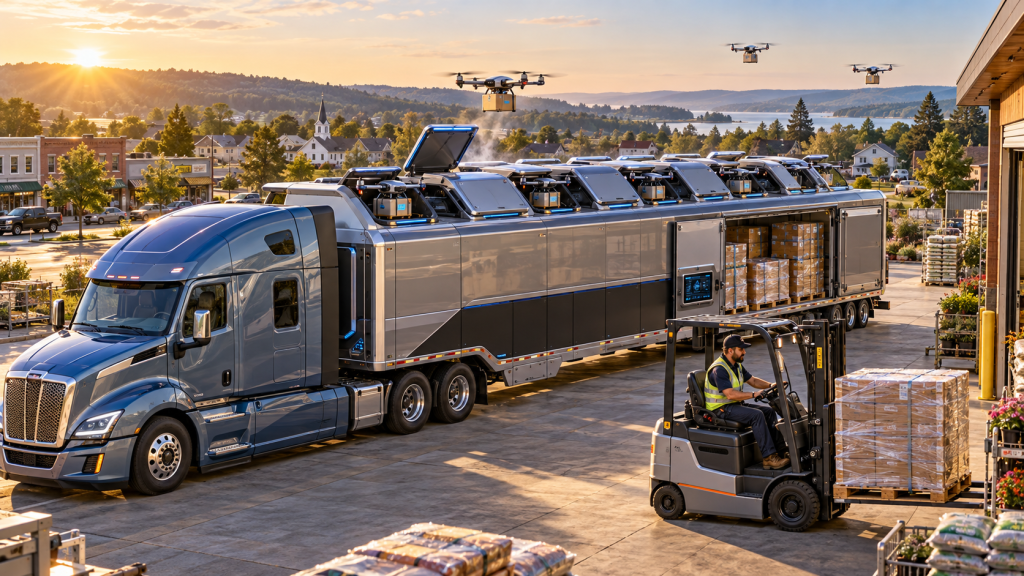
What if a super truck’s trailer carried a dozen delivery drones?
The truck transports the area’s freight together. At suitable stops, the captain handles larger deliveries while onboard drones take smaller packages to nearby destinations. The trailer becomes a mobile delivery base, designed with secure package compartments, charging facilities, and launch-and-return equipment.
Now we are giving that trucker a much larger reach.
Could one captain coordinate several deliveries while completing another personally? Could the right combination of truck, route, and intelligent assistance double—or even quadruple—the deliveries accomplished in a working day?
That is a possibility worth testing, rather than a performance claim we can make today.
The intelligent system would organize dispatches, track aircraft and packages, and flag exceptions. The captain would have a manageable supervisory role, with authority to pause operations and resolve problems. A dozen drones should not mean twelve simultaneous distractions for someone driving a semi.
Weather, payload, battery range, safe delivery locations, and aviation permissions would shape where this works. Those are design challenges for the inventors joining the conversation.
The economic design matters just as much: if one professional becomes capable of coordinating substantially more deliveries, that increased capability should increase their earnings.
This is one possible branch of the grand idea. The rail network carries freight in bulk. The truck carries a coordinated group of deliveries into an area. Smaller equipment extends the captain’s reach from there.
The captain brings the mothership. The smaller deliveries take wing.
Could Some Super Trains Run Beneath Our Feet?
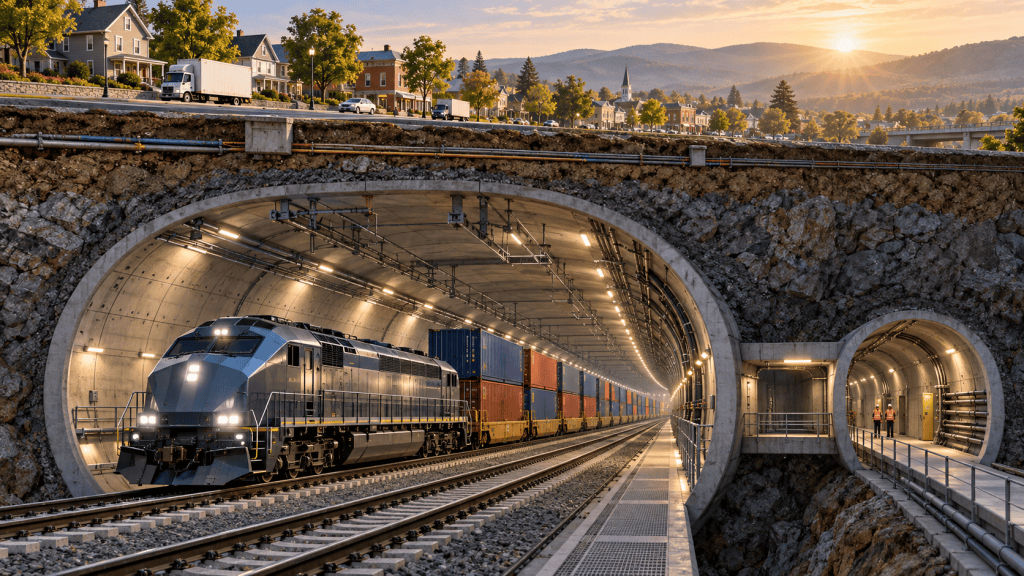
The underground deserves a place in this conversation, too.
Tunnel-boring technology could help create selected freight corridors beneath surface bottlenecks. The Boring Company—a separate business from Tesla—already lists freight among its tunnel applications. Meanwhile, the Brenner Base Tunnel project between Austria and Italy demonstrates the scale of planning underway for underground passenger and freight rail. (boringcompany.com, bbt-se.com)
Neither example proves the economics of an underground super train network. They give us reasons to investigate.
Where could a tunnel improve the route enough to justify its construction? What dimensions would the freight require? What speeds, emergency provisions, and maintenance arrangements would make sense?
Going underground would not automatically deliver extreme speed or make every route economical. Each corridor would need to earn its place.
Surface routes, upgraded existing tracks, and new tunnels could all contribute. The opportunity is to give engineers a clear objective and room to find the best combination.
Keep a Captain at the Wheel
My governing principle is that transportation needs accountable human command.
Even with a “ghost captain”—an automated system doing much of the operating—we need people who understand the vessel, recognize trouble, and retain the practiced skills to respond.
That requires deliberate investment: hands-on training, meaningful authority, time to maintain proficiency, and equipment designed for human understanding and intervention.
A captain should know what the machinery is doing, what its limits are, and what to do when assistance becomes a problem of its own.
We also need an honest transition for workers whose existing jobs change. More rail freight would change some long-haul trucking work. Good regional opportunities, training, and fair compensation must be part of the proposal from the beginning.
Getting drivers home more often only counts as progress if they can still afford the home.
An Invitation to Build
Here is the grand idea I am putting on the table:
Maximize bulk movement with super trains. Connect it with intelligently designed super trucks. Invest in super truckers trained and paid to command them.
The details are open for invention.
Bring better lifting equipment, better terminals, better maintenance designs, better rail corridors, delivery motherships—and ideas we have not imagined yet. Put transportation workers in the room while those ideas are being developed. Their experience belongs in the blueprints.
Judge the results by freight delivered, reliability, resource use, working conditions, and the capability of the people running the system.
Let’s build a transportation future that gives our machines extraordinary capability—and gives the people at the captain’s wheel the tools to match.

