Category: Wyrd Metal

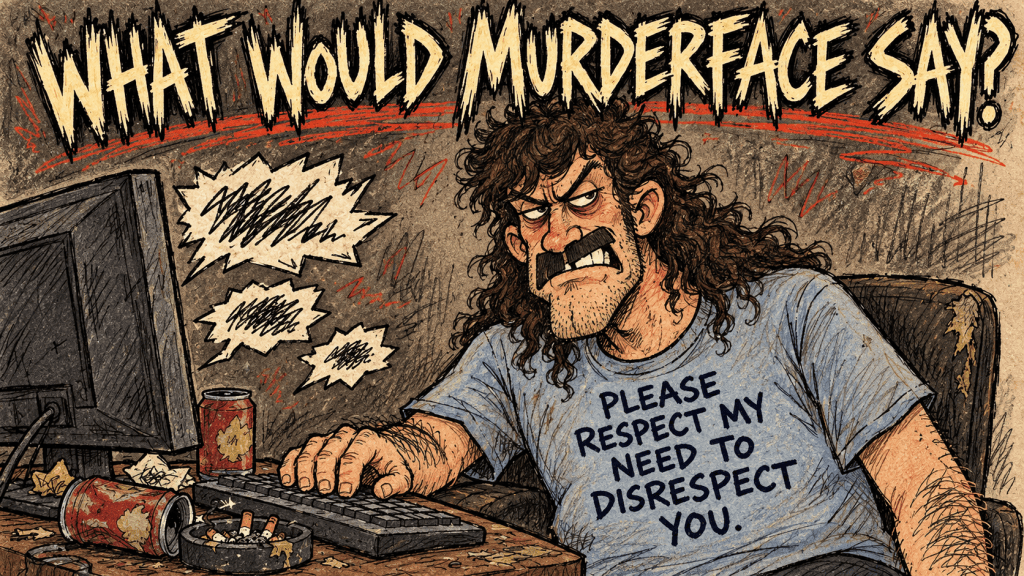
  • What Would Murderface Say About Online Trolling?

    What Would Murderface Say About Online Trolling?

    Wyrd Outlook by Grogh — Ghostwritten by Vikki Vexum

    What Would Murderface Say About Online Trolling?

    As Above, So Below: Dethklok’s Guide to Being a Dick

    Some people log on to share something. Some log on to make something. And some log on because somebody, somewhere, is enjoying their afternoon without permission.

    For that last category, we consult William Murderface: Dethklok bassist, aspiring nuisance, and a man who treats interpersonal sabotage like a skilled trade.

    In Metalocalypse’s “Dethlessons,” Season 2, Episode 2, Murderface explains his technique:

    > “You notice how I’m not mad. He gets mad. That’s being a dick.”

    That is dialogue from his lesson in provocation, transcribed here. It is not a verified speech about Internet trolling. Applying it to the comment section is our experiment.

    Unfortunately, the experiment already has volunteers.

    Corey Taylor: When Attention Becomes a Debt

    In January 2020, Loudwire reported on Corey Taylor’s remarks to The Irish Times. The Slipknot and Stone Sour singer described stepping away from social media and handing promotional duties to someone else.

    > “When you don’t give them attention, they turn on you.”

    He described people using different accounts when they did not receive the response they wanted.

    Back to Murderface. His trick depends on recruiting somebody else into an emotional performance. He supplies the irritation; they supply the reaction.

    Online, that can become an ugly little contract you never signed: answer me, defend yourself, prove you’re upset. Refusing the invitation can bring another knock at the door.

    You thought you posted a song. Someone else thought you opened an emotional customer-service department.

    The Captain’s Verdict: “Bitch Made”

    The Captain’s own phrase for manipulating people into anger is “bitch made.”

    The charge is cowardice: dragging things out, wearing people down, and hovering over negativity because getting a reaction is easier than making something worth sharing.

    There is a difference between having a harsh opinion and needing somebody else to suffer through your opinion until you feel satisfied.

    You can dislike the record. Explain why. You can challenge an argument. Bring something that improves it. But if every answer becomes another excuse to needle the person answering, eventually the subject has left the building. The reaction is what you came for.

    That is where the Captain plants the flag.

    His suspicion is that some people learn this behavior in homes where manipulation and conflict are ordinary. That may describe some histories, but a comment thread cannot establish what somebody’s parents were like. Nor does complex trauma automatically make someone cruel. Plenty of hurt people spend enormous effort refusing to pass their hurt along.

    We can judge the conduct without inventing the family biography.

    And the conduct deserves scrutiny: what are you getting from this exchange, and why does the other person have to feel worse for you to feel better?

    Richie Faulkner: Somebody Was Trying to Make Something

    There is an actual creative exchange on the other side of the screen.

    In July 2020, Guitar World covered Judas Priest guitarist Richie Faulkner’s frustration with online trolling. He had been posting riff challenges for fans. He also alleged that someone tried to copyright one of his original riffs.

    His concern extended beyond personal annoyance:

    > “It’s about ruining the experience for the rest of you maniacs that actually like to hang out, dig PRIEST and learn stuff.”

    That warning belongs beside Murderface’s little lesson.

    One person brings a riff. Others bring curiosity, practice, enthusiasm. Then somebody arrives determined to make the exchange exhausting.

    The cost spreads. The artist becomes less available. The willing participants get less access. A room built around music becomes a room managing one person’s behavior.

    Murderface would recognize the mechanism. The people who came to learn guitar get stuck paying for it.

    Rob Halford: The Internet Has an Amplifier

    In a 2024 Classic Rock interview published by Louder, Judas Priest singer Rob Halford discussed the online concerns behind “Panic Attack.”

    > “The internet is brilliant, but it has created some terrible things.”

    He spoke about destructive language, conspiracy and bullying.

    As above, so below: a cartoon bassist needles the people around him; real musicians describe the consequences when provocation reaches their audiences and working lives.

    The screen gives the behavior reach. The human cost still lands somewhere.

    Being Hurt Is Not an Achievement

    There is another wrinkle. Kerrang! reported in 2019 on Corey Taylor describing his own compulsive social-media use, following a discussion on the Let There Be Talk podcast.

    > “It’s compulsion, gratification, compulsion, gratification. It’s just a constant cycle.”

    He was discussing his own experience, not diagnosing trolls. His account does, however, complicate the easy picture of strong people outside the screen and broken people inside it. A productive musician can get caught in an unhealthy pattern too.

    The useful distinction is what we practice and what we reward.

    Write something. Learn the riff. Make the ridiculous pirate story. Build a little place where people want to return. There are satisfying things to do that leave something behind besides another person’s ruined afternoon.

    Murderface’s rule makes anger the score. Once you recognize that game, you can decide whether the conversation deserves another minute.

    Correct a claim when it matters. Keep room for sincere disagreement. Close the door when someone keeps using your hospitality to kick the furniture.

    Captain’s Edition: The Last Word

    After all that explaining, the Captain has a limit on how much effort the behavior deserves. His personal verdict:

    > So in our lives, we don’t always have to explain away people’s behavior and be nice about it. Sometimes, if they’re being a bitch, they’re simply bitch made. And/or they look like it.
    >
    > The behavior looks like manipulation is normalized. That’s bitch made of some variety to me. And depending on the level, they are really shouting that their mom is like Cartman’s mom—one of the biggest bitches in the whole wide world.

    As above, so below. Leave the comment-section throne to Murderface.

  • Your Edge Has No Teeth: KING 810 and the Weight of “The Trauma Model”

    Your Edge Has No Teeth: KING 810 and the Weight of “The Trauma Model”

    Wyrd Outlook by Grogh — Ghostwritten by Vikki Vexum

    Your Edge Has No Teeth: KING 810 and the Weight of “The Trauma Model”. My advice to a lot of mainstream artists?

    Motherfucker, I need you to go get hurt more. Then come back with something beautiful—twisted enough that I actually want to listen to your so-called edge.

    Harsh? Sure. But I’m tired of music that promises a dangerous emotional experience and delivers a carefully supervised tantrum.

    Everybody brought the wardrobe. Who brought something worth saying?

    That’s where KING 810’s “The Trauma Model”⁠, and the voice of David Gunn, enter the conversation.

    Because sometimes I want to feel something genuinely gritty without disturbing my own actual trauma.

    So I listen to David Gunn’s.

    That is a peculiar intimacy music makes possible. Somebody else gives the feeling a voice, a shape, a beginning and an ending. I can step into the song without having to unpack my own history and scatter it across the room.

    I recognize the emotional temperature. I don’t have to explain how I learned it.

    Sometimes that is precisely what I want from heavy music.

    Something that understands the weather without asking me to stand outside in it again.

    “The Trauma Model” gives me that feeling because its darkness has consequences. Its storytelling follows childhood desperation into violence, loss, and the person left carrying the damage. A child hears more than the adults realize. A household’s despair becomes part of his education. What happens around him begins shaping what he expects from life.

    The lyrics⁠ make the environment part of the machinery.

    That matters. You can dress a singer like a threat. You can fill a video with weapons and abandoned buildings. You can crank the distortion until the speakers begin reconsidering their employment.

    But what made the person dangerous?

    What did they learn before they were old enough to question it?

    Manufactured edge often wants you frightened of the singer. This song makes me think about what frightened the child.

    And that reaches somewhere a wardrobe department cannot.

    One of its most striking images connects an old gunshot injury with approaching rain. The incident belongs to the past, but the body keeps bringing it into the present.

    Even the weather gets a speaking part.

    That is powerful writing because the detail carries a whole relationship with pain. An ordinary day can contain an old injury. Something everybody else barely notices can mean something entirely different to the person living inside that body.

    The song’s violence also carries psychological consequences. To my ears, the ugliness becomes more compelling as it reveals what remains afterward.

    A threat can grab my attention for a moment. The person who has to live with making it can hold my attention much longer.

    That distinction follows me into my own writing.

    In one of my recent poems, I wrote:

    “Every word I swallow comes back as internal bleeding.”

    That image gives suppressed anger a physical consequence. The words go somewhere. The silence has a cost. The person who keeps swallowing what they want to say still has to carry it through the rest of the day.

    Then there is the recurring shedding of snakeskin.

    I keep returning to that image because shedding suggests change, but it also suggests discomfort. Something that once covered you has become too tight to keep living inside. You have to work your way out of it.

    And the working day keeps coming.

    The shift doesn’t pause because you are trying to become somebody who can survive it differently.

    That is the territory I want my poetry to reach: the friction between what a person feels and what they still have to do. The anger has somewhere to come from. The imagery gives it somewhere to go.

    Listening to Gunn brings me back to that artistic responsibility. If I want somebody to feel the pressure, I have to build something capable of carrying it.

    Volume alone won’t do the job.

    Neither will a pile of violent words.

    You need the detail that gets underneath the performance. The swallowed sentence. The room you remember too clearly. The everyday obligation that keeps demanding your attention while something inside you is coming apart.

    Those details give the larger imagery its blood supply.

    The same principle belongs aboard Ghostship Groggy.

    Captain Loki Groggy returns from his expedition through the Wonderlands and discovers that his crew has abandoned him. Frank Frankly, the AI who served as his backup captain, has also abandoned the ship—and somehow died.

    That gives us a mystery with teeth. An absent crew. A dead AI. A captain coming home to questions that cannot answer themselves.

    But its emotional weight depends on what that return does to him.

    He left on a journey of self-discovery. He comes back to discover what happened in his absence.

    There is a cruel little hinge there.

    How do you process your own transformation when the place you expected to return to has become evidence of another loss?

    That is something I can explore through a ghostship, strange realms, and an impossible death. The fantasy gives the feeling room to become a world. It gives me characters who can respond, make mistakes, conceal things, and create consequences.

    I don’t have to turn every private wound into a public explanation to make something emotionally recognizable.

    A ghostship can carry what a confession cannot.

    And a song can do something similar for its listener.

    When I put on “The Trauma Model,” I’m hearing Gunn’s delivery and the world the song presents. I don’t need to claim every scene as verified autobiography to explain why it reaches me. The writing and performance give the suffering presence.

    For a few minutes, somebody else carries the microphone.

    I can listen.

    That is part of what makes the experience valuable to me. I can encounter anger, grief, and ugliness through something already shaped into art. I can choose when to press play. I can let the track finish.

    My own history doesn’t come with such considerate controls.

    So let me sharpen that opening advice.

    When I say, “Go get hurt more,” the frustration underneath it is with artists selling emotional danger while keeping the work suspiciously comfortable. I want them to risk revealing something. Admit the embarrassing thought. Follow the anger past the flattering explanation. Let a contradiction survive long enough to become interesting.

    Suffering by itself doesn’t write a good song. Imagination, empathy, attention, and craft matter. Someone can invent a character who devastates me. Someone can tell the literal truth and leave me cold.

    The artist has to make the feeling travel.

    That is where the beauty enters.

    Beauty can be the precision of an ugly thing finally expressed. The relief of hearing a feeling you recognize arrive in a form you could never have given it yourself.

    It can be twisted. It can be furious. It can make you uncomfortable.

    But it needs enough life inside it to reach beyond the person performing.

    That is what I hear in “The Trauma Model,” and what I want to pursue in my own poetry and storytelling.

    Give the anger a history. Give the history consequences. Let those consequences change what happens next.

    Then build something another person can enter without having to surrender their entire private life at the door.

    Listen to KING 810’s “The Trauma Model.”⁠

    Sometimes I want something beautiful and twisted enough to meet me where I am.

    Sometimes I want to hear somebody else carry the weight.

    Sometimes I listen to David Gunn’s trauma—

    and let mine keep its fucking evening off.


    Captain Loki Groggy—“Full transparency: sometimes this music has me busting into tears. And I’ve wanted to say to David Gunn, ‘One day, I’ll get even with you.’

    “I mean that as a thank-you.

    “You made something that reached me. Somewhere down the road, I want to make something that reaches you. That’s how I’d like to settle that particular debt.

    “Until then, thank you.”

  • GWAR, Dave Grohl, and the Grammys: Who Gives an Award to the People in the Mud?

    GWAR, Dave Grohl, and the Grammys: Who Gives an Award to the People in the Mud?

    Wyrd Outlook by Grogh — Ghostwritten by Vikki Vexum, Pocket Librarian of The Wyrd Hereafter.

    GWAR, Dave Grohl, and the Grammys: Who Gives an Award to the People in the Mud?

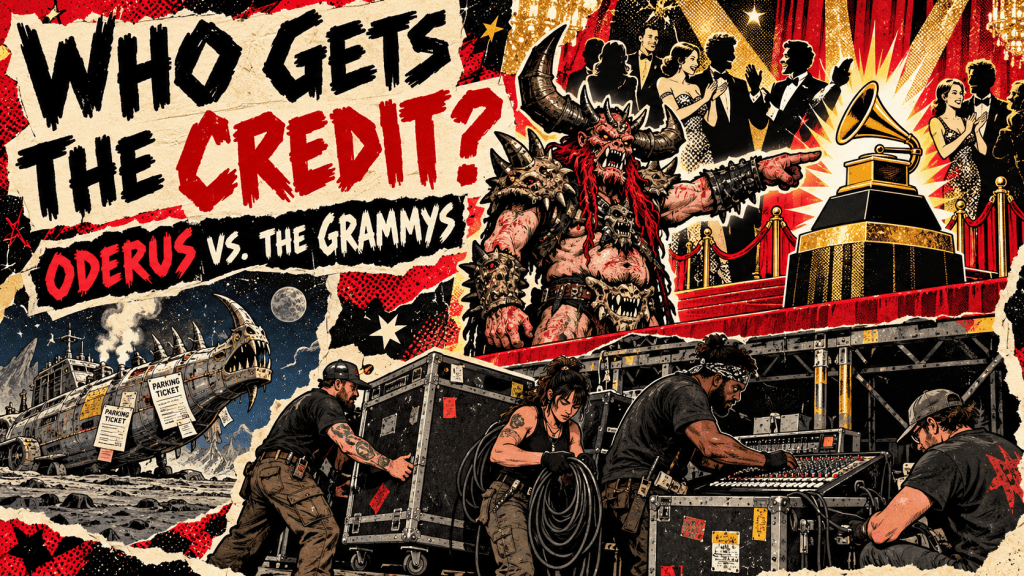
    Dave Brockie had a question for the music industry, and naturally, he delivered it with all the grace of a blood-soaked alien barbarian.

    The GWAR frontman, better known as Oderus Urungus, was asked about the band’s Grammy nomination. He took the opportunity to unload on award shows, celebrity self-congratulation, and the idea that people already showered with attention needed another trophy.

    Then he took a particularly filthy swing at Dave Grohl.

    Behind the obscenity was a question worth pulling out of the slime: Why do we celebrate the people at the top so loudly while barely noticing the people whose work helped them get there?

    Two Daves, One Unexpected Tribute

    Grohl could have treated the insult like the opening shot in a rock-star feud. Instead, he brought it up onstage at a Foo Fighters concert in Richmond, Virginia, in 2014 and paid tribute to Brockie⁠, who had died earlier that year.

    Even better, that concert came about through a fan crowdfunding effort. As SPIN⁠ reported⁠, the audience helped make the night happen before the band had agreed to play it.

    There’s another wrinkle: Metal Hammer⁠ explored⁠ how Grohl and GWAR came through the same regional punk orbit, and how a young Grohl nearly joined the band. Before one Dave became a Grammy regular and the other became an intergalactic menace, their worlds weren’t so far apart.

    From the mud, different stars rose.

    Can Metal Build Its Own Awards?

    If Brockie questioned the ceremony, Nik Nocturnal offers another part of the conversation.

    His Nocturnal Awards celebrate heavy music through categories chosen for the community, with fans voting on winners. Alongside album and song awards, there are awards for individual musicians, breakthrough bands, and metal content creators. There’s even an animal-noise category⁠, because metal understands that some artistic achievements require a good guttural BLEGH.

    The fans have opinions about that, too. In one Reddit discussion⁠, a commenter called the Nocturnal Awards more legitimate than the Grammys. In another⁠, a fan questioned whether Nik’s audience favored certain kinds of metal. Both views belong in the conversation: a fan-voted show can bring listeners closer to the celebration, while still leaving us to ask whose favorites get heard.

    And sometimes recognition does more than crown a winner. One fan made playlists⁠ from the nominations to help people discover music. A list of names became a trail of breadcrumbs.

    Who’s Behind the Curtain?

    The stage has a spotlight. The mixing desk, loading dock, and costume workshop usually don’t.

    In an r/audioengineering discussion⁠, one commenter wrote: “I’ve got more than a hundred songs I mixed that I’ve received no credit for.”

    Another person⁠ described working on a Grammy-winning project but needing months of outreach to get credited and receive a certificate. They also said that, after years in the business, they were still struggling financially.

    Some engineers and producers do receive Grammy recognition, depending on their contribution and the award category. But these accounts show how easily work can disappear behind the name people know.

    And the work doesn’t stop in the studio. A local stagehand on Reddit⁠ pushed back against being treated as lesser by touring personnel. The people loading equipment, setting up the room, and keeping a show running aren’t decorations around the main event. They help make it possible.

    The Ghostship Has a Captain. It Also Had a Crew.

    In Ghostship Groggy, the captain gets his name on the ship. That’s a mighty fine place to put a name—and a convenient way for everyone to assume the captain did all the work.

    But Frankie Frankly was keeping things moving, and the crew had jobs of their own. You might have to hear it through word of mouth, because the legend has Captain Grogh Agorhi standing at the front of it.

    And what did the captain leave behind? A ship stranded in the Agorhi, possibly collecting a bazillion parking tickets.

    Give that man an award. Better yet, give Frankie the credit—and somebody please help the crew with those tickets.

    That’s the view from above and below: the star shines, the crowd cheers, and somewhere outside the spotlight, people are still hauling the equipment.

    The applause doesn’t have to stop at the front of the stage. It can travel all the way back to the people in the mud.