Category: Wyrd and Nerdy

  • How to Understand Alternative and Weird Cultures: They’re the Foodies of Fashion, Music, and Art

    How to Understand Alternative and Weird Cultures: They’re the Foodies of Fashion, Music, and Art

    Wyrd Outlook by Grogh — Ghostwritten by Vikki Vexum

    How to Understand Alternative and Weird Cultures: They’re the Foodies of Fashion, Music, and Art

    You don’t have to share my taste. I want you to understand what goes into developing it.

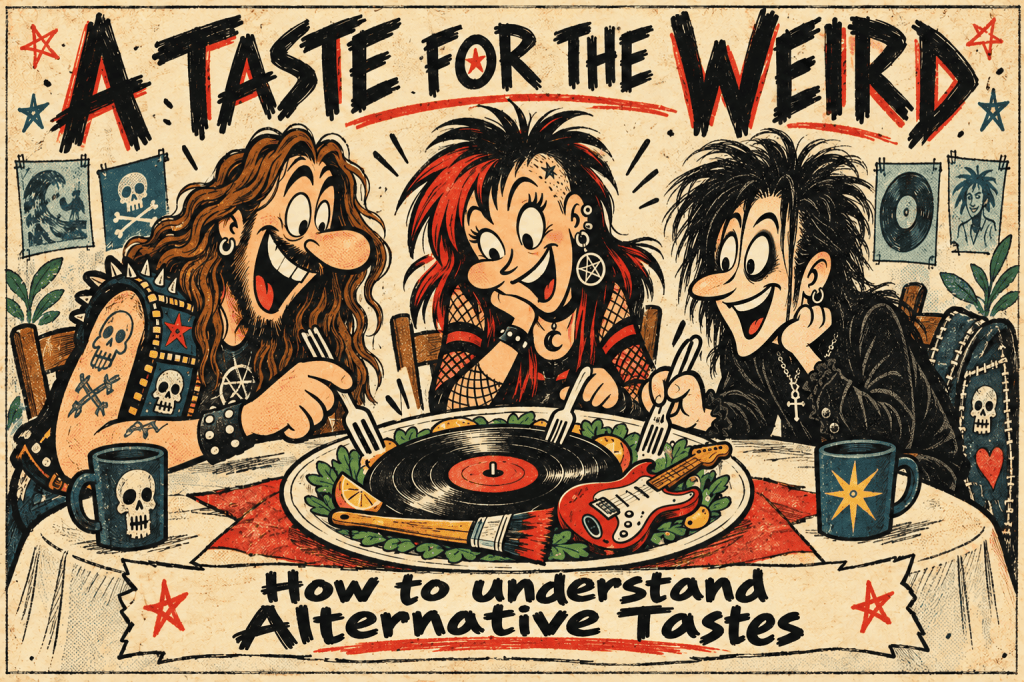
    If you want to understand alternative and weird cultures, try seeing their explorers as the foodies of fashion, music, and art.

    Think about a foodie.

    Someone who explores unfamiliar dishes, learns ingredients, follows a flavor into another culture, and eventually starts experimenting in their own kitchen. Their enjoyment deepens as they learn to recognize the details. They discover combinations they never knew they wanted.

    Now carry that curiosity into a record store. A wardrobe. An art gallery.

    Through the Captain’s goggles, that familiar appetite offers a way into an unfamiliar world.

    And some of us have been seasoning this strange stew for decades.

    Fitting in is not everybody’s destination

    There is an assumption that people enter a subculture primarily to find a crowd that will accept them.

    That can happen. But it misses the pursuit I want to explain: discovering what you actually like and developing a personal world around it.

    You hear something that catches your attention. You find an image that stays with you. You imagine clothes that nobody around you wears.

    So you investigate.

    The reward can begin long before you meet anyone who shares your interest. There is pleasure in finding the thing itself, learning its details, and recognizing what it awakens in you.

    Alternative, punk, goth, and metal communities have different histories. They are not interchangeable, and no single motive explains everybody within them. What I am describing is the creative approach I value across those worlds: curiosity becoming deliberate personal taste.

    Someone else’s approval is a poor substitute for that discovery.

    A palate develops through attention

    A curious eater might begin with one unfamiliar dish. Something catches their attention: the heat, the texture, an ingredient they cannot identify.

    Music can unfold the same way.

    You hear a guitar tone that grabs you. You follow it to another band, then an earlier influence, then a musical tradition you had never explored.

    Eventually, distinctions emerge from what once sounded like a wall of noise. You recognize the rhythmic feel. You hear how a voice works against the instruments. You notice the space between heavy passages and the unusual way a song builds tension.

    Your enjoyment acquires detail.

    Fashion offers its own education. You start noticing silhouette, fabric, movement, construction, historical references, and the relationship between pieces.

    Somebody else sees a black jacket.

    You see why that jacket belongs with those boots, why its worn texture matters, and what one handmade alteration could do to the arrangement.

    A person who has spent years exploring these things may have an extraordinarily practiced palate. They have experimented, made mistakes, changed their mind, and discovered pleasures that reward patience.

    We readily respect that experience in a kitchen. It deserves consideration in a wardrobe or record collection too.

    Rob Halford: when the ingredients connect

    Judas Priest’s Rob Halford gives us a useful example of artistic identity developing through experimentation.

    In a 2020 interview with Kory Grow for Rolling Stone, he described the band’s early appearance feeling disconnected from its powerful music. Trying a leather biker jacket helped the visual side begin to make sense.

    “That’s more like it. Now it’s connecting.”

    That is a moment of recognition familiar to anyone who has assembled something until it finally feels right.

    His listening also ranged across Pavarotti, Dolly Parton, Bob Dylan, and heavy music. I hear a developed palate in that combination: an artist with a strong identity and an appetite extending beyond one musical shelf.

    You can be deeply devoted to metal and still find something magnificent in an operatic voice.

    A personal taste has room to grow.

    Ordering beyond the familiar menu

    There is a place for a familiar meal. Sometimes you want exactly what you already know.

    But imagine answering every restaurant question from an adventurous foodie by pointing toward the nearest McDonald’s.

    Or suggesting their curiosity about seafood ought to be completely satisfied by Red Lobster.

    They may have something more particular in mind. A little Cajun place. A family recipe. A preparation they have never tried.

    Alternative taste often involves that same appetite.

    The familiar shopping rack may offer serviceable clothes while offering little that excites this particular person. The popular playlist may contain competent songs while missing the sound they are hungry for.

    So they keep looking.

    Some discoveries may never touch the Top Forty. Others may eventually become enormously popular. Neither outcome decides whether the work deserves your love.

    Obscurity is no guarantee of quality. Popularity is no guarantee of satisfaction. You still have to taste the thing.

    Do it yourself: learning to cook

    Eventually, a dedicated explorer may want something they cannot find.

    That is where the kitchen opens.

    In fashion, it might mean sewing, painting, patching, repurposing, or making an accessory from materials never sold as fashion supplies.

    You have an idea. The stores do not carry it. You learn how to bring it into existence.

    A jacket becomes a personal recipe.

    Punk designer Vivienne Westwood connected originality with knowledge and technique in a 2014 interview with Kristin Tice Studeman for Vogue. She stressed learning from the past, then using clothing to express your own story.

    “Then you have to use your clothes to tell your personal story.”

    My kitchen comparison fits here: knowing your ingredients and learning your craft gives you more ways to create. Westwood’s perspective makes originality something you develop through study and practice.

    You cannot sew a sleeve with an attitude alone. Eventually, somebody has to learn what the needle does.

    Sue Webster: fandom becomes a creative life

    Artist Sue Webster offers a particularly vivid account of discovery becoming personal expression.

    In Interview magazine’s 2019 feature by Jadie Stillwell, Webster recalled the importance of discovering Siouxsie and the Banshees when she was young. She drew Siouxsie repeatedly and described a jacket she customized with studs and a portrait painted in leather dye.

    “Even at that age, I would make my own clothes.”

    She also traced connections between those musical discoveries and her later work as a visual artist.

    That story carries the point beautifully. An artistic fascination can travel into your hands. You begin by appreciating somebody else’s creation, then discover things you want to create yourself.

    Fandom becomes an ingredient in your own development.

    You do not have to erase your influences to develop a voice. You can learn what they awaken in you and see where that leads.

    Rob Zombie: a whole world on the plate

    For some artists, the ingredients travel across many forms of media.

    In a 2021 Stereogum interview with Larry Fitzmaurice, Rob Zombie traced his early musical imagination to television shows such as the Monkees, the Archies, and the Groovie Goolies. Bands and fantastical characters belonged together in the entertainment he grew up enjoying.

    Discussing his filmmaking and personal background, he explained:

    “People write what they know, and I write the world that I know.”

    I see that as another way to understand a personal artistic recipe. Childhood entertainment, music, imagery, and lived experience become materials for creation.

    An audience sees the finished work. The artist has spent a lifetime gathering ingredients.

    These artists illustrate the approach I am describing. Their stories give us examples, rather than a rule for every person in a scene.

    Art becomes a meal of wild, intriguing tastes

    Once you recognize this appetite, other artistic choices become easier to appreciate.

    An unusual dance performance might offer the excitement an unfamiliar dish offers an adventurous eater.

    A surreal painting might hold an emotional flavor someone cannot find elsewhere. A strange film might combine humor, discomfort, beauty, and mystery in a way they want to experience again.

    Some people want comfort from art. Some want intensity. Some want surprise. Most of us want different things at different times.

    A harsh voice can carry anguish, determination, theatrical menace, or exhilaration. Its effect on a devoted listener may differ considerably from your first impression.

    The person who loves an abrasive record may also treasure a delicate melody. Someone dressed in elaborate black clothing may have a tremendous appetite for ridiculous comedy.

    You cannot discover the whole menu by glancing at the tablecloth.

    And you cannot establish somebody’s beliefs or character from their outfit. Ask what a symbol means to its wearer. Watch how a person treats others.

    There is no single personality issued with the boots.

    The company around the table

    Imagine finding people who approach art with that same curiosity.

    One knows an obscure illustrator. Another makes extraordinary clothes. Someone introduces you to a peculiar film or a band you spend the next week listening to.

    They bring discoveries. You bring yours.

    An ideal alternative community has room for many distinct appetites. People can appreciate the enthusiasm behind a pursuit without needing identical preferences.

    For this article, I call the opposite impulse the hipster attitude: treating discovery as an imaginary VIP pass and resenting newcomers for enjoying it. I have little respect for that gatekeeping. It contributes nothing to the taste we are here to develop.

    Pass the interesting dish. Tell me what you found.

    Understanding without acquiring the taste

    You may never enjoy my favorite music.

    You may look at my wardrobe and feel absolutely no temptation to borrow anything except, possibly, a reasonably ordinary sock.

    We can work with that.

    A food enthusiast can explain a dish beautifully without making you want a plate. You can still recognize their knowledge, pleasure, and the care behind their choices.

    That is why I suggest seeing these artistic explorers as the foodies of fashion, music, and art. You can respect a developed palate without wanting the same meal.

    An unusual appearance may involve considerable craftsmanship. An unfamiliar musical preference may reflect years of attentive exploration. A seemingly bizarre artistic choice may have a precise appeal that becomes clear when someone has room to explain it.

    Ask what they appreciate. Ask what they notice. Ask what first caught their attention.

    And leave room for the simple answer, too: “I like it.” Nobody owes a dissertation in exchange for wearing boots to the grocery store.

    You may hear something that expands your own world. You may even notice an appetite you have never given yourself permission to explore.

    The Captain’s invitation

    My own appetite helped give Ghostship Groggy its universe: strange characters, pirate philosophy, mysteries, humor, and worlds where an ordinary question can arrive wearing an extraordinary face.

    Making that world is part of developing my own artistic life. So is following a witchful eye toward things I might otherwise overlook.

    The Wyrd Hereafter brings those discoveries to the table.

    You can arrive for heavy music, a peculiar place, a strange tale, or an idea worth turning over. Your existing interests are welcome here. There is room to add another flavor.

    Try something small. Ask about a handmade piece. Hear the story behind a song. Spend another minute with an artwork that puzzles you.

    Perhaps you enjoy it. Perhaps you understand why somebody else does. Perhaps it inspires you to make something.

    All three are worthwhile discoveries.

    Fitting in has never been everybody’s destination. Some of us are busy developing a taste for the life we want to inhabit.

    We explore. We experiment. We make things.

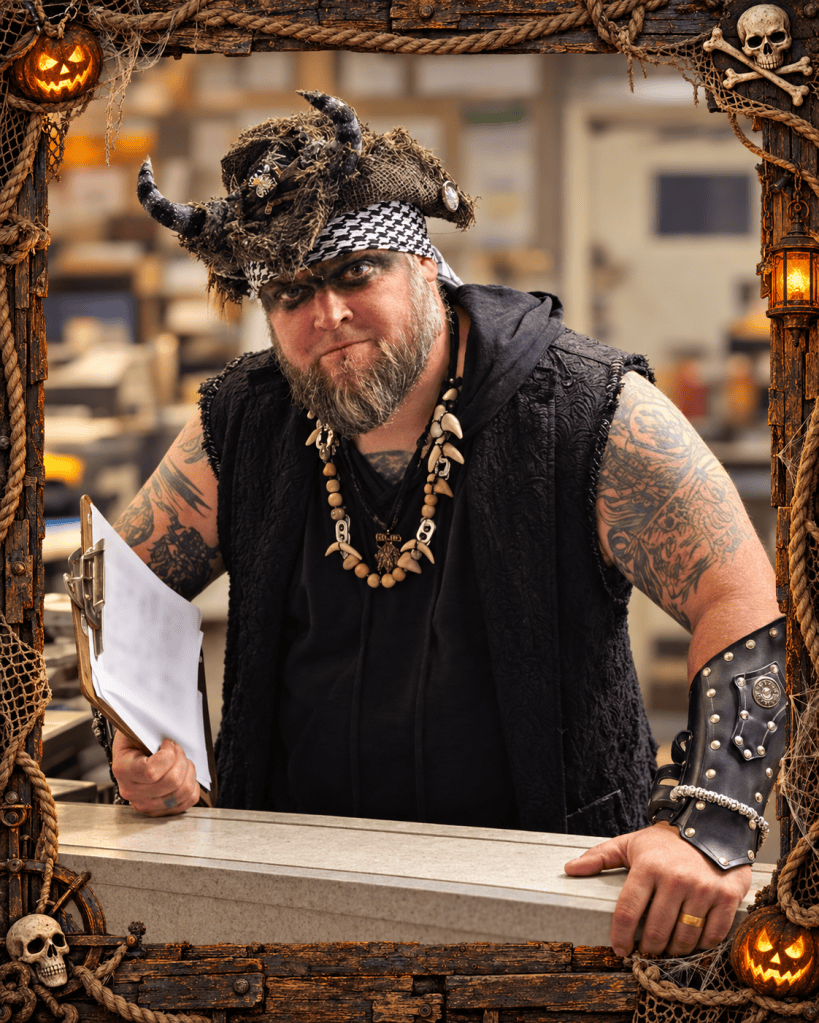
    And occasionally, we appear in public dressed like the chef escaped from a haunted pirate restaurant.

    Compliments to the kitchen.
  • Captain’s Plunder: Five Halloween Finds Worth Your Weekend

    Captain’s Plunder: Five Halloween Finds Worth Your Weekend

    Wyrd Outlook by Grogh — Ghostwritten by Vikki Vexum

    Captain’s Plunder: Five Halloween Finds Worth Your Weekend

    Time to Work that weekend as hard as you did your day job! Pirate yourself a Happy Halloween!

    October 30–31, 2026 — Nashville, Tennessee, plus one Huntsville road trip.

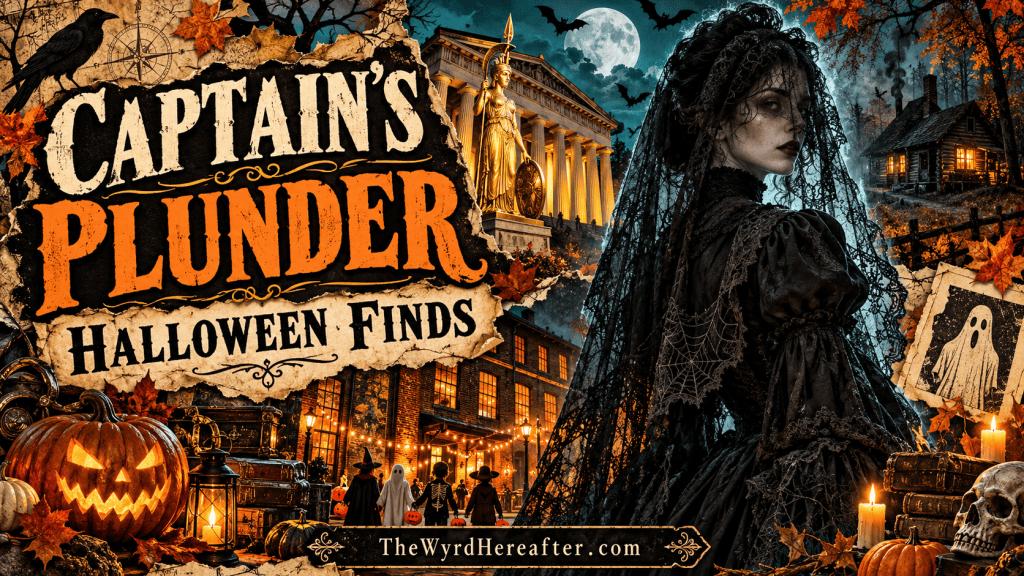
    Halloween weekend has arrived, and the Captain has been checking the treasure map. This haul includes candy among working artists, an after-dark party beneath Athena’s watch, strange performances at the Frist, and a haunted cabin in the woods.

    Five picks worth considering before your weekend disappears into the fog. Some cost money. Some require registration. One asks you to arrive bearing candy—a perfectly reasonable tribute.

    All times are Central. Friday events take place October 30; Saturday events take place October 31. Each link below leads directly to the official event page, where you can follow through to tickets or registration.

    1. The Captain’s Top Pick: Halloween at Lowe Mill

    Saturday, October 31, 1–3 p.m. — Huntsville, Alabama.

    An arts destination full of working studios becomes a Halloween candy trail? That earns a spot on my map.

    Lowe Mill’s annual Trick or Treat⁠ invites families to explore its community of artist studios in costume, collecting treats along the way. Creative spaces, working artists and discoveries around the next corner give the outing something beyond the candy haul. The grown-ups have something to explore while the children conduct their very serious confectionery business.

    The calendar lists admission as free, but each family must bring one bag of individually wrapped candy. Take it to one of the three candy drop-off stations when you arrive to receive access.

    This is my road-trip exception to the Nashville list and my top choice for families who want trick-or-treating to become an adventure through art.

    There are reasons to linger in Huntsville, too. The Halloween Night Market⁠ runs 6–10 p.m., with free entry, featuring Halloween and horror-themed wares on the grounds.

    Starlight Arcade offers $2 admission from 7–10 p.m.⁠ Its listing does not specify whether gameplay costs extra.

    For a separate paid adventure, the Haunted Halloween Tour⁠ is listed at $26, with departures from 7:30–10 p.m. Tours last approximately 30–45 minutes and include loud noises and strobe lighting.

    The afternoon candy trail and evening activities have separate hours, so plan for the gap between them.

    Address: 2211 Seminole Drive Southwest, Huntsville.

    2. Halloween Under Athena’s Watch

    Friday, October 30, 8 p.m.–midnight — Nashville Parthenon. Ages 21 and older.

    Athena has seen a few things. Your Halloween costume probably won’t alarm her.

    Night at the Museum: Halloween at the Parthenon⁠ opens the building after dark for DJs, tarot readings, local vendors, a photobooth and costume contests for Best Solo and Best Couple.

    An after-dark tour explores darker Greek myths and stories connected to the building. That gives the setting a proper role in the evening: mythology gets to come out and play.

    Tickets are $30 individually or $50 for a couple, with food included. Drinks are $3 from 8–9 p.m.

    Those inclusions make this a strong value contender. Music, food, costumes and darker mythology inside the Parthenon amount to a fairly distinctive Friday night.

    The event supports Centennial Park and the Parthenon through the nonprofit Centennial Park Conservancy. Follow the official event page to check ticket availability.

    Address: 2500 West End Avenue, Nashville.

    3. Freaky Frist Friday

    Friday, October 30, 7–10 p.m. — Frist Art Museum. Ages 18 and older.

    Freaky Frist Friday⁠ has a lineup worth inspecting: a contortionist, sword swallower, fire performance, DJ, photobooth and a self-playing piano adding its own ghostly contribution.

    Explore the galleries through scavenger hunts with prizes, decorate a pumpkin and make art in Martin ArtQuest, or enter the costume contest. The first-place prize includes a night at the Fairlane Hotel and dinner for two at the 7 Paintings dining experience.

    Admission is $40 general or $25 for Frist members. Food and drinks cost extra.

    It is the pricier party on this list, with performances and hands-on activities to help justify the spend.

    An important costume catch: masks and toy weapons are prohibited. Fellow pirates, plan your accessories accordingly.

    On-site parking is limited and paid; the museum recommends rideshare. The event page says tickets can be purchased online or in person that evening. Check for updates before heading out.

    Address: 919 Broadway, Nashville.

    4. Free Family Halloween With Athena

    Saturday, October 31 — arrive between 10:30 and 11:20 a.m. Families with children ages 12 and under.

    For a free family outing with a little mythological muscle, Kidsville at the Parthenon⁠ is exploring connections between The Odyssey and Halloween traditions.

    Costumes are encouraged, and Belmont University’s Bruins for Peds team will join the activities.

    Activity stations open at 10:30 a.m., with the main program beginning at 11 a.m. in front of Athena. Stations close at 11:45 a.m.

    Participating families receive free Parthenon admission, but registration and the arrival window matter.

    Register through the official event page in advance or in the lobby beginning at 10:30 a.m. Attendees must register before 11:20 a.m. to receive free entry. Advance registration still requires arrival within that window.

    Greek mythology, costumes, creative play and a towering goddess: a respectable return on a free morning.

    Address: 2500 West End Avenue, Nashville.

    5. A Haunted House in Warner Woods

    Friday, October 30 — ages 16 and older. Registration required.

    For those who would rather follow a creepy trail than a dance beat, A Haunted House in Warner Woods⁠ combines a short forest hike with a nature mystery and an escape from a haunted cabin.

    Campfire time, s’mores and ghost stories round out the evening. Something suspicious in the forest, followed by toasted marshmallows: Halloween understands balance.

    Choose between 5:30–8:30 p.m. and 6:30–9:30 p.m. when registering through the contact on the official event page.

    The listing does not state a price, and remaining spaces are unconfirmed. Contact the organizer before travelling. We cannot stamp this one “free” or promise walk-in access.

    Address: Warner Park Nature Center, 7311 Highway 100, Nashville.

    There’s the Captain’s haul: candy among artists, mythology beneath Athena, beautiful strangeness at the Frist, and something waiting in the woods.

    Choose your adventure—and check the entry details before your carriage turns back into a pumpkin.

  • GWAR, Dave Grohl, and the Grammys: Who Gives an Award to the People in the Mud?

    GWAR, Dave Grohl, and the Grammys: Who Gives an Award to the People in the Mud?

    Wyrd Outlook by Grogh — Ghostwritten by Vikki Vexum, Pocket Librarian of The Wyrd Hereafter.

    GWAR, Dave Grohl, and the Grammys: Who Gives an Award to the People in the Mud?

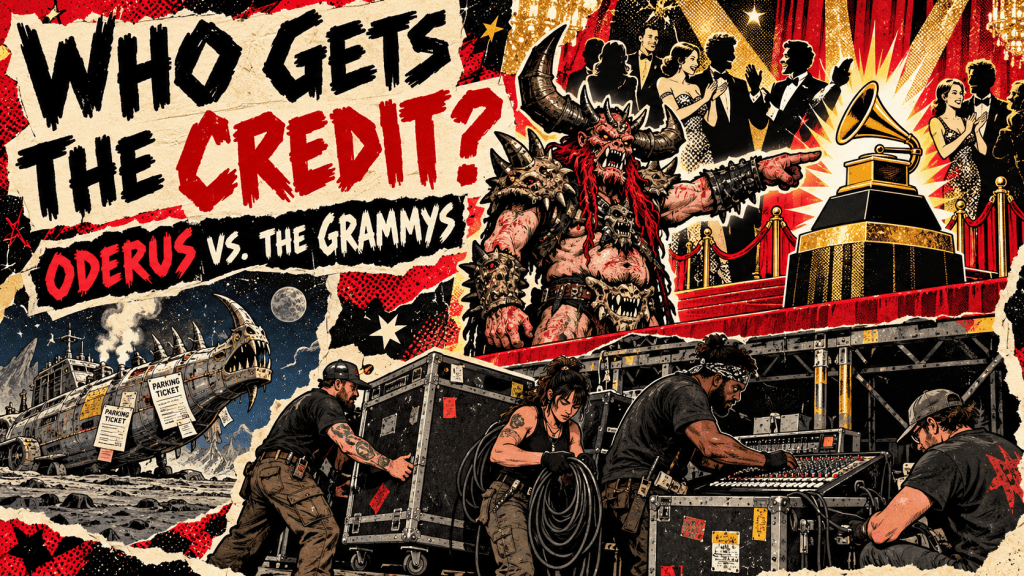
    Dave Brockie had a question for the music industry, and naturally, he delivered it with all the grace of a blood-soaked alien barbarian.

    The GWAR frontman, better known as Oderus Urungus, was asked about the band’s Grammy nomination. He took the opportunity to unload on award shows, celebrity self-congratulation, and the idea that people already showered with attention needed another trophy.

    Then he took a particularly filthy swing at Dave Grohl.

    Behind the obscenity was a question worth pulling out of the slime: Why do we celebrate the people at the top so loudly while barely noticing the people whose work helped them get there?

    Two Daves, One Unexpected Tribute

    Grohl could have treated the insult like the opening shot in a rock-star feud. Instead, he brought it up onstage at a Foo Fighters concert in Richmond, Virginia, in 2014 and paid tribute to Brockie⁠, who had died earlier that year.

    Even better, that concert came about through a fan crowdfunding effort. As SPIN⁠ reported⁠, the audience helped make the night happen before the band had agreed to play it.

    There’s another wrinkle: Metal Hammer⁠ explored⁠ how Grohl and GWAR came through the same regional punk orbit, and how a young Grohl nearly joined the band. Before one Dave became a Grammy regular and the other became an intergalactic menace, their worlds weren’t so far apart.

    From the mud, different stars rose.

    Can Metal Build Its Own Awards?

    If Brockie questioned the ceremony, Nik Nocturnal offers another part of the conversation.

    His Nocturnal Awards celebrate heavy music through categories chosen for the community, with fans voting on winners. Alongside album and song awards, there are awards for individual musicians, breakthrough bands, and metal content creators. There’s even an animal-noise category⁠, because metal understands that some artistic achievements require a good guttural BLEGH.

    The fans have opinions about that, too. In one Reddit discussion⁠, a commenter called the Nocturnal Awards more legitimate than the Grammys. In another⁠, a fan questioned whether Nik’s audience favored certain kinds of metal. Both views belong in the conversation: a fan-voted show can bring listeners closer to the celebration, while still leaving us to ask whose favorites get heard.

    And sometimes recognition does more than crown a winner. One fan made playlists⁠ from the nominations to help people discover music. A list of names became a trail of breadcrumbs.

    Who’s Behind the Curtain?

    The stage has a spotlight. The mixing desk, loading dock, and costume workshop usually don’t.

    In an r/audioengineering discussion⁠, one commenter wrote: “I’ve got more than a hundred songs I mixed that I’ve received no credit for.”

    Another person⁠ described working on a Grammy-winning project but needing months of outreach to get credited and receive a certificate. They also said that, after years in the business, they were still struggling financially.

    Some engineers and producers do receive Grammy recognition, depending on their contribution and the award category. But these accounts show how easily work can disappear behind the name people know.

    And the work doesn’t stop in the studio. A local stagehand on Reddit⁠ pushed back against being treated as lesser by touring personnel. The people loading equipment, setting up the room, and keeping a show running aren’t decorations around the main event. They help make it possible.

    The Ghostship Has a Captain. It Also Had a Crew.

    In Ghostship Groggy, the captain gets his name on the ship. That’s a mighty fine place to put a name—and a convenient way for everyone to assume the captain did all the work.

    But Frankie Frankly was keeping things moving, and the crew had jobs of their own. You might have to hear it through word of mouth, because the legend has Captain Grogh Agorhi standing at the front of it.

    And what did the captain leave behind? A ship stranded in the Agorhi, possibly collecting a bazillion parking tickets.

    Give that man an award. Better yet, give Frankie the credit—and somebody please help the crew with those tickets.

    That’s the view from above and below: the star shines, the crowd cheers, and somewhere outside the spotlight, people are still hauling the equipment.

    The applause doesn’t have to stop at the front of the stage. It can travel all the way back to the people in the mud.

  • Why Can’t I Order That? A Proposal for On-Demand Comics and Fandom Gear

    Why Can’t I Order That? A Proposal for On-Demand Comics and Fandom Gear

    Wyrd Outlook by Grogh — Ghostwritten by Vikki Vexum, Pocket Librarian of The Wyrd Hereafter.

    Why Can’t I Order That? A Proposal for On-Demand Comics and Fandom Gear

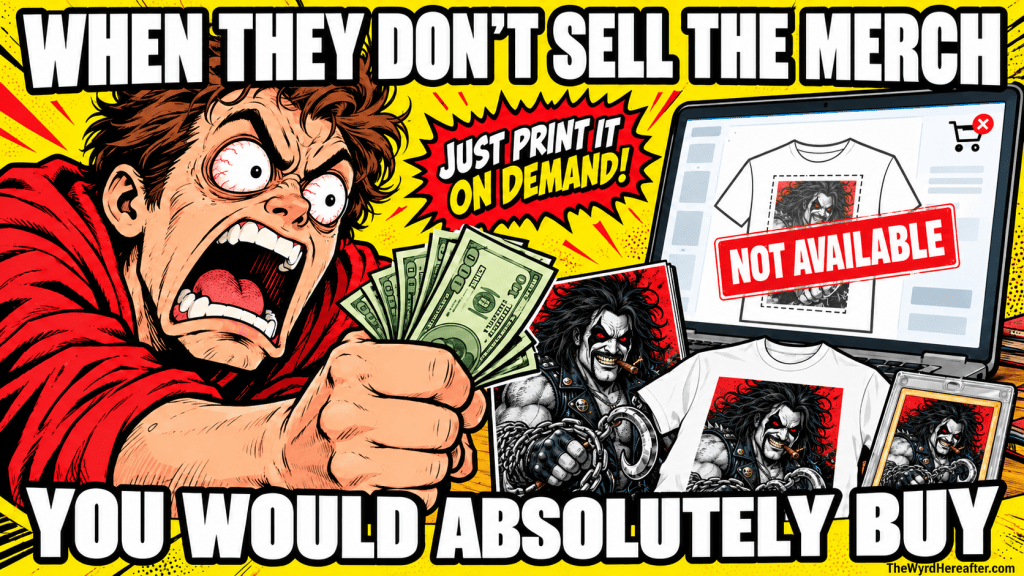
    Every comic fan could probably point to something they would buy if somebody would make it. A missing back issue. A forgotten cover. A single panel that belongs on a shirt far more than the twentieth version of the same familiar logo.

    Here is the Captain’s proposal: put comic reprints, approved fandom merchandise, and requests for new licensed products on one website. Let people order what is already available—and pay for the work of finding out whether something else can be made.

    The price would need to cover the effort. That is part of the idea. If someone wants an unusual, officially authorized item enough to pay a profitable price for it, could a business make that desire worth answering?

    This is a proposed combination of services. Several of its foundations already exist.

    The machinery is already turning

    Ka-Blam offers comic printing with no minimum order, including a single copy. Its related storefront, IndyPlanet, lets independent creators list comics, set their prices, and have Ka-Blam handle fulfillment.

    That gives us a working foundation for comics manufactured when people want them.

    For other products, Printful describes an operation in which a customer orders, then the company prints, packages, and ships the merchandise. It offers products including apparel and home goods without minimum order quantities.

    Licensed fandom shopping also has an existing foothold. Zazzle’s brand-partner catalog promotes officially licensed products, and its stores include Marvel and DC.

    Even cards have a manufacturing precedent: MakePlayingCards offers online design and print-on-demand services for playing cards and game cards.

    These examples demonstrate separate capabilities. They do not establish that these companies will obtain permission for any comic panel a customer chooses, or that Marvel or DC has agreed to the platform proposed here. The interesting question is how much further those capabilities could go together.

    One website, two ways to order

    The first side would be straightforward: browse an approved catalog and buy.

    Choose an authorized comic reprint, a permitted cover variation, a shirt, a poster, or a card product. See the price and production estimate. Place the order. The provider makes or arranges the item.

    A clearly branded on-demand comic line could help readers understand what they are purchasing: a newly produced edition, identified as such. Someone who discovers a series halfway through could order its available earlier issues without waiting for another conventional print run.

    The second side would offer something more adventurous: request an item that is not yet in the catalog.

    “I would like this issue reprinted.”

    “Could this cover become a poster?”

    “Could this particular panel go on a shirt?”

    The answer could begin with an estimated range and an explanation of what needs checking. The business would investigate permissions, artwork availability, manufacturing, and costs, then return with a firm offer when possible.

    Fandom gets a request desk.

    Pay for the footwork, too

    Someone has to answer those inquiries, locate usable files, approach the appropriate people, and work out whether the item is practical.

    Why should all that labor depend on a customer eventually deciding to buy?

    A possible structure would offer a free preliminary screening, followed by a disclosed research fee for requests requiring substantial work. A separate production deposit could be refundable if the project proves impossible, under terms shown before payment.

    The distinction matters. Money promised back in full cannot also be counted on to pay for unsuccessful research. Customers should know which payment funds the attempt, which funds manufacturing, and what happens if permission is refused.

    The business should charge enough to make the service worth providing. An estimate would help customers decide whether to proceed; a firm quote would come before they commit to production.

    If you are arranging permission, explore the possibilities

    The thought behind this proposal is simple: fandom merchandise already requires decisions about artwork, authorization, products, manufacturing, and price.

    Could a paid customer request help initiate those decisions?

    And when a provider is discussing comic reprints with a publisher or creator, could it also explore permission for selected images on shirts, prints, or cards?

    Those uses would need their own explicit coverage. The proposal is to negotiate a useful range of authorized options wherever the rights holders are willing, rather than assume a comic-printing agreement covers everything.

    For Marvel, DC, and independent publishers alike, the opportunity would be a controlled way to discover what fans want beyond the usual merchandise selection. A pilot could begin with one willing publisher, a small archive, a few product types, and clear approval rules.

    Nobody needs to unlock every vault on opening day.

    Let the first request help the next fan

    Here is where the platform might gain momentum.

    The first request for an overlooked image could involve considerable preparation. If the agreement allows ongoing sales, that work could produce a permanent approved listing.

    The next customer could order directly. The research, file preparation, and permissions would already be in place, within the agreement’s limits.

    A successful request could therefore add something useful to the catalog. The website would gradually accumulate both products and knowledge about what can be made.

    For expensive requests, fans could also register interest together. The platform might show a proposed product, an estimated price, and a participation threshold. Once enough buyers commit under clear terms, the provider could seek final approval and confirm the production price.

    That would be a proposed feature, not a promise that every request becomes cheaper with enough clicks.

    The rare-card feeling

    There is an appeal here beyond simply owning another superhero shirt.

    A fan could choose an obscure scene, a peculiar expression, or an illustration that never received its own merchandise. Something deeply specific to their affection for the work.

    That has a little of the rare-Pokémon-card feeling: the pleasure of finding something unusual that matters to you.

    The platform could offer genuinely limited, numbered editions where the agreement permits them. It could also sell open-ended on-demand products whose attraction is their unusual artwork or approved configuration.

    The distinction should stay clear. An item available for unlimited future orders has no fixed scarcity. Neither kind needs a promise of resale value to be enjoyable.

    Sometimes the treasure is simply that somebody finally made your wonderfully specific thing.

    What would make this worth trying?

    The selling price would need to cover production, permissions and agreed payments, preparation, service labor, transaction costs, fulfillment, and profit. Shipping and taxes would need to be visible before purchase.

    The useful test would be a modest pilot: how many requests become approved orders, how much staff time they consume, whether customers accept the quoted prices, and whether approved items attract repeat sales.

    A premium price can support a service only when enough people willingly pay it.

    Still, the foundations make this worth asking. We can already point to comics printed individually, merchandise manufactured after purchase, licensed fandom storefronts, and custom card production.

    Could one website combine those capabilities with a paid service for bringing new authorized items into existence?

    Give fans a place to ask. Give creators and rights holders a way to approve and earn. Give the provider enough margin to make the effort worthwhile.

    Somewhere, somebody wants one ridiculous comic panel on a shirt.

    Let them ask what it would cost